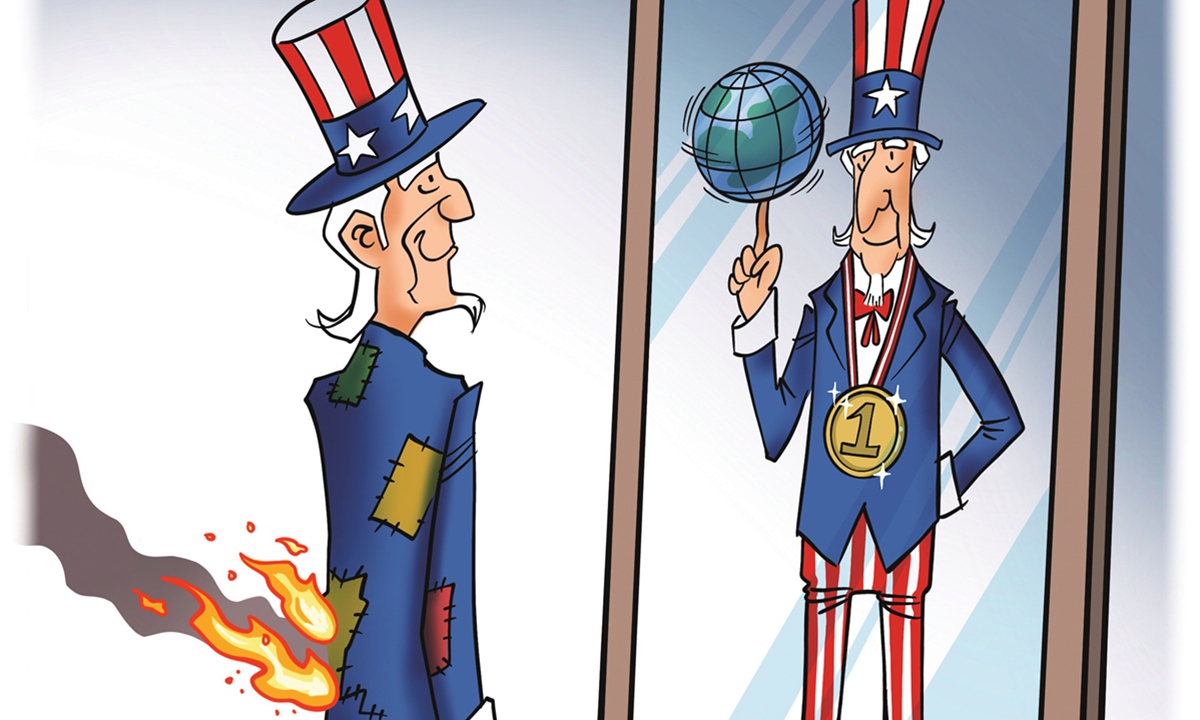
Illustration: Liu Rui/GT
In recent months, Western media - and American outlets in particular - have grown bluntly inquisitive: Can the US still survive? Pieces like the Hill's provocatively titled "Will America survive another 250 years?" capture more than melodrama; they register a deepening doubt.
Massive layoffs, a government shutdown and raids on migrants are not isolated headlines but symptoms of a society under stress. Millions more fear they will lose health coverage, and suicides are surging along with homelessness. A handful of billionaires live large and enjoy tax cuts, while most Americans struggle to make ends meet.
Once a symbol of prosperity, the US is now divided between winners and losers, with no signs of compromise.
Decades of deindustrialization hollowed out the economy. Investors sent manufacturing abroad, leaving real estate, military production and insurance as the main profit centers. Debt grips the country like a vice: Mortgage debt forces families out of their homes, student debt chains young people to uncertainty. Shopping malls and supermarkets that once served middle- and low-income buyers are closing by the thousands. Even Walmart, once the temple of cheap abundance, has raised prices beyond the reach of budget shoppers under the pressure of tariffs and inflation.
Federal debt is soaring, driving cutbacks in vital programs, while the war budget climbs ever upward. Dollars that once flooded in from abroad to finance conflict have gone elsewhere as global trade diversifies across Europe, Asia and the Global South. The resulting "cash crunch" has caused panic in Washington.
Yet, even as essential social programs are slashed, the Immigration and Customs Enforcement (ICE) agency has received a gigantic budget boost for raids against migrants. Such contradictions reveal a government increasingly detached from the realities of its people.
Instead of addressing its domestic decline, US government has chosen to "blame China" and slash the social safety net. It is systematically undermining the gains of the Civil Rights movement of the last century.
This reflexive scapegoating only deepens the US' internal wounds. The same energy spent confronting imaginary external and internal enemies could have been used to rebuild infrastructure, improve healthcare or lift people out of poverty. These choices expose the US' short-term politics and ideological hostility, rather than genuine concern for national renewal.
US government has even rolled back environmental commitments, abandoning efforts to phase out fossil fuels in favor of expanded oil drilling. The priorities are clear: war and profit over welfare and sustainability. Meanwhile, the social fabric tears further. The US has become a nation of billionaires and beggars, of privilege and despair, of domination abroad and disintegration at home.
Resistance is rising. In Chicago, hundreds of thousands defied National Guard and ICE operations; in Portland, protesters mocked and challenged militarized police; in New York and Boston, demonstrations were the largest in memory. Banners reading "Stop the War on America's Workforce" filled the streets as tens of thousands of federal workers were fired or laid off. Across the country, a weary population is saying no to endless war, no to inequality, and no to fear. Millions have lost faith in the old hallmarks of trust in institutions, hope for opportunity and fairness of the laws.
Washington's global preaching about "human rights" now rings hollow. The same government that mourns extremist figures at home turns a blind eye to racial injustice and police violence. Abroad, it continues to fuel conflicts in Ukraine and the Middle East while ignoring calls for genuine peace. Most Americans are rejecting these policies: Slogans like "China is not our enemy" are gaining traction among farmers and workers.
These shifts reveal a society awakening to the cost of endless confrontation. Yet Washington remains trapped in its cold war mind-set - obsessed with dominance, incapable of introspection.
The US once achieved global dominance, at least partially through innovation and openness. Today, it stands as a warning of what happens when inequality, militarism and political dysfunction go unchecked.
Unless the US abandons the illusion of global hegemony and confront its domestic decay, it risks accelerating its own downfall. Whether the US can survive this decline depends on its willingness to abandon its superiority complex and deal realistically with its problems. But for now, the signs point in a darker direction: a divided, exhausted nation struggling to live up to the ideals it once preached to others.
The author is a member of the Advisory Council of the Friends of Socialist China and the author of Befriending China: People-To-People Peacemaking. opinion@globaltimes.com.cn
RELATED ARTICLES