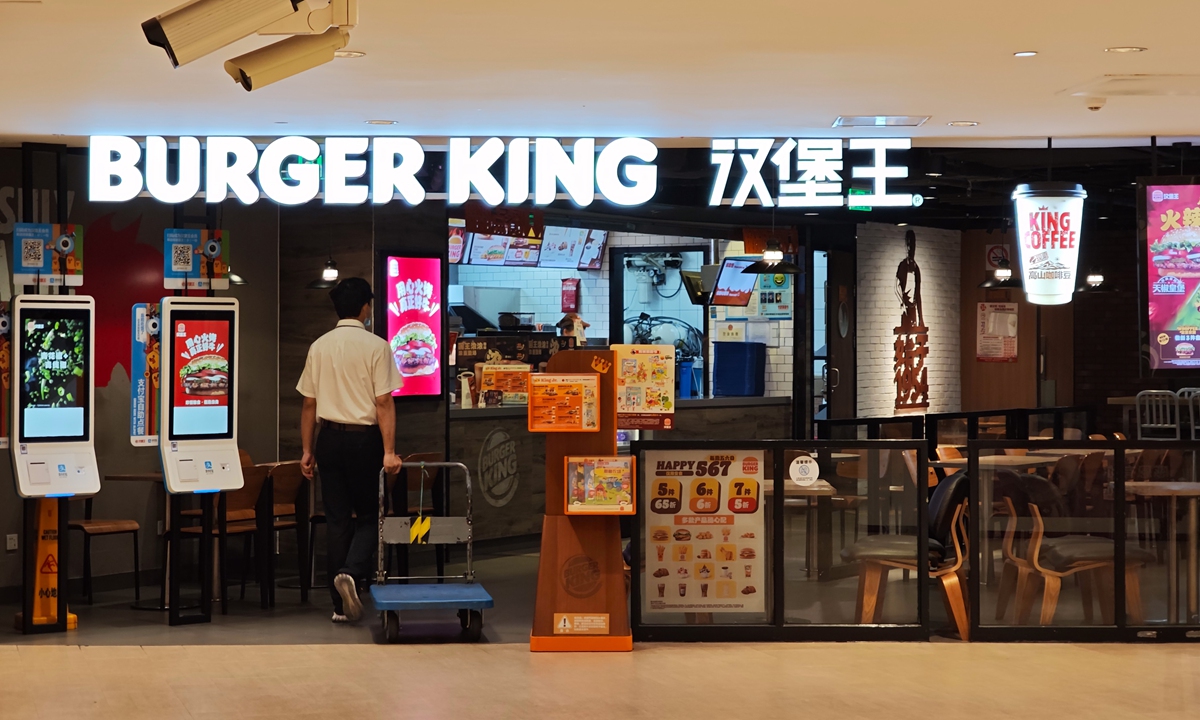
A Burger King outlet in a shopping mall in Shanghai's Huangpu District opens on June 24, 2025. Photo: VCG
An increasing number of overseas-origin restaurant chains are making moves to become "Chinese brands," with experts saying that deep localization is essential to capturing consumption growth in the Chinese market.
Following a wave of international chains such as Starbucks and McDonald's becoming locally controlled under Chinese capital, Chinese asset management company CPE on Monday announced a strategic partnership with the Burger King brand to establish a joint venture (JV) called Burger King China (BKC).
The shift from mere "menu adaptation" to the localization of operations and supply chains shows that foreign catering brands are no longer simply adjusting to the Chinese market, but are increasingly treating China as a key driver of their global growth strategy, insiders said.
CPE announced a strategic partnership with the Burger King brand to establish BKC, marking the next phase of the brand's growth in the Chinese market, according to a statement on Monday by Burger King.
This China-based asset management firm offers innovative investment solutions to leading enterprises across the technology and industrial, consumer and healthcare, and infrastructure sectors, said industry insiders.
The Burger King brand is wholly owned by Restaurant Brands International (RBI). CPE will inject an initial $350 million into BKC. Upon completion of the transaction, CPE will hold about 83 percent of the JV, while RBI will retain about 17 percent, according to a statement published on CPE's official WeChat account.
Previously, Starbucks, another long-established foreign brand in China's catering sector, recently set up a JV with Chinese company Boyu, with the Chinese side to hold a stake of up to 60 percent in its China operations.
This trend is not merely a shift in ownership structure, but is driven by changes in market dynamics and the competitive landscape and consumer demand, and it is reshaping brand operations, product strategies and market positioning in a more profound way.
In China's fast-evolving market, the signature menus and service speed that legacy chains once took pride in are now being reassessed by consumers shaped by a more diverse and efficiency-driven dining scene.
Notably, Boyu's involvement is likely to reshape Starbucks' membership system, online ordering, delivery network and even its marketing approach in China, effectively driving a digital overhaul, a Chinese expert said.
McDonald's localization in China is also widely viewed as a successful case of keeping pace with the dynamics of the Chinese consumer market, with its number of stores tripling since its China operations came under majority Chinese ownership, according to the company's report unveiled in August.
McDonald's, which in 2017 restructured its China retail operations through a JV, now operates as "Golden Arches" with Chinese capital holding a major stake. The company has since worked to blend its global standards with distinctly Chinese tastes.
Between the time that McDonald's China entered the "Golden Arches" era in 2017 and August 1 this year, the number of its restaurants tripled to more than 7,100, serving more than 1.3 billion customers annually. China has become McDonald's second-largest and fastest-growing market worldwide, data from the company's report showed.
Foreign brands' cultural advantage in China is weakening, while domestic brands have a stronger grasp of the local market and consumer trends, and foreign brands tend to react more slowly in cross-cultural operations, Hu Qimu, a deputy secretary-general of the Forum 50 for Digital-Real Economies Integration told the Global Times on Tuesday.
When competitiveness shifts from "brand and model" to "channels and local execution," domestic capital has greater incentive to invest in expansion, meaning foreign brands may need to cede some control to secure growth in the Chinese market, Hu said.
With the entry of Chinese capital, Starbucks has set a long-term target of expanding its store network in China to as many as 20,000 locations, the company recently told the Global Times in a statement. The brand currently operates about 8,000 stores in the country.
In a market that continues to expand, introducing Chinese capital with strong local insights and resource integration capabilities can help foreign brands improve their operational efficiency and investment returns, said Zhang Yi, CEO of the iiMedia Research Institute.
As equity and supply chain localization deepens, Burger King and Starbucks are expected to further localize their brand positioning, business models and product offerings.
By strengthening emotional engagement, developing new growth curves across adjacent categories and building more flexible digital operations, they could not only regain growth momentum in China, but also potentially export a model that integrates global standards with Chinese innovation to other markets, according to Zhang.
RELATED ARTICLES