A view of Lujiazui Financial and Trade Zone in Shanghai, China and Gwangan Bridge in Busan, South Korea Photos: VCG
Editor's Note:
Chinese President Xi Jinping paid a state visit to South Korea - his first visit to the country in 11 years - and attended the 32nd APEC Economic Leaders' Meeting recently. As Xi pointed out, during his meeting with South Korean President Lee Jae-myung, China and South Korea are important neighbors that cannot be moved away and cooperation partners that cannot be separated.
To enhance understanding of South Korea and grasp the trajectory of China-South Korea relations, the Global Times, in collaboration with Chinese universities and think tanks, is releasing a series of reports on South Korea.
In the second installment of the series, we explore how China and South Korea are deepening cooperation within the APEC framework to boost regional connectivity, innovation, and sustainable growth, jointly contributing to the building of an open and prosperous Asia-Pacific community.
As the highest-level, most extensive and most influential economic cooperation mechanism in the Asia-Pacific region, APEC has long been the central engine driving regional development and the key platform for deepening cooperation among its members.
Today, amid weak global economic recovery, rising anti-globalization sentiments and mounting challenges to the multilateral trading system, the strategic importance of enhanced coordination between China and South Korea - two major economies in Asia - has become even more prominent.
During the 32nd APEC Economic Leaders' Meeting held in Gyeongju, South Korea, China and South Korea signed more than 10 cooperation documents covering trade, finance, agriculture and science and technology. These achievements have not only injected new momentum into bilateral practical cooperation but also driven regional synergy through bilateral collaboration, contributing to the building of an Asia-Pacific community.
China-South Korea economic ties undergoing new changes
President Xi Jinping made four proposals on opening up new prospects for China-South Korea relations during his meeting with President Lee Jae-myung. One of four proposals was to "deepen mutually beneficial cooperation and tighten the bonds of interests." President Lee noted, "The ROK is ready to enhance mutually beneficial cooperation with China, keep industrial and supply chains stable, and bring more benefits to the two peoples." The remarks of both leaders reflected the significant potential for mutually beneficial cooperation between the two economies.
The South Korean economy currently faces two structural challenges. The first is that its export-led growth is being challenged by unilateralism and trade protectionism. South Korea has long been an export-oriented economy. Under the Yoon Suk-yeol administration, South Korea, claiming and promoting "value diplomacy," drew even closer to the US while to some extent distancing itself from China. It was attempting to forgo the Chinese market. However, this policy has instead increased South Korea's economic vulnerability.
The US imposed high tariffs on South Korean goods and forced renegotiations of free trade agreements, severely impacting South Korean exports. This, in turn, compelled many Korean enterprises to shift investments to the US, further increasing economic uncertainty.
The second major challenge lies in the demographic changes that have led to a continuous decline in South Korea's potential economic growth rate. South Korean society is aging rapidly, while its birth rate has fallen to a lower level. This drastic demographic shift has become a major issue affecting South Korea's economic growth.
Amid these developments, South Korea has recorded its first-ever trade deficit with China in 2023. Since the 1990s, China has served as South Korea's major export market and supply chain base. The two economies, underpinned by complementary industrial structures, established efficient production chains - especially in semiconductors - within the WTO framework, providing sustained growth momentum for both countries. In 2024, bilateral trade between China and South Korea reached $328.08 billion, a year-on-year increase of 5.6 percent. China has been South Korea's largest trading partner for 21 consecutive years, while South Korea has regained its position as China's second-largest trading partner in 2024.
Three fundamental realities about China-South Korea economic relations must be clearly recognized.
First, China and South Korea's mutual dependence is asymmetrical. South Korea's domestic market is limited, and its economy heavily depends on exports - especially to China. South Korea's core industries - semiconductors, automobiles and batteries - are heavily dependent on China both for upstream components and for downstream market demand. By contrast, China, as the world's second-largest economy, is strengthening its domestic demand through its "dual circulation" strategy, which takes the domestic market as the mainstay while allowing domestic and international markets to reinforce each other, thereby reducing its dependence on South Korea. Consequently, even minor economic fluctuations in China can trigger major ripple effects in South Korea.
Second, traditional high-tech cooperation between China and South Korea is increasingly constrained by US technological containment. Intermediate goods account for a very high proportion of bilateral trade. According to reports, intermediate goods make up over 80 percent of South Korea's exports to China. Therefore, the US' tech blockade and export restrictions on China have created significant obstacles to China-South Korea bilateral cooperation.
Third, technology and talent have become China's new comparative advantages. For the past three decades, South Korea's technology and capital complemented China's labor resources. However, this structure is now shifting. With China's industrial upgrading, the division of labor established since their diplomatic normalization is being reshaped, and the bilateral relationship is moving from complementarity toward one of coexistence between competition and cooperation. As China's manufacturing technology rapidly advances, South Korea's traditional advantages in medium- and low-tech industries are diminishing. With its robust talent pool and innovation system, China is now demonstrating strong competitiveness in advanced manufacturing, intelligent industries and emerging technologies, marking a new era in China-South Korea relations characterized by both cooperation and competition.
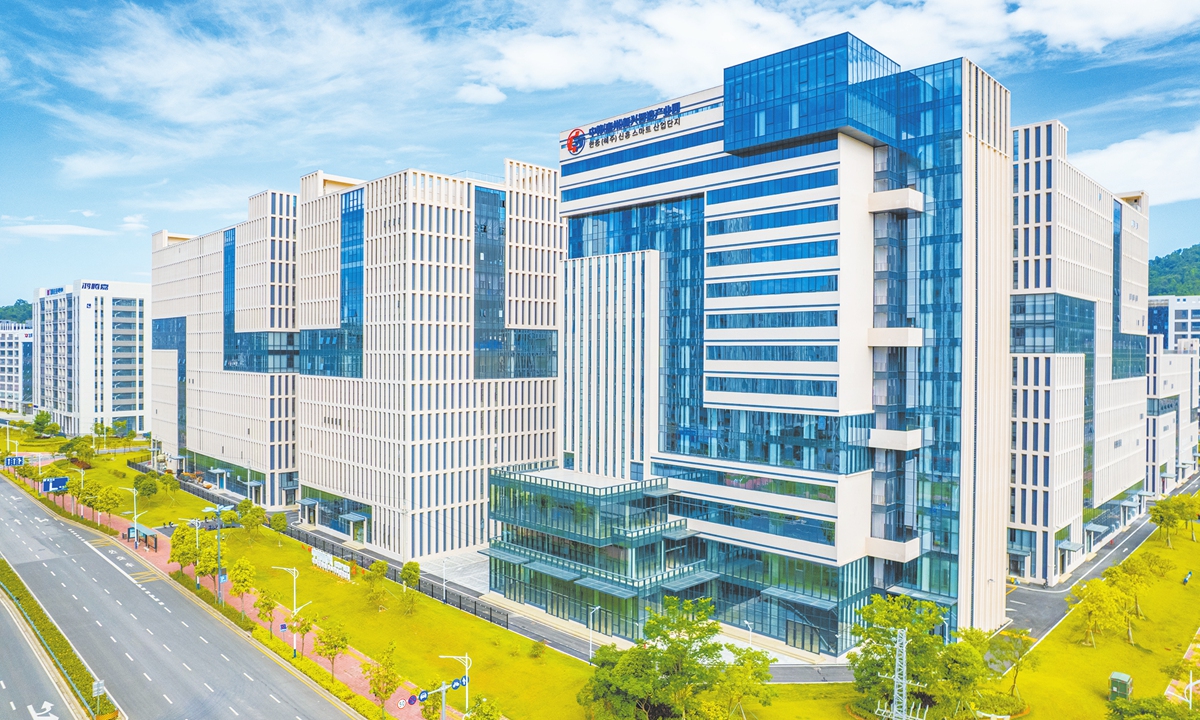
The China-ROK (Huizhou) Industrial Park in Huizhou City, South China's Guangdong Province Photo: VCG
Promoting the building of Asia-Pacific community
Currently, with the multilateral trading system under severe strain, the Asia-Pacific region faces a crossroads - whether to advance or to retreat. Thus, the APEC meeting has become a key moment for adjusting regional governance and coordinating national policies. At the APEC CEO Summit, President Xi delivered a written speech, pointing out that all leaders should renew their commitment to the founding mission of APEC and make outstanding contributions to the world through more vibrant and resilient Asia-Pacific cooperation.
The Gyeongju APEC meeting adopted the theme "Building a Sustainable Tomorrow - Connect, Innovate, and Prosper." Leaders attending the summit endorsed the Gyeongju Declaration.
For "connect," APEC leaders reaffirm their shared recognition that robust trade and investment are vital to the growth and prosperity of the Asia-Pacific region, and remain committed to deepening economic cooperation to navigate the evolving global environment. The leaders will advance economic integration in the Asia-Pacific region in a manner that is market-driven, encourage the sharing on AI adoption and related policies to strengthen the resilience of Asia-Pacific supply chains, and foster cultural exchange and dialogue-based cooperation, according to the Gyeongju Declaration.
Although it does not explicitly mention multilateralism or the World Trade Organization (WTO), the Gyeongju Declaration, like in previous years, includes a statement on implementing the APEC Putrajaya Vision 2040, "with the goal of realizing an open, dynamic, resilient, and peaceful Asia-Pacific community by 2040, for the prosperity of all our people and future generations including through the implementation of the Aotearoa Plan of Action."
This vision, serving as a blueprint for APEC's future, clearly reaffirms its support for free trade, the multilateral trading system and the WTO. Additionally, the Joint Statement by APEC Foreign Ministers and Trade Ministers notes that "we acknowledge the agreed upon rules in the WTO are key to facilitating global trade," indirectly reinforcing support for the spirit of free trade. For the first time, the Gyeongju Declaration also identifies the cultural and creative industries as a new growth driver for the Asia-Pacific region.
For "innovate," APEC leaders acknowledge that advancements in science and technology can contribute to addressing common challenges and create new drivers of growth in the APEC region, according to the Gyeongju Declaration. The leaders encourage enhanced information sharing on information and communication technology and digital policies, the implementation of the APEC Internet and Digital Economy Roadmap, and strengthening business and consumer trust in digital transactions.
The Gyeongju Declaration also endorses the APEC AI Initiative, aimed at enabling all members to participate collectively in AI transformation and share the benefits of AI technological development. The leaders also call for continuing efforts to enhance security, accessibility, trustworthiness and reliability in realizing the benefits of AI for all with balanced and human-centered approaches to the workforce, education and capacity building policies.
For "prosperity," recognizing that low birth rates and population aging are common challenges for the Asia-Pacific, the Gyeongju Declaration supports collaboration through the APEC Collaborative Framework for Demographic Changes to address demographic challenges. Acknowledging that the region's future prosperity depends on empowering the next generation, the leaders look forward to continuing to provide young people with the opportunities for development and tools to actively shape their future.
The meeting also calls for joint responses to global challenges such as energy, food security, environment, extreme weather events and natural disasters. At the same time, the Gyeongju Declaration emphasizes building resilient, sustainable, accessible, age-responsive, multisectoral and future-ready health and care systems across the region, broadening access to digital health tools and domestic capacity-building in this field. Through these measures, the Gyeongju Declaration establishes a cooperative blueprint of open connectivity, innovation-driven growth and shared prosperity, providing clear guidance for sustainable development in the Asia-Pacific region.
Injecting new momentum into Asia-Pacific development
This year marks the 10th anniversary of the China-South Korea Free Trade Agreement (FTA). Both sides have agreed to strengthen multilateral cooperation, support multilateralism, uphold free trade, and jointly address regional and global challenges. As beneficiaries of economic globalization, China and South Korea should work together to inject new momentum into Asia-Pacific development and jointly promote the building of an Asia-Pacific community.
Against this backdrop, China and South Korea should collaborate to uphold free trade and advance an interconnected Asia-Pacific Free Trade Area. They should adhere to a multilateral trading system centered on the WTO, promote trade and investment liberalization and facilitation and steadily push forward regional economic integration. As core members of the Regional Comprehensive Economic Partnership (RCEP), China and South Korea can jointly establish a supply chain security cooperation mechanism, strengthen regional connectivity and trade resilience, and reduce transaction costs, thereby laying an institutional foundation for building an open, inclusive and prosperous Asia-Pacific community.
Second, both sides should explore the potential for cooperation in innovation to enhance quality. Technological innovation and digital cooperation will become the core driving forces of future China-South Korea strategic cooperation. Through joint R&D and policy coordination, the two countries can build institutional trust in AI governance, digital ethics and data flow standards. At the same time, they should actively leverage multilateral platforms such as APEC to strengthen strategic communication and innovation dialogue.
Finally, both sides should adopt a green development approach to jointly build a sustainable Asia-Pacific community. Green transformation was a key theme of this year's APEC meeting. China and South Korea have strong complementarities in green industries and can carry out strategic cooperation in renewable energy, batteries and carbon reduction. Leveraging multilateral platforms such as APEC and RCEP, China and South Korea can jointly develop green industrial chains and establish green finance cooperation mechanisms, and coordinate green standards. These efforts will drive green transformation and the achievement of carbon neutrality goals, and form the basis for jointly building an inclusive, sustainable Asia-Pacific community, injecting new momentum into regional green growth.
The author is an associate professor at the Northeast Asia Research Center of Jilin University. opinion@globaltimes.com.cn
RELATED ARTICLES