CCCEU report urges EU to take practical measures to strengthen cooperation amid uncertainty for Chinese firms
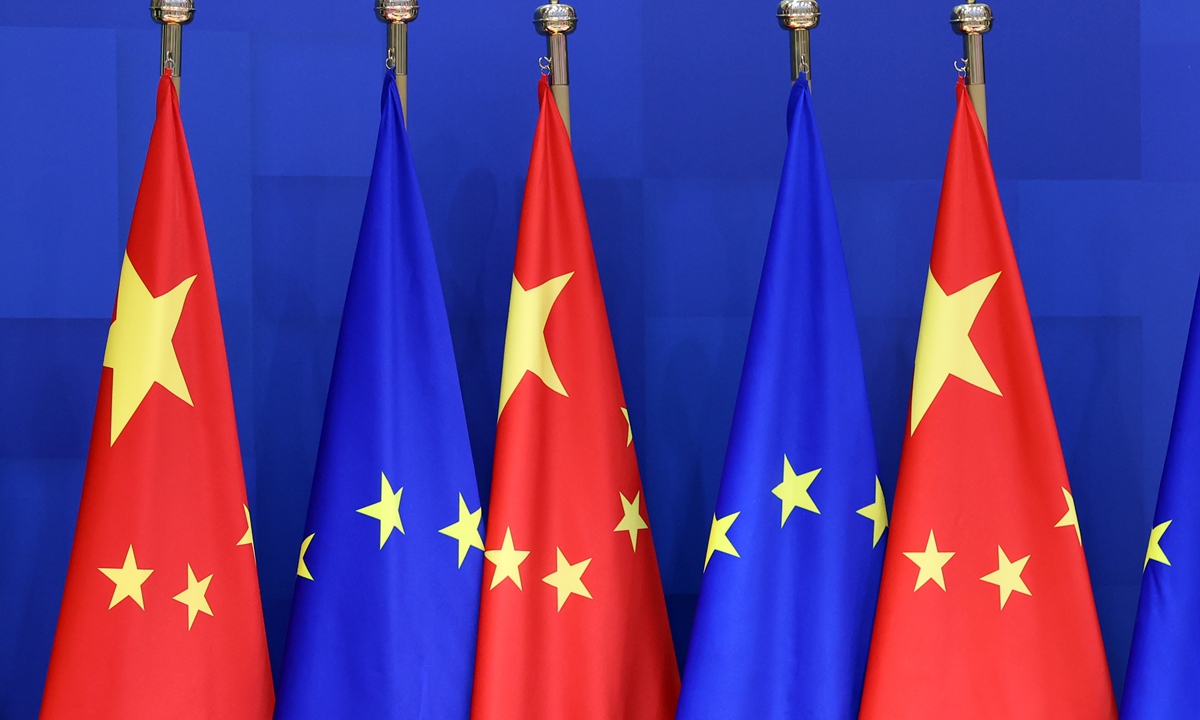
China EU flags Photo: VCG
"Uncertainty" remains a defining feature of Chinese enterprises' operations in Europe, with enterprises calling for a fair, transparent, and predictable market environment to restore confidence and facilitate stable growth, according to a report the China Chamber of Commerce to the EU (CCCEU) sent to the Global Times on Wednesday.
Based on four months of surveys and in-depth interviews with 205 Chinese companies and organizations operating in the EU, the report, released by the CCCEU and global management consultancy Roland Berger, urges both sides - on the occasion of the 50th anniversary of China-EU diplomatic ties - to take concrete steps to rebuild trust.
It urges the EU to use the 50th anniversary of China-EU diplomatic ties to implement practical measures that strengthen cooperation, while avoiding an overextension of the "economic security" agenda that could hinder commercial collaboration.
According to Eurostat, bilateral trade in goods reached 732.2 billion euros in 2024, down 1.6 percent year-on-year amid weak global demand yet demonstrating resilience, said the report. High-tech products accounted for 26 percent of total trade, while machinery and transport equipment made up more than half of total exchanges. Household appliances saw strong two-way growth, with EU imports from China reaching 16.3 billion euros, up 27 percent and EU exports to China also up 27 percent, per the report.
Data showed that Chinese FDI into Europe rebounded significantly in 2024, with investment focus shifting eastward and Hungary capturing a substantial share. This surge was underpinned by historic levels of greenfield investment, the vast majority of which flowed into the new-energy vehicle (NEV) and battery value chain. By the end of 2024, nearly 3,000 Chinese-invested enterprises were operating across all 27 EU member states, employing more than 260,000 local staff, the report said.
Despite macroeconomic pressures, Chinese enterprises demonstrated strong resilience. Over 80 percent of surveyed companies reported stable or improved business performance in 2024, with 53 percent recording revenue growth in the EU market. From a profitability perspective, 40 percent saw higher profits, and half of all surveyed firms plan to expand investment in the EU in 2025, according to the report.
However, business confidence erodes as uncertainty persists, the report said. The overall rating of the EU business environment among Chinese companies declined for the sixth consecutive year, falling to 61 out of 100 in 2025 from 73 in 2019. More than one-third of respondents reported a clear deterioration, particularly in new energy, IT, and healthcare sectors. Core indicators such as the research environment, talent availability, and digital development continue to trend downward, while market-access barriers remain a major concern, according to the report.
About 90 percent surveyed firms said "de-risking" and "economic security" policies have negatively affected their operations, mainly through stricter investment screening, market-access barriers, and greater policy uncertainty.
Following the implementation of the Foreign Subsidies Regulation (FSR) in July 2023, the EU has, as of September 2025, launched several investigations into Chinese companies. The scope of these probes has broadened beyond the clean energy, locomotive, and security equipment sectors to also include the automotive industry, according to the report.
The report showed that the EU's anti-subsidy investigation into Chinese electric vehicles has introduced new uncertainties to bilateral economic relations. According to the surveyed Chinese companies, the measures have affected Chinese automakers' performance and confidence while sparking internal EU debate about the implications for Europe's economic and green-transition goals. Companies hope both sides will address differences constructively, for instance through a "price undertaking" arrangement to help restore stability.
Despite these headwinds, most Chinese enterprises are responding proactively: 41 percent are partnering with local firms, 35 percent strengthening internal compliance training, and 24 percent conducting data and information audits. Only 8 percent are considering scaling back or postponing activities, underscoring long-term commitment to Europe, said the report.
Liu Jiandong, chairman of the CCCEU, noted that China-EU economic relations are evolving from "complementary interdependence" to "strategic co-shaping." For Chinese enterprises, Europe has moved beyond a traditional export destination to become a hub for technological innovation, a proving ground for global brands, and a key arena for standards alignment.
He outlined three emerging trends: a "dual-track uplift" in trade structure where China's new-energy products and Europe's advanced equipment remain highly complementary; a rapid shift in investment models toward ecosystem embedding; and a growing need for rules-based dialogue. Despite six consecutive years of perceived headwinds, Liu emphasized that Chinese companies have shown strategic resolve and remain committed to the European market. He called for innovative dialogue platforms, deeper mutual understanding, and practical cooperation in green transition and advanced manufacturing to stabilize supply chains and foster mutual benefit.
The report, proposing 336 recommendations for China-EU cooperation, urges the EU to avoid over-politicizing or over-securitizing economic issues and to strengthen institutional dialogue. The China-EU relationship, it concludes, remains structurally complementary: Chinese enterprises are active contributors to Europe's green, digital, and innovation transitions and are essential partners in advancing the EU's sustainable-development goals.
Marking the 50th anniversary of China-EU diplomatic relations, the report calls this milestone a new starting point for rebuilding mutual trust. Chinese enterprises encourage both sides to expand cooperation in trade, technology, education, culture, and climate action - and to pursue cooperation rather than confrontation, jointly upholding multilateralism and free trade while tackling global challenges.
RELATED ARTICLES