IN-DEPTH / IN-DEPTH
From ‘Lipstick Effect’ to ‘Treatonomics’: ‘Rewarding yourself’ spending becomes a window into China’s shifting consumer values
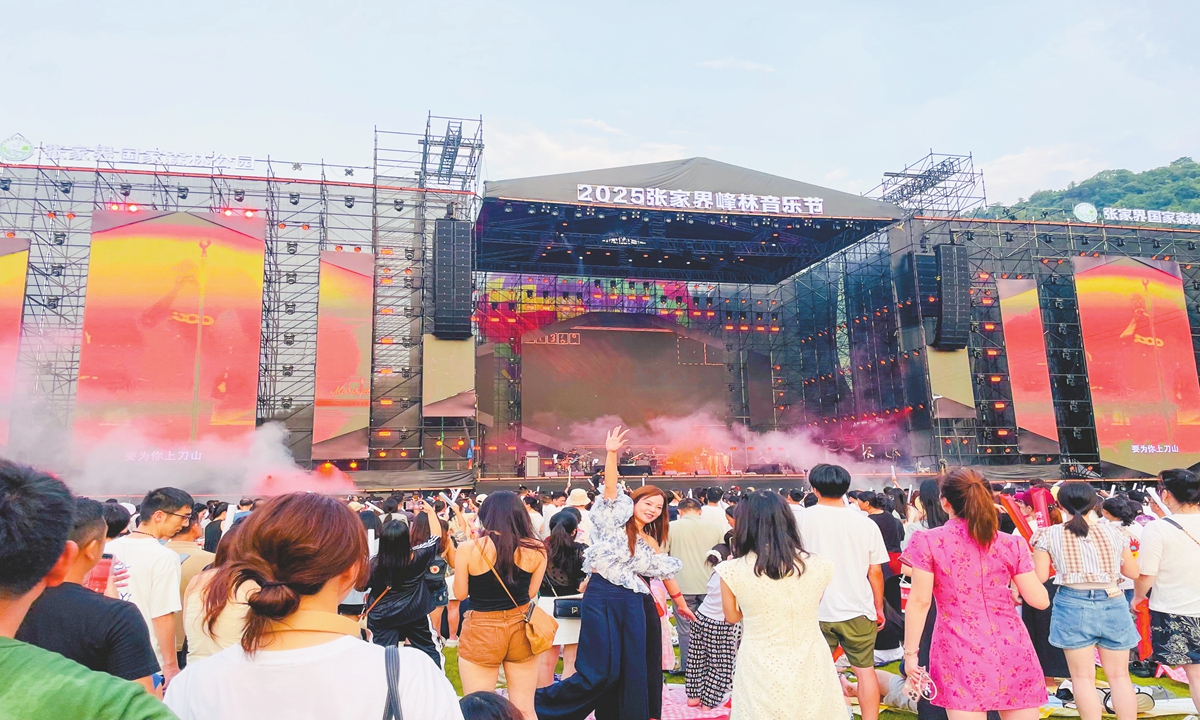
Crowds of tourists gathered at a music festival venue in Zhangjiajie, Central China's Hunan province, on August 30, 2025. Photo: VCG
At a cafe in Shanghai, Li Zhiyuan, a 25-year-old programmer from a video game company, ordered a new coffee priced at 48 yuan ($6.8), which is well beyond his usual budget. He had just completed a demanding two-week coding sprint, solving a tough problem in his project. The cup, he said, was his "smallest unit of self-reward."
After taking a sip, Li opened his phone and placed an order for two long-awaited model kits in his online shopping cart, costing over 3,000 yuan.
"At that moment, I needed something tangible, something I could hold in my hands to remind myself that all the hard work was worth it," Li told the Global Times.
This instinct to "reward oneself," known as the "Treatonomics," has quietly spread through numerous corners of Chinese consumption.
From the "Lipstick effect" to "Treatonomics," Chinese consumers are looking to reward themselves as life's traditional milestones are harder to achieve.
The latest annual "Double Eleven" shopping festival underscored this rewarding emotional connection in consumer behavior. Zhang Yi, iiMedia Research CEO, noted that the 2025 "Double Eleven" was marked by a clear trend: consumers were "paying for happiness and experience." Sectors such as tourism and live entertainment have boomed this year, reflecting a growing willingness to invest in mental well-being and healthy lifestyles, reported Jiaohuidian News, a media outlet under the Xinhua Daily Media Group on November 11.
A psychology expert told the Global Times that as emotional value becomes a new moral compass for Chinese consumers, "Treatonomics" is emerging as a philosophy of people's daily life. Its core principle - "I deserve it" - has evolved from buying small treats to pursuing experiences, passions, and holistic quality of life. This window into China's consumer market also vividly reflects the profound shift in social mindset and the ongoing transformation of market structures.
'self-compassion'
Across from Li's bed stands a four-tier glass cabinet: model kits on the top shelf, anime badges and acrylic charms on the second, figurines on the third, and plush toys crowding the bottom.
In Li's view, these little trinkets - kept locked away in his cabinet after purchase - have given him an unprecedented sense of "freedom." Beyond these collections, Li also invests in aromatherapy and high-quality speakers.
"I bought all of these since I started working two years ago," Li said. "I never counted how much I spent, but each piece is tied to a moment. Its emotional value is full."
The small room feels cramped, but he doesn't mind. "Buying an apartment isn't realistic for someone like me, a 'drifter' in Shanghai. I can't wait for some distant future to be happy. I need to affirm myself now."
Li's outlook isn't rare. On Chinese social media platforms, "treat yourself" is a trending topic - posts about an "autumn's first milk tea" after work, an afternoon tea to celebrate weight loss, a limited-edition LEGO for a promotion, or a trip for an anniversary.
Currently, various forms of "companion economy" - from accompanying trips and hikes to medical visits and study sessions - are flourishing, largely meeting consumers' emotional needs. Sinolink Securities predicts that China's "companion economy" will reach a market size of 50 billion yuan by 2025, reported the Economic Information Daily in July 2025.
Liu Haihua, a researcher at the research center on personality and social psychology in Peking University, sees this as an evolution from the "lipstick effect," which once reflected budget indulgence during economic downturns.
"The lipstick effect came from people wanting comfort when they couldn't afford big purchases. 'Treatonomics,' however, comes from 'self-compassion', a psychological idea that emphasizes self-care. Many young people now prioritize emotional value and refuse to postpone happiness for far-off goals," Liu told the Global Times.
The China consumer report 2025 from Mintel, a market intelligence agency, shows that compared with the consumption trends of the past decade, experience-oriented, self-rewarding, and health-driven spending have emerged as distinct and sustainable growth drivers across economic cycles.
Data supports this. Statistics from iiMedia Research show that China's emotional economy exceeded 2.3 trillion yuan in 2024 and is projected to surpass 4.5 trillion yuan by 2029, according to a report published by teh Economic Daily on October 14.
As a representative segment, China's "guzi economy" reached 168.9 billion yuan in 2024 and is projected to exceed 300 billion yuan by 2029, the Xinhua News Agency cited iiMedia Research data in August 2025. The word "guzi," a homonym for the English word "goods," refers to badges, acrylic figure stands, cards and other merchandise featuring ACG (animation, comic and game) culture elements.
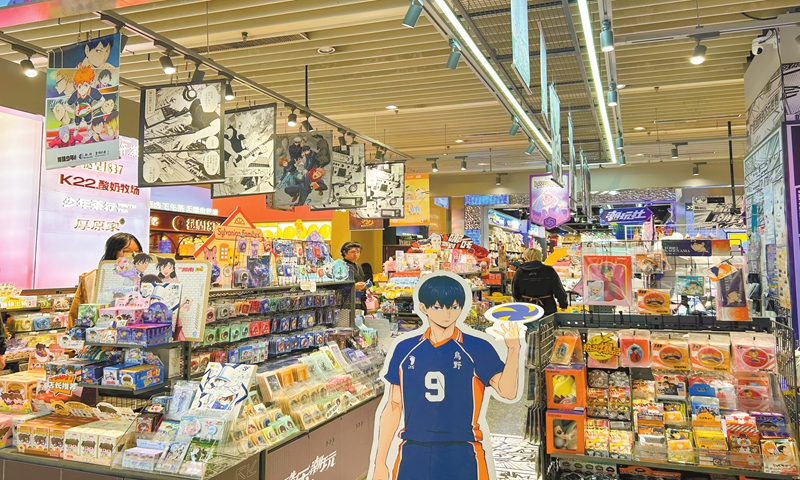
A view of a "guzi" store at a shopping mall in Beijing Photo: Liang Rui/GT
Redefining happiness
The surge of "Treatonomics" is more than a behavioral change, it's a profound shift in values. Its driving force lies in how consumers, especially younger generations, redefine happiness and life milestones.
Liu believed that one important social factor driving the "treating oneself" phenomenon is that, in the face of work and life pressures, indulgent consumption has become a convenient outlet for emotions - a quick compensation mechanism for stress. "It's a micro-solution for individuals to cope with anxiety," he said.
"Moreover, as traditional life paths, such as buying property or achieving upward mobility, have become less accessible, people tend to seek new and attainable milestones in life," Liu added.
Li, meanwhile, said that although his "treating myself" mindset has only been in practice for about a year, his outlook has changed along the way.
"In the past, I used to reward myself only after accomplishing something significant," he said. "But now, anything counts, whether it's a real achievement or simply celebrating a good day. I'm learning to treat myself with more kindness."
"Their 'sense of worthiness' has grown," Liu said. "And this is directly linked to another factor driving emotional-value-oriented consumption: a shift in self-perception."
The younger generation's self-awareness increasingly centers on "me as an independent individual." Their sense of value is no longer only defined by family or workplace validation, but also by personal experiences, feelings, and preferences. Consumption has become the most immediate tool to construct and express this unique self. Every act of paying for emotional value is, in a way, a small investment in one's ideal life, Liu explained.
It's not only young individuals who are embracing the logic of self-reward. In Guangzhou, 47-year-old nurse Chen Jing and her family have just booked flights to Japan for Christmas.
As the holiday price surges, Chen describes it as an "expensive family gift" meant to reward her eight-year-old little daughter for her excellent performance this semester.
"When I was young, doing well in school was simply expected," Chen told the Global Times. "But now, I believe that a child's discipline and effort also deserve to be celebrated. This trip is not just about fun, it's an investment in her curiosity about the world, a family ritual of shared achievement."
Family-oriented reward consumption tends to peak after exams. Following the conclusion of China's national college entrance examinations in June 2025, Economic Daily reported a sharp rise in spending among students on electronics, travel, beauty services, and skill training. Such behavior not only satisfies individual needs but also stimulates broader household consumption.
"This wider acceptance reflects a societal shift - particularly among China's urban middle class - from survival consumption to existential consumption," Liu said. "People are now routinely willing to pay for higher-level needs such as meaning and happiness."
"This may signal a broader transformation, from a single-minded, 'delayed gratification' mindset to one that blends instant enjoyment with long-term investment, a more complex and personalized outlook that values balance in the pursuit of progress," he added.
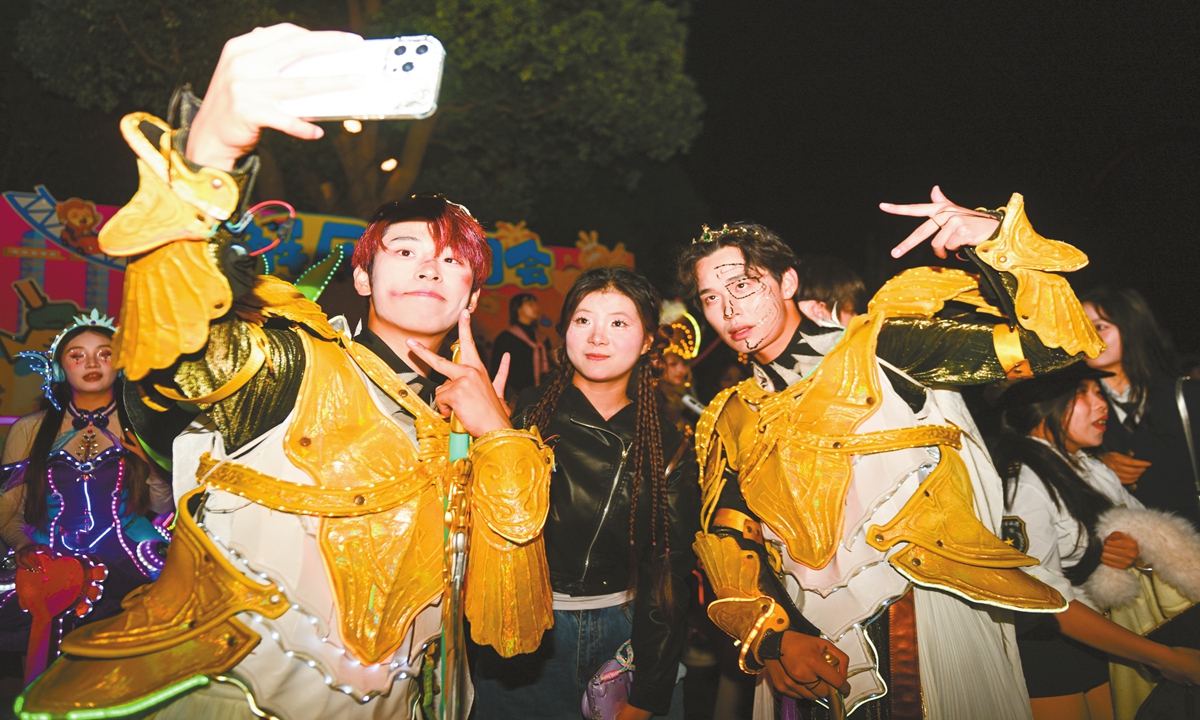
A tourist takes photos with two cosplayed staffs during an event at a theme park in Suzhou, East China's Jiangsu province, on November 1, 2025. Photo: VCG
Growth and risk
As emotional value increasingly drives spending, the "Treatonomics" has become both a new growth frontier and a double-edged sword that demands awareness.
A senior vice president at Mintel Asia-Pacific noted that while innovation and expertise still matter, consumers now expect brands to show empathy, reliability, and warmth. Personae like "the caretaker" or "the intimate partner" have gained appeal - but few brands truly embody them. To secure loyalty, companies must build emotional depth and differentiated identities, according to Mintel's Wechat account.
"Humorous and emotionally resonant items, like a "working man standee" with bittersweet slogans, became viral hits. Such products let young people vent emotions with humor," Xinhua reported, citing an e-commerce director, in June.
"The heart of business value," Liu said, "has shifted from offering better performance metrics to weaving more moving emotional stories and healing experiences. The product is just a prop, emotion is the real commodity."
Policy support has also followed. Many regions are actively cultivating service consumption as a new growth driver. For example, Haikou in South China's Hainan Province has introduced incentive policies, providing one-time rewards ranging from 300,000 to 5 million yuan to organizers who bring in high-quality large-scale concerts or music festivals, the Economic Information Daily reported.
As the Communique of the Fourth Plenary Session of the 20th Central Committee of the Communist Party of China emphasized, China should see that new demand drives new supply, that new supply helps create fresh demand.
Regarding this perspective, Guan Qingyou, vice president of the Chinese Society for Study of the Private Economy, said in an event hosted by Xinhua that the "sense of experience" is increasingly becoming a key factor influencing consumption decisions. He cited the global popularity of "Labubu" created by Chinese toymaker Pop Mart in 2025 as a clear demonstration of the immense potential contained within "emotional consumption."
Yet the other side of the coin is risk. Liu said, aggressive marketing and algorithmic recommendations have amplified the culture of "buying equals happiness." Without financial planning or restraint, some may slip into irrational or overextended spending.
"Meanwhile, when we're overly emotional or stressed, impulsive spending can turn addictive," Liu cautioned. "From concert tickets to online tipping, these habits may mask anxiety, trauma, or depression. We must stay aware of our real motivations."
Liu said that excessive self-reward can even become a new form of social pressure - "If others' treats are European trips, is my new game still valid?" - fueling comparison and insecurity.
Liu suggested that both individuals and society foster healthier reward mindsets. "We shouldn't be slaves to emotion. Healthy rewards come after genuine effort and self-awareness. The key is whether the treat reinforces your growth, not just distracts from emptiness."
Society should promote diverse standards of success and happiness, encouraging dialogue about inner satisfaction rather than external consumption, Liu added.
Li still habitually opens his shopping cart after finishing a project. But as a cautious person, he has already considered the potential risks of over-consumption and set a dedicated budget for his "treats."
"I tell myself: it's about mastering consumption, not being mastered by it. What I buy isn't just an item, it's a clear acknowledgment of my effort. It means, I deserve it, and I'm in control," Li said.
From 'Lipstick Effect' to 'Treatonomics'
RELATED ARTICLES