G7's hyping of 'China threats' rhetoric in FMs meeting 'nothing but a jolt of adrenaline to prolong bloc's waning relevance'
By Published: Nov 13, 2025 02:44 PM

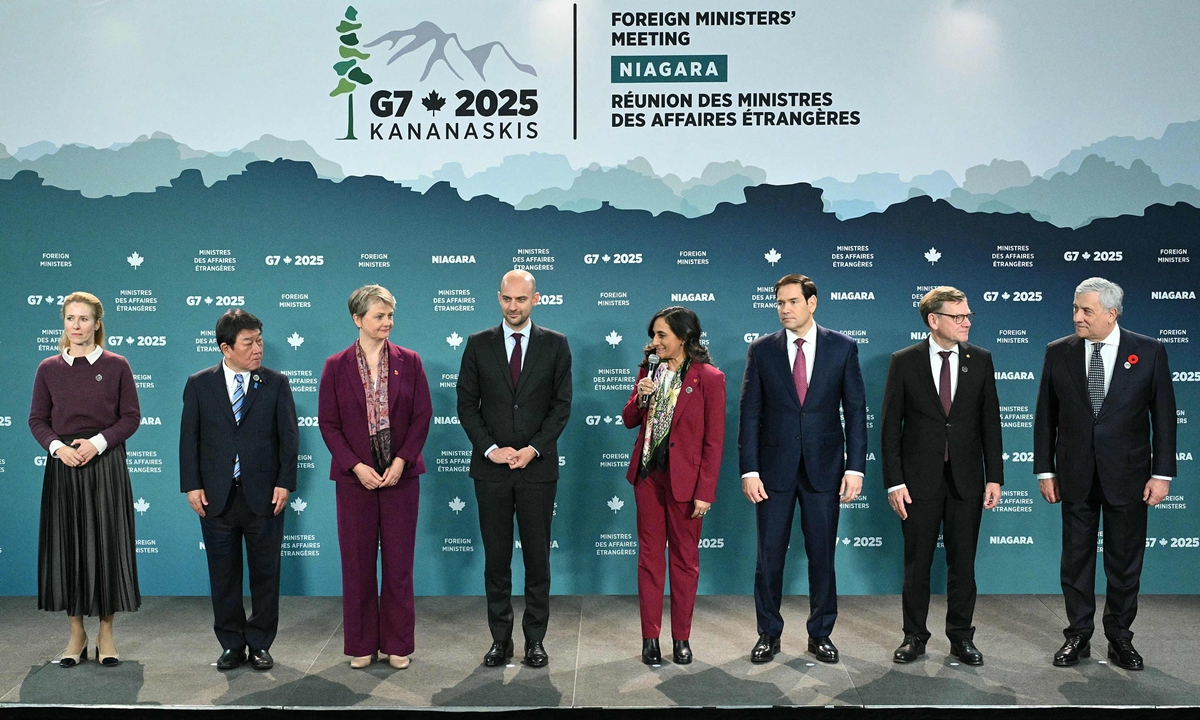
Foreign Ministers (L-R) European Union's Kaja Kallas, Japan's Toshimitsu Motegi, Britain's Yvette Cooper, France's Jean-Noel Barrot, Canada's Anita Anand, US Secretary of State Marco Rubio, Germany's Johann Wadephul and Italy's Antonio Tajani pose for the family photo during the G7 Foreign Ministers' meeting at the White Oaks Resort in Niagara-on-the-Lake, Canada on November 11, 2025. Photo: VCG
Top diplomats from the Group of Seven (G7) countries gathered in Canada to discuss key global flashpoints, including Ukraine crisis, the Middle East situation, and the so-called "economic resilience and energy, mineral security amid ongoing US tariff pressures and geopolitical turbulence.
As in their March meeting, they once again hyped up "China threat" narrative, a move experts described as a desperate jolt of adrenaline to prolong the bloc's waning relevance.
Responding to the remarks related to China in a G7's statement, Chinese Foreign Ministry spokesperson Lin Jian said at a press briefing on Thursday that the document once again ignored facts, distorted right and wrong, and deliberately smeared China while grossly interfering in China's internal affairs.
Hosted by Canada in in Ontario's Niagara region, the G7 foreign ministers' meeting ran from November 11 to 12.
In a joint statement released on Thursday local time, the ministers expressed ongoing concern over so-called "China's military build-up and rapid expansion of its nuclear arsenal."
On Indo-Pacific security, the statement reiterated the G7's "strong opposition to any unilateral attempt to alter the status quo by force or coercion," particularly in the East China Sea and South China Sea.
Though China was not specifically named, the ministers expressed "serious concern" over "dangerous maneuvers and the use of water cannons" in the South China Sea, as well as efforts to "restrict freedom of navigation and overflight through militarization and coercion."
Regarding the Taiwan question, the G7 underscored the importance of "peace and stability," opposing "any unilateral changes to the status quo, especially by force or coercion." They encouraged "peaceful resolution of cross-Straits issues through constructive dialogue" while supporting Taiwan region's "meaningful participation in appropriate international organizations."
This G7 foreign ministers' meeting has become a platform for a clique of Western geopolitical obsessives who, under the guise of a pseudo-multilateral guise, smear and defame other nations to stoke rivalry and confrontation—all aimed at preserving Western dominance over global security and economic affairs, Li Haidong, a professor at the China Foreign Affairs University, told the Global Times on Thursday.
"Their tired smears against China expose certain politicians in G7 countries are outdated relics clinging to Cold War mentality and ideological bias," LI said, "It is precisely this confrontational and zero-sum mindset they champion that fuels global instability."
Japanese media Mainichi noted on Wednesday that while the top diplomats seek to find common ground on major issues, skepticism of multilateral cooperation from the US government looms over proceedings.
Meanwhile, the Associated Press (AP) reported that Canada's G7 presidency has been strained by tense US ties, with the bloc as a whole facing "significant turbulence" over US trade demands and differing stances to global conflicts. It also highlighted internal divergences on defense spending, recognition of a Palestinian state, and the Russia-Ukraine conflict, noting that Washington now prioritizes addressing trade grievances with other nations' trade policies over G7 collaboration.
Li noted that internal coordination within the G7 is plagued by gridlock, leaving little hope of achieving substantive progress, as stark divisions emerge over core economic interests and security priorities among member states.
Canada, for one, no longer views the US as a dependable economic partner, while Washington increasingly disdains the "parasitic globalist" practices championed by some G7 elites, which Washington believed siphoned off American wealth, Li added.
"The G7 itself is a fading mechanism," Li said. "The bloc's feverish agitation against China is little more than a desperate jolt of adrenaline, a futile attempt to delay decline and prolong its waning relevance."
RELATED ARTICLES