Courtesy of Nanjing Jinling Hospital, Affiliated Hospital of Medical School, Nanjing University
The first intelligent clinical research ward dedicated to brain-computer interfaces (BCI) in East China's Jiangsu Province was recently unveiled at the Nanjing Jinling Hospital, Affiliated Hospital of Medical School, Nanjing University, expected to serve patients who receive BCI surgeries, providing a full range of preoperative, intraoperative and postoperative monitoring and rehabilitation services covering data collection, intelligent analysis and precise treatment, the Global Times learned from the hospital on Thursday.
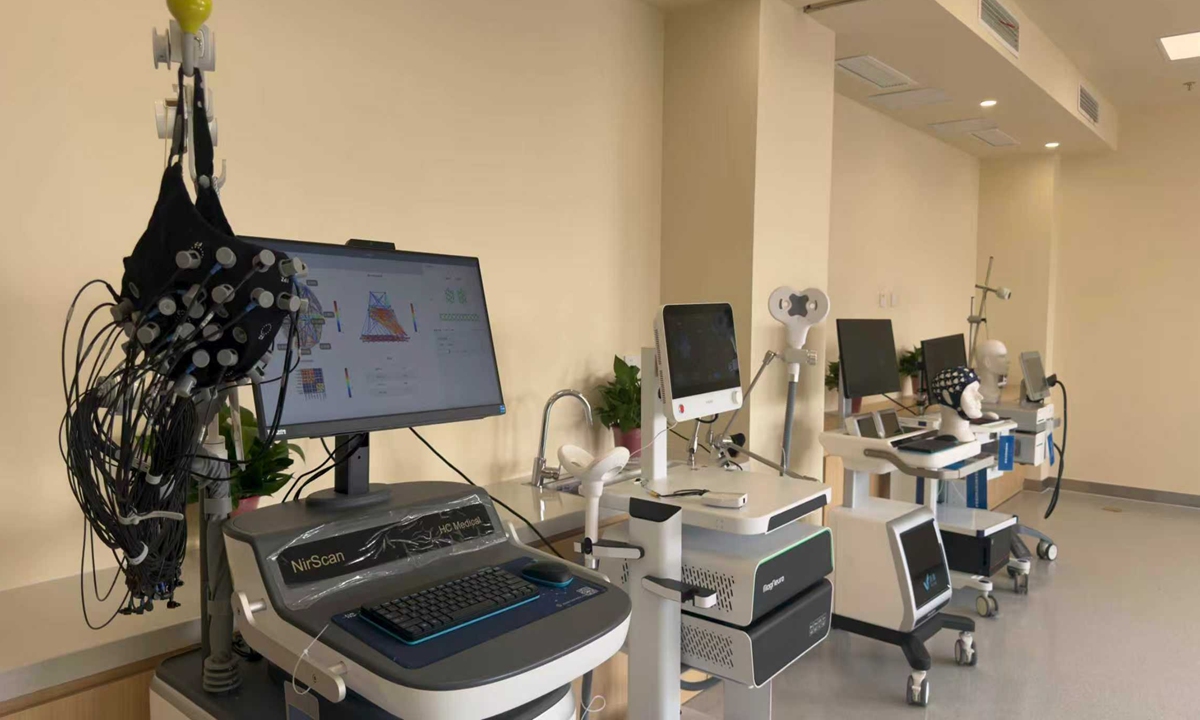
The research ward is equipped with a range of precision rehabilitation facilities, including a ceiling rail system, which can accurately support part of the patient's body weight, assisting the patient to stand and walk in a safe environment to help restore motor functions, Ma Chiyuan, director of the Neurosurgery Department at the Nanjing Jinling Hospital, Affiliated Hospital of Medical School, Nanjing University, told the Global Times on Thursday.
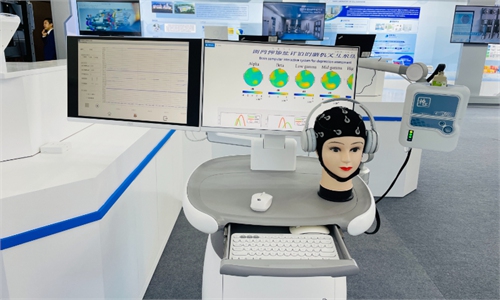
The ward is also equipped with devices for limb function training, speech and swallowing rehabilitation, and brain electrical stimulation, forming a complete chain of care that ensures preoperative assessment, intraoperative precision and postoperative rehabilitation, Nanjing Daily reported.
Meanwhile, the ward also offers full-process rehabilitation coverage from pre-implantation assessment to post-implantation training and monitoring, providing data support for precision rehabilitation, according to the Yangtse Evening News.
In addition, the ward features warm-toned walls to ease patients' emotions, plays 40-hertz gamma brainwave music to accelerate cognitive recovery, and is staffed with dedicated personnel responsible for assessment, training, data collection and nursing, ensuring scientific and professional care services, the Yangtse Evening News reported.
During the ward's preparation and construction beginning this June, the hospital completed its first semi-invasive BCI clinical research surgery on a 52-year-old male patient surnamed Guo from North China's Inner Mongolia Autonomous Region, who became paralyzed eight years ago after a cervical fracture which caused spinal cord injury, leaving him unable to even lift a cup with his hands. Over the past eight years, he has persevered with rehabilitation training, supported by the devoted care of his family.
According to Ma, the surgery used a domestically developed semi-invasive BCI device, which offers significant safety advantages compared with invasive BCI technology at Neuralink.
"Neuralink requires electrodes to be inserted directly into the brain, whereas our device is placed entirely outside the dura mater, which acts as a natural protective shield, minimizing damage to neuro tissues and reducing the risks of complications such as infection and bleeding," Ma told the Global Times on Thursday.
According to Ma, an evaluation three months after the surgery showed significant improvement in Guo's right-hand function. The patient can not only lift a water bottle using a pneumatic glove but also grasp a wooden block with his bare hands, demonstrating that the BCI technology has facilitated brain function remodeling and taken a crucial step toward his independent living. The ultimate goal is to enable the patient to perform daily activities independently - such as drinking water, eating and dressing - without relying on external devices.
At present, the primary target group for BCI technology is patients with quadriplegia caused by cervical spinal cord injuries. As the technology matures, it will be extended to deal with the diseases such as epilepsy and Parkinson's disease, or rehabilitation of stroke patients, and other conditions, offering solutions to a broader range of patients with neurological impairments, according to Ma.
This research ward, equipped with cutting-edge technology, not only marks the accelerated clinical translation of BCI research in Nanjing from the laboratory to the patient, but also gives patients new hope for neural function restoration, according to Nanjing Daily.
RELATED ARTICLES