Hungarian experts tour Chongqing logistics hub park, hail China’s opening-up, Hungary’s bridging role
By in Chongqing Published: Nov 13, 2025 11:00 PM

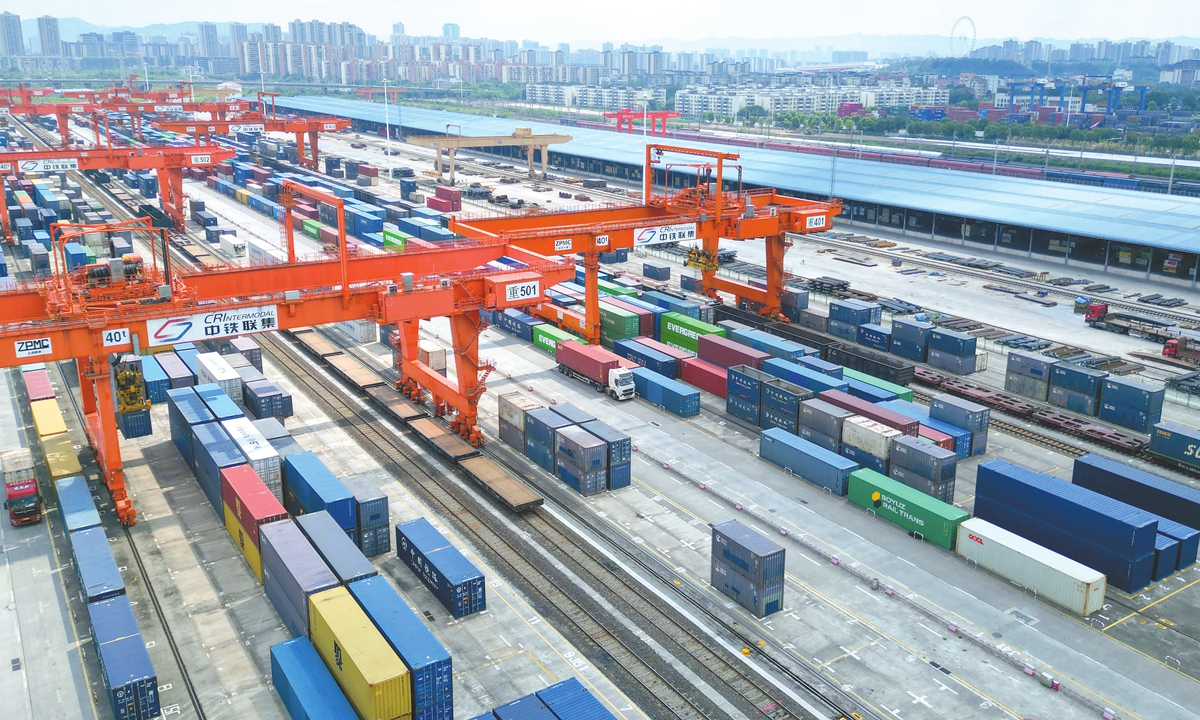
A view of the Chongqing International Logistics Hub park on July 22, 2025 Photo: VCG
A sharp whistle pierced the air as the Yu-Ou Express, or the Chongqing-Europe Express, a cross-border freight service laden with cargo, pulled away from the Chongqing International Logistics Hub Park in Southwest China's Chongqing Municipality and embarked on its transcontinental trek to Europe.The launch successfully opened Chongqing's "third corridor," complementing the established northern and southern pathways. It cuts transit time from Chongqing to the EU to just 25 days, enhancing trade exchanges between China, the EU, and all countries along the way.
The late-October launch was witnessed by a 14-member delegation of scholars from Hungarian think tanks who were on a visit to the Chongqing International Logistics Hub Park.
They were impressed by China's opening-up and connectivity efforts. They also expressed optimism about China-Europe cooperation, in which Hungary plays the role of a bridge.
Stronger connectivity
"Chongqing as an international logistics hub is very crucial for European economic growth, because it is key infrastructure to move all the containers, all the goods from China, and vice versa, thus strengthening Europe-China relations," Santo Martin, research director and chief analyst at Hungary's Makronóm Institute, and a member of the Hungarian delegation, told the Global Times while touring the park.
Santo noted that global supply disruptions are among the biggest problems facing the world economy today; therefore, infrastructure must be strengthened, not just sea routes, but also railways.
In recent years, Chongqing has been well placed to upgrade its opening-up platforms and build itself into an inland international logistics hub.
The Chongqing International Logistics Hub Park is the starting point for China-Europe freight trains and the New International Land-Sea Trade Corridor, which connects global ports via rail, sea and road. It has helped the inland municipality of Chongqing, where mountains and hills account for 90 percent of its terrain, transform into a pivotal logistics nexus.
The park serves as the central hub for the municipality's "four-directional channels." On land, it connects via China-Europe freight trains to over 110 cities in nearly 40 Asian and European countries. By sea, leveraging the Western Land-Sea New Corridor for rail-sea intermodal services, it reaches more than 500 ports in over 120 countries and regions worldwide, with over 60 main routes linking more than 40 domestic and international hubs, forming a "four-directional radiating" global channel network.
The China-Europe freight train, a hallmark of the China-proposed Belt and Road Initiative (BRI), has become a vital bridge for trade and connectivity between China and Europe. According to statistics shared with the Hungarian visitors by staff at the park, the number of the China-Europe freight trains starting from Chongqing as well as Chengdu of Sichuan Province reached 5,854, an increase of 10 percent year-on-year. Rail-sea intermodal trains via the New International Land-Sea Trade Corridor totaled 4,411, up 37 percent, transporting 220,500 TEUs.
Hungary is the first European country to sign a Belt and Road cooperation document with China. China is Hungary's largest trading partner outside Europe, and Hungary is one of China's most important trading partners in Central and Eastern Europe. In 2024, about 31 percent of Chinese investments in Europe flowed to Hungary.
Over the years, Hungary's policy of "opening to the East" has been in synergy with the BRI, as China stays committed to promoting high-standard opening-up and pursues steady and sustained growth of China-Europe relations.
Expanding opening-up is highlighted in the Communique of the Fourth Plenary Session of the 20th Central Committee of the Communist Party of China held in late October, a meeting that charts the course for China's economic and social development over the next five years. "We should promote high-standard opening-up and create new horizons for mutually beneficial cooperation," said the Communique.
A bridging role
As an EU member, Hungary is in a strong position to become a hub between China and Europe and serve as a bridge between Asia and Europe, said Kitta Gergely, director for Institutes at the Mathias Corvinus Collegium Foundation and a member of the Hungarian delegation visiting Chongqing.
"It's inevitable that goods and services will come to the EU in the future from China on maritime routes and rail tracks as well. We can help China interstate into the European market. I would like to persuade all the Chinese companies to come to Hungary and do businesses, because we are waiting for them with relatively reasonable and favorable cost environment, excellent infrastructure, a high skilled workforce, not mentioning the excellent geographical position of Hungary," Kitta told the Global Times.
Hungarian Minister of Foreign Affairs and Trade Péter Szijjártó said earlier this year that 54 modern large-scale Chinese investments have been created in the last 10 years. Among them, Chinese electric car giant BYD's first European factory will start production in Szeged in southern Hungary early next year, and CATL, which is building one of Europe's largest electric battery plants in Debrecen in eastern Hungary, will start production this year.
"Automobile industry mobilization, and everything which is in connection with it, such as the battery industry, is a natural territory of cooperation because China is the leader of the manufacturing development," said Artner Annamária, a political economist and senior research fellow at the Institute of World Economics, Eötvös Loránd University and a professor at the Milton Friedman University during her tour of the Chongqing International Logistics Hub Park.
RELATED ARTICLES