South Korea moves to tighten hate speech laws amid rising anti-China rallies and public concern
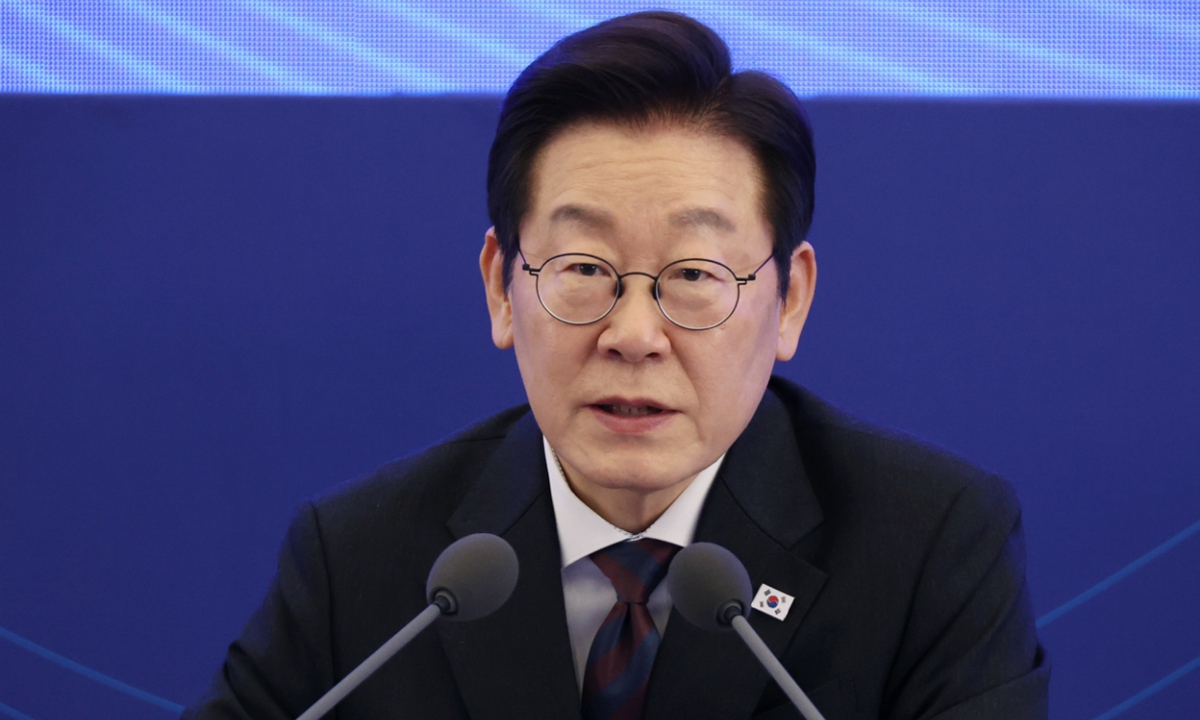
South Korean President Lee Jae-myung File photo: VCG
South Korea is accelerating legislative efforts to curb hate speech and disinformation, as President Lee Jae-myung and senior ministers call for stronger penalties against expressions of hatred based on race or nationality, according to reports from the Korea Times, Maeil Business Newspaper and Chosun Ilbo.During a Cabinet meeting on Monday, Lee condemned what he described as "anachronistic discrimination and hate," instructing police and officials to step up enforcement against hate speech and online disinformation, the Korea Times reported on Thursday.
"On social media, hate speech targeting specific groups is being spread indiscriminately, and false and manipulated information is flooding the space," Lee said. "These acts are clear criminal behavior that go beyond the limits of freedom of expression." Such acts, he added, pose a serious threat "not only to democracy but also to the fabric of everyday life," according to the Korea Times.
The Korea Times reported that lawmakers proposing the new bill cited recent anti-China rallies held by certain groups in Seoul and other cities, where participants hurled insults and spread false claims. "Currently, both defamation by false statement and insult are limited only to cases where a specific individual is identifiable as the victim, and do not acknowledge insults or defamation targeting a group. Perpetrators and participants in anti-China rallies are exploiting this legal loophole," lawmakers said in the proposal.
Momentum for reform is growing, with the Justice and Interior Ministers both voicing support for legislative revisions. Interior and Safety Minister Yun Ho-jung said during Monday's Cabinet meeting that "the problem of hate-filled banners is becoming serious. Particularly, political party banners are permitted under both the Outdoor Advertising Act and the Political Parties Act, which requires a legal amendment," Hankyoreh reported.
His remarks were echoed by Defense Minister Ahn Gyu-back, who said, "Such displays not only have negative educational effects but also trigger hatred toward political parties. The law should be revised so that parties act responsibly," according to the Hankyoreh.
According to the National Assembly's legislative information system cited by Maeil Business Newspaper, Democratic Party lawmaker Yang Bu-nam, along with other lawmakers, submitted the proposed amendment to the Criminal Act on November 4. The proposal cites the recent surge of hateful remarks targeting specific countries and races both online and offline, as well as rallies marked by slurs and inflammatory language, with anti-China protests named as a key example.
If enacted, the bill would impose penalties of up to five years in prison or 10 million won ($6,800) in fines for defamation, and up to one year in prison or 2 million won in fines for public insults, the Korea Times reported.
The JoongAng Daily on Wednesday noted that public opinion sees Lee's push against hate speech as partly aimed at addressing recent far-right "anti-China" demonstrations organized by conservative groups. The newspaper also quoted Chinese Ambassador to South Korea Dai Bing as saying that "far-right forces in Korea are spreading disinformation about China and organizing anti-China protests, which not only damage the friendship between our two countries but also tarnish Korea's national image." Dai urged the Korean government to "find a fundamental solution" to such demonstrations.
In interviews with the Global Times on Wednesday, a Seoul resident expressed support for tighter regulations, saying that vulgar political banners, unchecked online abuse and the spreading of false information at rallies "clearly go beyond the boundaries of normal criticism." The resident added that the government's move to strengthen oversight was both timely and necessary.
Global Times
RELATED ARTICLES