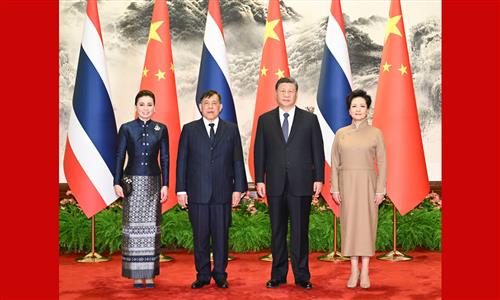
Xi calls for advancing community with shared future when meeting Thailand's king
Meeting a crowning touch of Beijing-Bangkok ‘Golden Jubilee’: expert
By Published: Nov 14, 2025 11:34 PM

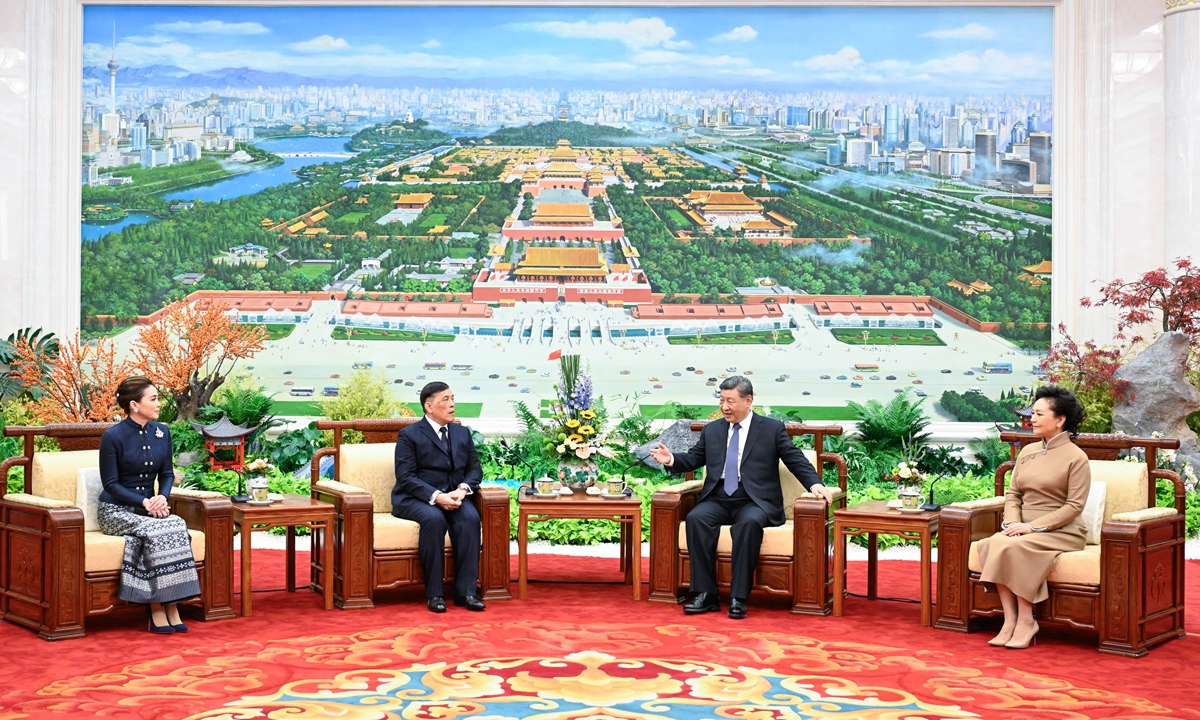
Chinese President Xi Jinping meets with King Maha Vajiralongkorn Phra Vajiraklaochaoyuhua of the Kingdom of Thailand, who is on a state visit to China, at the Great Hall of the People in Beijing on November 14, 2025. Photo: Xinhua
Chinese President Xi Jinping met with visiting King Maha Vajiralongkorn Phra Vajiraklaochaoyuhua of the Kingdom of Thailand in Beijing on Friday, calling for joint efforts to further advance the building of a China-Thailand community with a shared future, the Xinhua News Agency reported.
Xi said the king has taken China as the first major country to pay a state visit to and is the first Thai king to visit China since the establishment of diplomatic relations, which fully reflects the great importance attached to China-Thailand relations and the deep friendship characterized as "China and Thailand are as close as one family."
Noting that this year marks the 50th anniversary of diplomatic ties and the "Golden Jubilee of China-Thailand Friendship", Xi said that over the past half-century, amid an ever-changing international landscape, China and Thailand have always worked together and supported each other, making the two countries good relatives, good friends and good partners.
Xi said that at this new historical starting point, he would like to work with Thailand's king to further advance construction of the China-Thailand community with a shared future over the next 50 years and jointly write a new chapter in China-Thailand friendship.
Calling his state visit to China a great pleasure, the Thai king said profound changes have taken place in China since his last visit many years ago, and he congratulated China on its significant achievements in economic and social development.
Thailand and China enjoy close and friendly relations, with robust people-to-people exchanges and extensive and in-depth mutually beneficial cooperation, he added, per Xinhua.
Prior to the meeting, President Xi and his wife, Madame Peng Liyuan, held a welcoming ceremony for King Maha Vajiralongkorn and Queen Suthida Bajrasudhabimalalakshana at the square outside the Eastern Entrance of the Great Hall of the People, according to the Chinese Foreign Ministry. President Xi and Madame Peng hosted a welcoming banquet for King Vajiralongkorn and Queen Suthida in the evening.
Under the visionary leadership and strategic guidance of both nations' leaders, China-Thailand relations are embracing new historic opportunities, said Song Qingrun, a professor from the School of Asian Studies at Beijing Foreign Studies University.
Looking ahead to the next fifty years, China-Thailand relations will continue to serve as a model for China-ASEAN relations, jointly promoting regional peace, stability, and prosperity, Song added.
Xu Liping, director of the Center for Southeast Asian Studies at the Chinese Academy of Social Sciences, believed the meeting between the two heads of state serves as the crowning touch of the Chinese-Thai "Golden Jubilee", propelling bilateral relations across multiple domains and dimensions from the "Golden era" toward a "Diamond future."
Deepening cooperation
During the meeting, President Xi noted that the Recommendations of the Communist Party of China (CPC) Central Committee for Formulating the 15th Five-Year Plan for Economic and Social Development were adopted at the fourth plenary session of the 20th CPC Central Committee. China will prioritize promoting high-quality development and expanding high-standard opening up, while Thailand is at the crucial stage of national development and rejuvenation.
China is ready to strengthen synergy of strategies, ensure steady progress in China-Thailand railway and other major projects, expand imports of high-quality agricultural products from Thailand, and enhance cooperation in emerging fields such as artificial intelligence, the digital economy and aerospace, so that the two peoples can gain more tangible benefits from bilateral cooperation, said Xi, Xinhua reported.
In his meeting with the Thai king, Xi also called for enhanced cultural and people-to-people exchanges, and voiced active support for the public welfare programs of the Thai royal family, adding that China is willing to strengthen the exchange of poverty reduction experience, and facilitate the improvement of people's livelihood in Thailand.
Noting that cooperation between the two countries is as close as brothers, the king said Thailand is willing to learn from China's development experience, expand cooperation with China in all sectors, and enhance personnel and cultural exchanges, so that the Thai-Chinese friendship can take deeper root in the hearts of the people, Xinhua reported.
Data from the Chinese Foreign Ministry shows that China is Thailand's largest trading partner, and Thailand is China's main trading partner among the ASEAN countries. In 2024, the bilateral trade volume reached $133.98 billion, with a year-on-year growth of 6.1 percent.
In 2024, Thailand topped the list of ASEAN members in agricultural product exports to China, with a total value of $11.6 billion.
On the firm foundation of established cooperation, the next chapter of China-Thailand partnership will prioritize infrastructure interconnectivity, for instance, with a focus on the high-quality construction of the China-Thailand Railway and its seamless integration with the China-Laos Railway, Song said.
Moreover, both nations are set to pursue deep convergence in emerging domains such as the digital economy, scientific and technological innovation (notably AI), and green energy, forging tighter, more resilient industrial and supply-chain linkages, he added.
Thailand has the largest overseas production capacity layout for Chinese new energy vehicles of any country. Eight Chinese automakers, including SAIC and BYD, have invested in factories in Thailand, with an annual production capacity of nearly 600,000 vehicles. Thailand is also the first ASEAN country where China's 5G technology has been fully commercialized, official data shows.
According to Xu, under the Lancang-Mekong Cooperation (LMC) framework, both sides are well-positioned to lead with project-driven initiatives, advancing comprehensive sub-regional cooperation centered on water resources.
At the ASEAN level, China and Thailand are poised to leverage the 3.0 version of the China-ASEAN Free Trade Area (CAFTA), further enhancing trade and investment facilitation between China and regional countries, Xu said.
"Amid surging protectionism and deglobalization currents, the China-Thailand partnership exemplifies both nations' commitment to openness, inclusivity, and mutual prosperity," Song said, "This collaboration not only elevates the well-being of the two peoples but also injects vital momentum into regional economic integration."
Compelling exemplar
The historic state visit to China by Thailand's King has captured attention in the region, as the trip's significance is regarded as going far beyond bilateral ties.
Thailand media outlet Khaosod mentioned that Thailand was the first ASEAN country to engage in strategic cooperation with China as well as to establish a comprehensive strategic cooperative partnership with China. The high-level exchanges between China and Thailand also "contributed strong momentum to regional peace, stability and prosperity."
"For Southeast Asia as a whole, the visit sends an unmistakable message: regional stability, economic complementarity, and shared Asian development pathways continue to outweigh geopolitical disruptions and external pressure," Ibrahim Khalil Ahasan, a Bangladesh-based independent columnist wrote in the Sri Lanka Guardian.
Thai King's visit to Beijing "highlights Beijing's role as a dependable economic partner" and "underscores China's regional importance" and "strengthens historically rooted trade ties between the two nations," commented the news outlet Devdiscourse.
Chinese-Thai engagement at the top level reflects the three key strategic postures of the two countries: upholding independent foreign policies and freedom from external interference; practicing genuine multilateralism while safeguarding ASEAN centrality; advancing an open and inclusive framework for regional cooperation, Song said.
As pivotal members of the Global South, with Thailand also serving as a BRICS partner country, Beijing and Bangkok share extensive common interests and are truly bound by a shared future in addressing global challenges, Xu said.
The King's visit further highlights China's distinctive stature in Thailand's diplomacy, positioning China-Thailand ties as a compelling exemplar for other regional countries—one that constructively bolsters political trust between China and other nations throughout Southeast Asia.
RELATED ARTICLES