Japanese side must not misjudge the stern warning issued by China: Global Times editorial
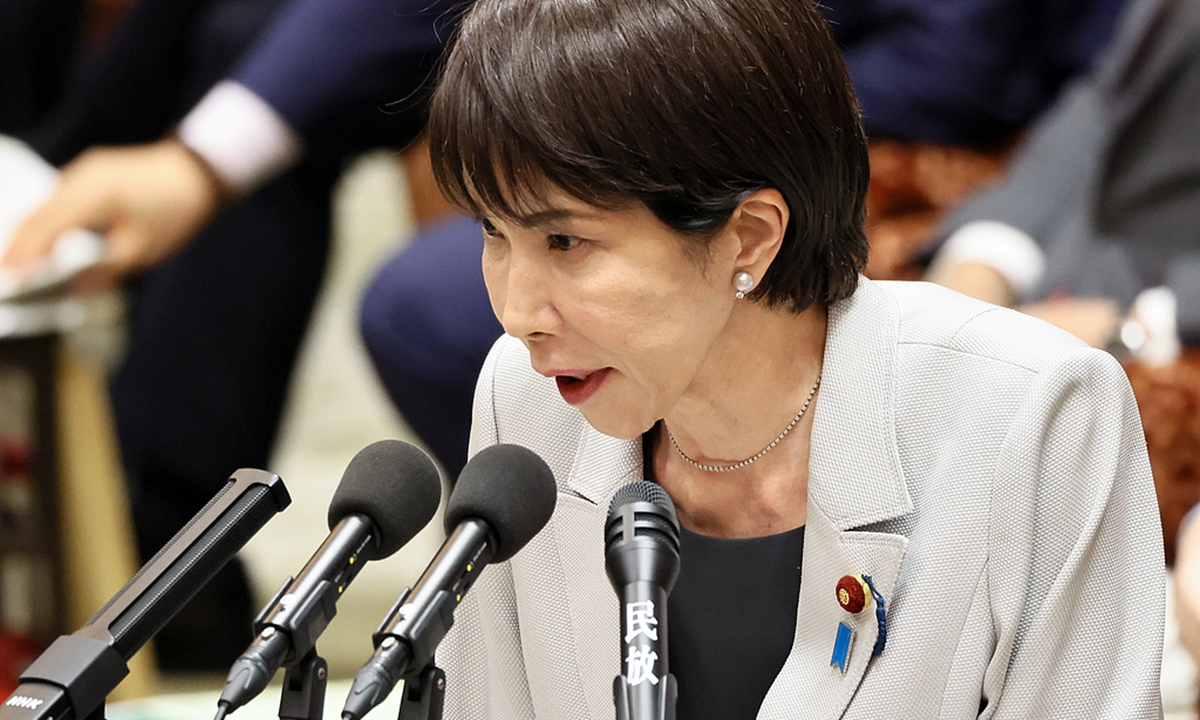
Japanese Prime Minister Sanae Takaichi attends the House of Representatives Budget Committee and responds to questions at the Diet building in Tokyo on November 10, 2025. Photo: VCG
On Thursday evening, Chinese Vice Foreign Minister Sun Weidong, upon instruction, summoned the Japanese ambassador to China Kenji Kanasugi, making serious démarches over Japanese Prime Minister Sanae Takaichi's erroneous remarks regarding China. This was a highly unusual diplomatic action, and the severity of the warning it conveyed is unprecedented. Tokyo should harbor no illusions.Looking back at Chinese diplomacy, the term "summoned upon instruction" is extremely rare, and its seriousness and authority are extraordinary. This was not a routine communication, but a high-level and stern warning. Tokyo must have a clear understanding of this and must not attempt to just muddle through. It should immediately reflect, correct its mistakes, and retract the malicious remarks.
Takaichi's remarks regarding the island of Taiwan are extremely egregious. As the sitting Japanese prime minister, she openly challenged the one-China principle, seriously infringed upon China's sovereignty and territorial integrity, and deliberately undermined the post-World War II (WWII) international order. This not only crossed the bottom line of China-Japan relations, but also subverted historical justice and undermined the global environment for peace and development.
The Taiwan question is the core of China's core interests and the cornerstone of the political foundation of China-Japan relations. Without this foundation, the entire structure of bilateral relations will be shaken to its core.
China's summoning of the Japanese ambassador this time is not only just a warning directed at Takaichi's personal remarks, but also a stern one against the long-standing malicious deeds of Japanese right-wing forces, including inciting anti-China sentiment, damaging China-Japan relations, and systematically undermining Japan's path of peaceful development. Tokyo's response must involve concrete actions to draw a clear line, including a public reaffirmation of the one-China principle by the Japanese government and the complete withdrawal of statements regarding military involvement.
It takes more than one cold day for the river to freeze three feet deep. Takaichi's wrongful and provocative remarks are not an isolated incident; they are the latest proof of the dangerous trend of right-leaning politics and populism within Japan. Recent reports indicate that Japan is considering reinstating certain pre-WWII Imperial Japanese Army ranks in the Self-Defense Forces. When we consider Takaichi's Taiwan-related remarks in conjunction with various right-wing and populist regressive moves inside Japan, a dangerous picture comes into sharp focus.
Some Japanese politicians are stoking xenophobic sentiment at home and fabricating external "enemies" abroad, attempting to artificially construct a sense of "survival-threatening situation," thereby freeing Japan completely from the "constraints" of the pacifist constitution and restoring its status as a political and military power. Hidden behind this is the dangerous revival of militarist thinking. These various acts of turning back the wheel of history are essentially aligned with Japan's wrongful perceptions and provocative moves on the Taiwan question. They will not only seriously hurt the feelings of the peoples of countries victimized by Japan's past aggression, but also heighten regional countries' vigilance and unease regarding Japan's development trajectory.
Of course, we have also noticed that there is no shortage of rational and sober voices within Japan. Former prime ministers Yukio Hatoyama, Yoshihiko Noda and Shigeru Ishiba, some opposition parties, as well as certain Japanese media and scholars have questioned or criticized Takaichi's words and deeds, believing that her statements undermine China-Japan relations and harm Japan's national interests. In stark contrast, Japan's online sphere has, to a large extent, been hijacked by right-wing agitation and anti-China sentiment, where hostility and malice toward China continue to grow. This exposes the Japanese government's dual responsibility.
On the one hand, the Japanese government must first correct its own understanding, honor the commitments made in the four China-Japan political documents through concrete actions, and return to the correct policy direction toward China. On the other hand, the Japanese government has the responsibility and obligation to properly guide irrational domestic opinion, rather than allow itself to be held hostage by extreme populism, and certainly not indulge or exploit anti-China sentiment for short-term political gain, which would ultimately undermine Japan's long-term national interests.
Meanwhile, China's summoning of the Japanese ambassador also sends a clear signal to the international community. We have noticed that certain Western media outlets have once again played a disgraceful role in this incident. They irresponsibly and one-sidedly hyped up "deteriorating" China-Japan relations, portraying China's legitimate and justified diplomatic response as "wolf warrior diplomacy." Such reporting does nothing to clarify the facts and may instead encourage provocative behavior by Japanese right-wing forces, which is extremely irresponsible.
China-Japan relations currently stand at a crucial crossroads. China has no room for compromise or concession on the Taiwan question. No one should underestimate the strong resolve, firm will, and powerful capability of the Chinese people to safeguard national sovereignty and territorial integrity. We urge Japan to pull back from the brink, abide by the principles set out in the four China-Japan political documents, and truly put into practice the political consensus of being "partners, not threats" to each other, rather than saying one thing and doing another, and certainly not "playing with fire" on the Taiwan question. Those who play with fire will only get burned.
RELATED ARTICLES