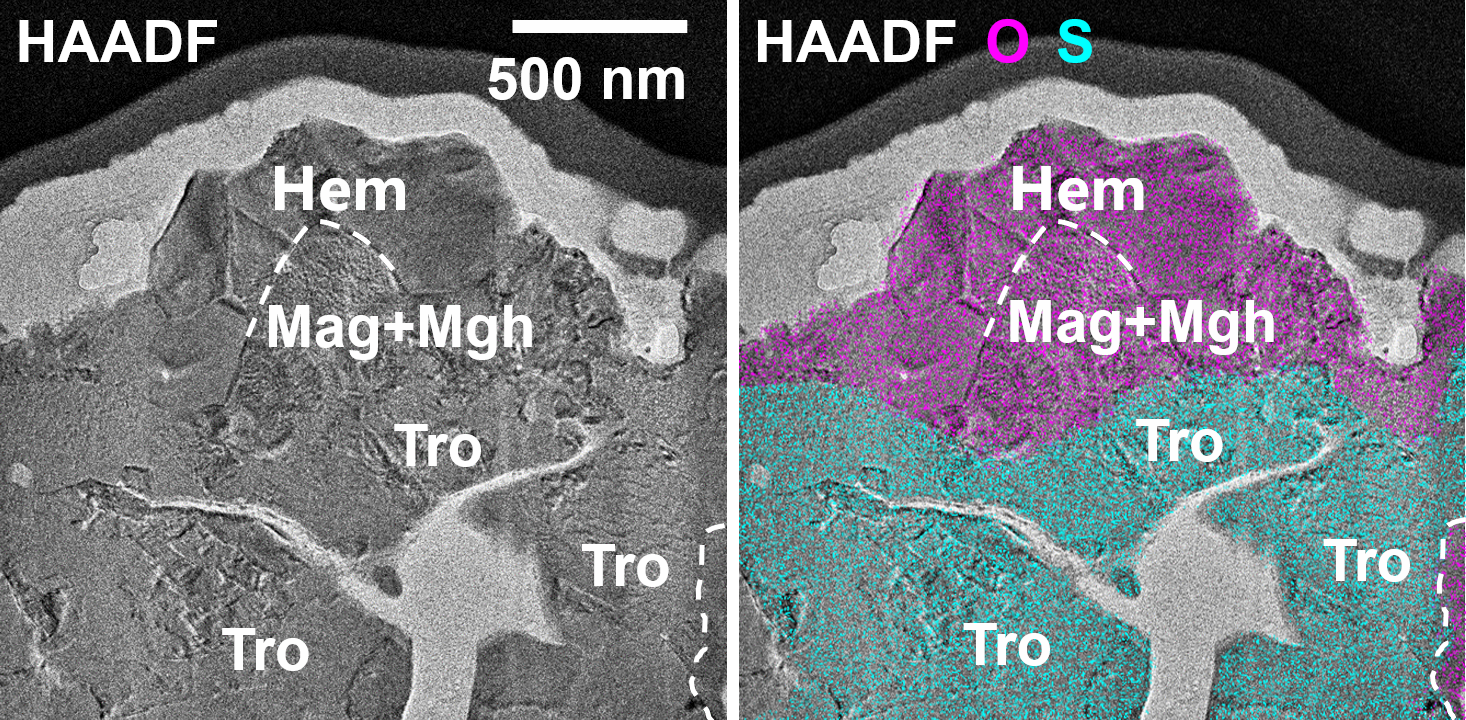
Left: Hematite grains imaged with a transmission electron microscope Right: Contact relationships between iron-oxide particles and troilite particles, distinguished by characteristic elements Photo: Courtesy of Shandong University
A Chinese research team has achieved a major breakthrough in lunar science by analyzing samples returned by China's Chang'e-6 mission. For the first time, micrometer-scale hematite and maghemite crystals possibly formed by large-scale impact events have been identified, providing sample-based evidence for the impact origin of the magnetic anomalies surrounding the South Pole-Aitken (SPA) basin, according to a release sent to the Global Times by the China National Space Administration (CNSA) on Sunday.
This research was carried out jointly by Shandong University's planetary science team and researchers from the Institute of Geochemistry, Chinese Academy of Sciences and Yunnan University, using lunar samples provided by the CNSA, according to the release.
This finding has been published in Science Advances, and will provide important scientific evidence for future lunar research, helping deepen understanding of the moon's evolutionary history, the release said.
The researchers wrote in the abstract of the article, "this finding provides credible evidence for the presence of Fe2O3 on the lunar surface, challenging the traditional understanding of lunar surface redox states."
In addition, the crystalline hematite in the form of maghemite may be the mineralogical cause of the magnetic anomalies observed around the SPA basin, according to the article.
"On Earth, as it is rich in water and oxygen, iron easily forms trivalent iron oxides, what people commonly call 'rust,' but the situation on the moon is completely different," said Ling Zongcheng, a deputy director of the School of Space Science and Technology at Shandong University, Xinhua News Agency reported on Sunday. Because the lunar surface has no atmospheric protection and lacks water, scientists regard it as an overall "reducing environment," missing key evidence of oxidation, in particular high-valence iron oxides such as hematite, said Ling.
According to the release, the research suggests that the formation of hematite may be closely related to major impact events in the moon's history.
The study suggests that impact-induced oxygen release may have created localized micrometer-scale regions of elevated oxygen fugacity, facilitating the formation of hematite at extreme temperatures.
The SPA basin, one of the largest and oldest impact structures in the solar system, offers an ideal natural laboratory for studying oxidation reactions on the lunar surface. In 2024, the Chang'e-6 mission successfully collected samples from the interior of the SPA basin, laying the foundation for this groundbreaking discovery, the release noted.
Global Times
RELATED ARTICLES