Seoul standardizes 'S.Korea-China-Japan' as official sequence when referring to the three countries; gesture a goodwill toward Beijing: Yonhap
By Published: Nov 16, 2025 03:57 PM

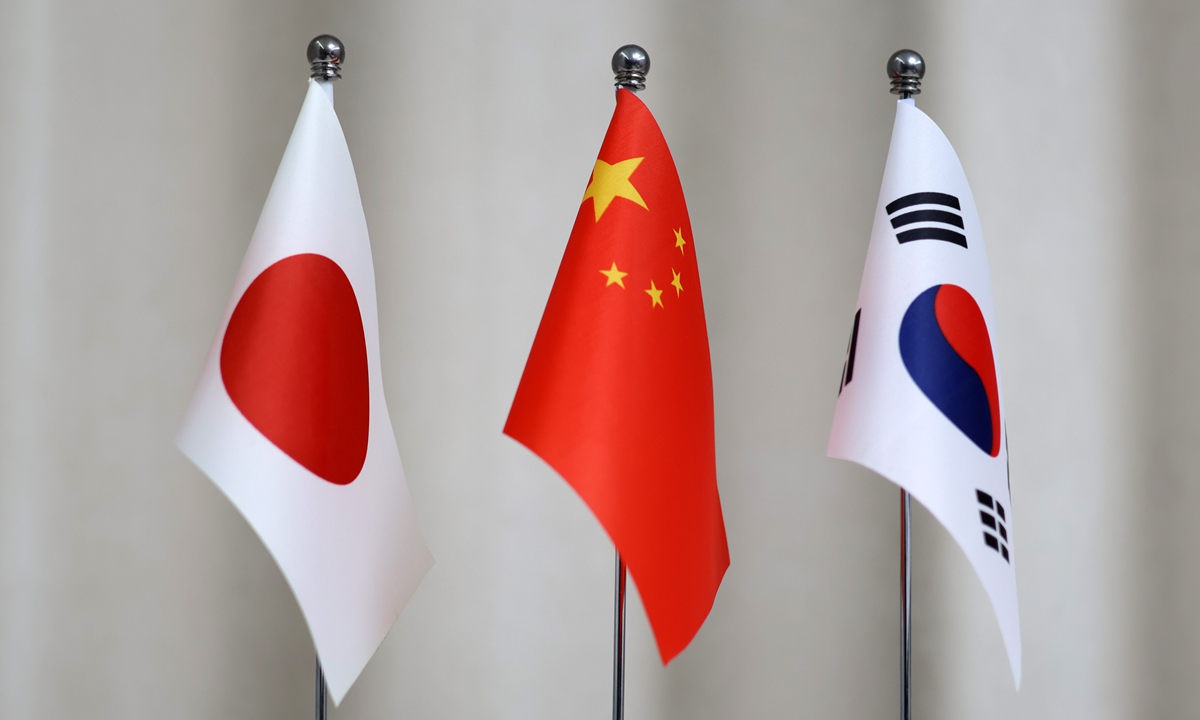
Flags of Japan (left), China (middle) and South Korea. Photo: VCG
South Korean President Lee Jae-myung's administration has decided to uniformly adopt "South Korea-China-Japan" as the official sequence when referring to the three Northeast Asian countries, Yonhap News Agency reported on Sunday.
The previous Yoon Suk-yeol administration had used both "South Korea-Japan-China" and "South Korea-China-Japan" interchangeably, but the decision has now been made to use "South Korea-China-Japan" as the official approach, restoring the sequence conventionally used before the Yoon administration, the media outlet reported.
The move comes as the South Korean government seeks to improve relations with China, leading to interpretations that it is a gesture of goodwill toward Beijing, the report said.
Echoing the analysis, a Chinese expert told the Global Times on Sunday that Lee Jae-myung administration's decision shows that Seoul values its ties with Beijing. This shows a balancing move to rectify the previous administration's lopsided alignment with the US.
A senior official from the South Korean Presidential Office disclosed the decision with the Yonhap News Agency on Sunday, adding that this is to adopt the most widely used sequence to "eliminate unnecessary controversy."
The official further explained that this decision follows criticism that the previous administration's mixed usage of sequences led to unproductive debates, such as implying closer ties with one country over another, the report said.
Citing government officials, Yonhap News Agency noted that "South Korea-China-Japan" had been the conventional sequence for referring to the three Northeast Asian countries prior to the Yoon Suk-yeol administration.
However, after former president Yoon attended the ASEAN Summit in September 2023, South Korean government began using "South Korea-Japan-China" as the sequence, Yonhap reported.
At the time, an official from the former Yoon administration's Presidential Office explained that since the inauguration of the Yoon administration, closer cooperation with the US and Japan has been pursued based on the so-called "shared values," according to Yonhap.
The decision this time has sparked interpretations within and outside the South Korean government as a measure reflecting President Lee Jae-myung's pragmatic diplomacy," reported Yonhap.
Some observers note that the previous administration's Japan-leaning diplomatic approach resulted in the exclusion of China and a loss of practical benefits, suggesting the current administration may be seeking to restore relations with China through pragmatic diplomacy grounded in factual assessments, according to the South Korean media outlet. The outlet noted Lee has recently emphasized the need to restore relations with China.
Quoting another South Korean presidential office official, Yonhap reported that "one of the core principles of diplomacy is balance, but the previous administration pursued ideology-driven diplomacy, exhibiting excessive tilt toward Japan." The official emphasized, "Reverting to the original approach is the correct direction."
Lü Chao, an expert at the Liaoning Academy of Social Sciences, told the Global Times that "Historically, successive South Korean governments have conventionally used the 'South Korea-China-Japan' sequence. However, the former Yoon administration deliberately went against this convention."
Lee administration's move reflects its quest for strategic autonomy against the backdrop of China-US strategic competition as South Korea seeks to strengthen relations with neighboring countries and develop its own economy - all closely tied to its core interests, Lü noted, expressing his expectations toward warming China-South Korea ties.
RELATED ARTICLES