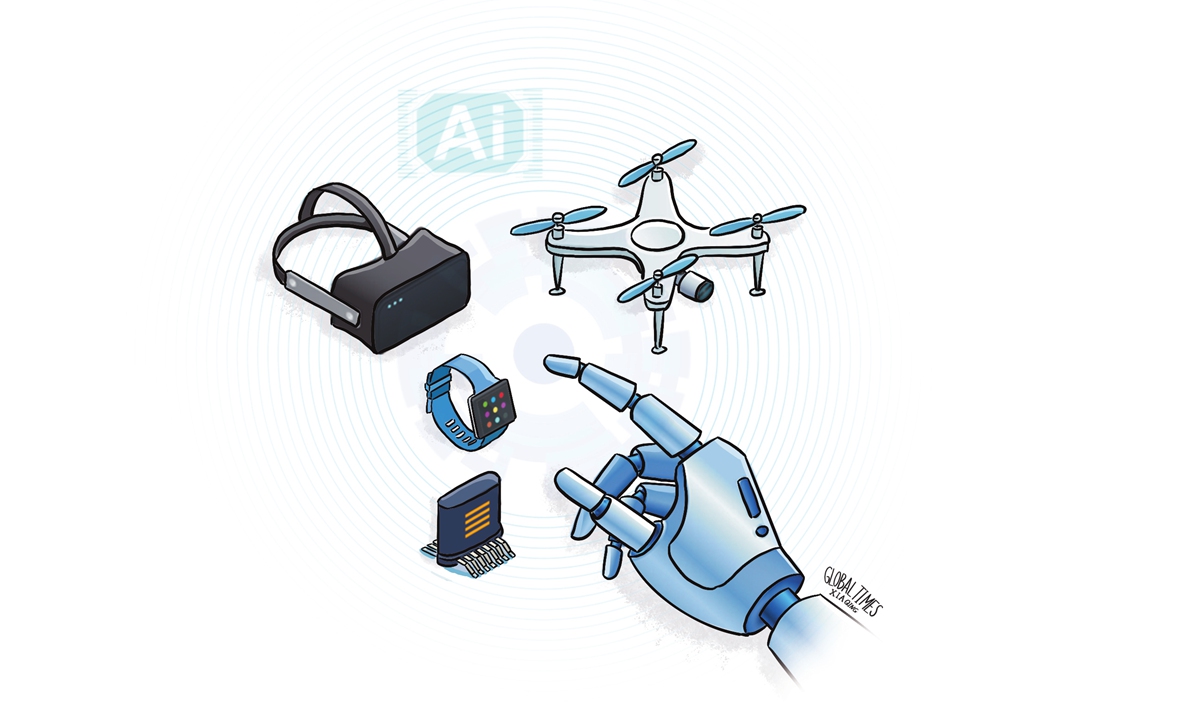
Illustration Xia Qing/GT
The 27th China Hi-Tech Fair (CHTF), one of the country's largest technology exhibitions, was held in Shenzhen, South China's Guangdong Province from November 14 to 16. The event drew broad international participation, reflecting its global character. Even as some Western politicians continue to advocate technological decoupling, the international tech industry is clearly voting with its feet.
This year's fair brought together more than 5,000 companies and international organizations from more than 100 countries and regions, showcasing the latest technological advancements shaping global industries. According to the Xinhua News Agency, "international participation is a key focus." The CHTF featured dedicated zones for friendly cities and Belt and Road partners, presenting innovations from Germany, Canada, Russia, Brazil, Argentina and others, with the goal of promoting cross-border investment and industrial cooperation.
There was a noticeable contrast with Western political rhetoric. While some politicians continue to characterize global technology as a zero-sum arena, advocating strict restrictions and strategic decoupling, the technology sector in practice remains highly interconnected. The scale and continuity of the CHTF highlight an important feature of the global technology landscape: multinational companies generally operate within extensive networks of supply chains and consumer markets, making complete isolation difficult to achieve.
The annual CHTF, inaugurated in 1999, saw its first edition reportedly include five foreign government teams, 86 delegations from 26 countries and regions, and 32 well-known multinational high-tech companies. Since then, the fair's international reach has grown substantially. This expansion reflects the realities of a globally interconnected technology ecosystem, rather than the scenarios imagined in some geopolitical narratives.
Those who emphasize technological decoupling often overlook three fundamental realities. First, China's pursuit of technological development is supported by a rapidly growing innovation ecosystem that continues to attract international partners. This year's CHTF spanned 400,000 square meters and featured 22 exhibition areas, covering major national equipment, artificial intelligence and robotics, semiconductors and integrated circuits, consumer electronics, as well as the low-altitude economy and commercial aerospace. More than 5,000 new products, technologies, and innovations were on display, representing advances at the global frontier. These figures illustrate the accelerating pace of Chinese innovation and show that technological progress is continuing across multiple sectors.
Second, China's technological progress is not happening in a closed system. On the contrary, it enhances resilience through openness and strengthens capabilities through collaboration. This year's fair attracted a substantial number of buyers and investors, highlighting China's role as both a source of innovation and a partner in international technology cooperation. The event demonstrated that China continues to provide opportunities for cross-border engagement and contributes to the broader global technology ecosystem.
Third, corporate decision-making is primarily driven by economic factors such as predictability and market fundamentals. Companies evaluate whether industrial infrastructure is well-developed, supply chains are reliable, and markets are sufficiently large. From its early editions to today's participation by numerous multinational firms, the CHTF reflects these practical considerations. The fair serves as a platform where technology connects with demand, supporting the formation of industrial networks and collaborative projects, demonstrating that decoupling is rarely a feasible option in practice.
The CHTF, considered by some as China's foremost technology exhibition, offers a clear window into the country's high-tech sector. Over the past two decades, the fair has grown steadily in scale and sophistication, reflecting not only China's expanding innovation capacity but also the depth of its manufacturing base, the completeness of its industrial chains, and the sustained pace of technological advancement.
Technological cooperation depends on stability, trust, and a pragmatic approach. In contrast to calls for decoupling by some Western policymakers, the CHTF demonstrates a measured reality: openness and collaboration advance global interests, while attempts to reshape competition through isolation are both impractical and poorly aligned with the trajectory of technological progress.
Global technology competition and strategic tensions are likely to persist. The CHTF, however, highlights a constructive approach: platforms that connect innovators, investors, and enterprises can translate technological breakthroughs into practical applications and foster international collaboration. The fair illustrates that, in practice, technological progress relies on cooperation and market-driven engagement rather than confrontation.
The author is a reporter with the Global Times. bizopinion@globaltimes.com.cn
RELATED ARTICLES