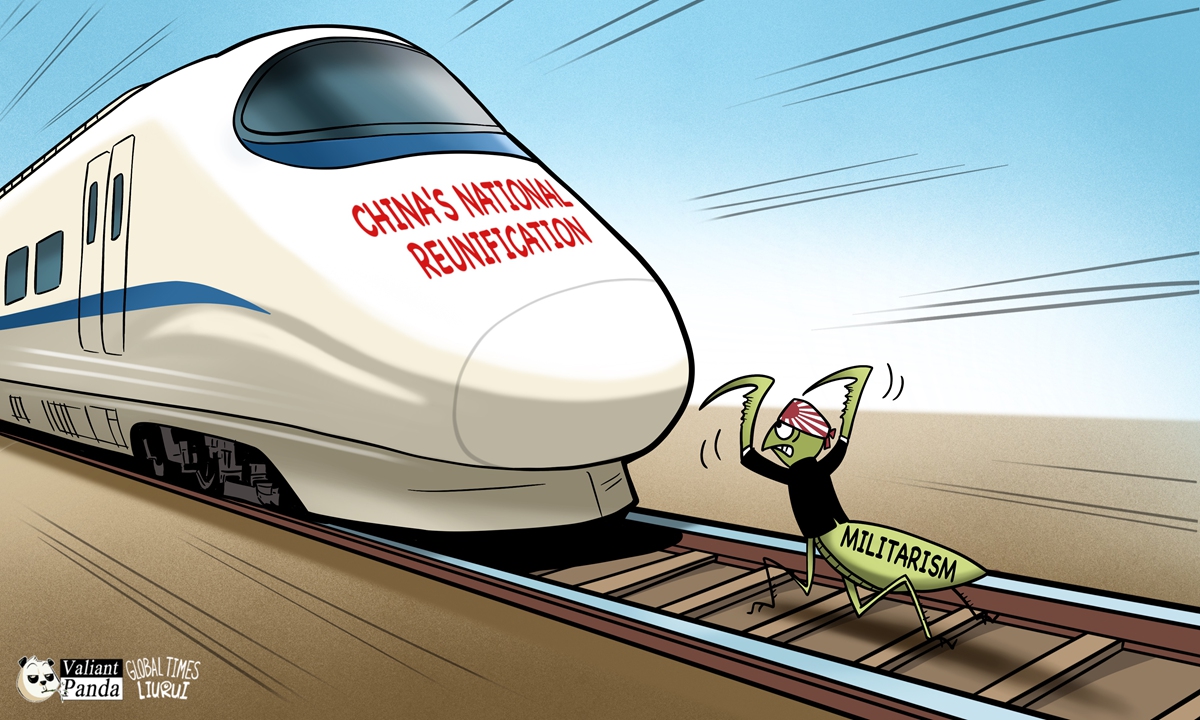
Illustration: Liu Rui/GT
Editor's Note:
Japanese Prime Minister Sanae Takaichi recently made gravely erroneous remarks regarding the Taiwan question, drawing widespread attention and strong criticism from both China and the international community. Takaichi's statements not only disregard the one-China principle but also heighten regional tensions, raising serious concern. In response to her wrongful comments, multiple ministries and government agencies of China issued consecutive warnings. "If Japan dares to attempt an armed intervention in the cross-Straits situation, it would be an act of aggression and definitely meet a firm response from China," a spokesperson for the Chinese Foreign Ministry said.
How should we understand China's response? In the face of provocations from Japan's right-wing forces, how can China effectively counter their arrogance? In this context, the Global Times invited five Chinese scholars to share their views.
Yang Zhen, deputy director of Northeast Asia Research Center of Shanghai University of Political Science and Law
First, Takaichi's remarks, which claimed that the Chinese mainland's "use of force on Taiwan" could constitute a "survival-threatening situation" for Japan and implied the possibility of armed intervention in the Taiwan Straits, have crossed the bottom line of civilization. It is universally recognized that Taiwan is a sacred and inseparable part of China's territory, however, Takaichi's statements treat Taiwan as if it were still a Japanese colony - a ghost-summoning of Japan's history of aggression against China. As is widely known, Japan's invasion was, in essence, a barbaric act against humanity. By making such claims, Takaichi stands on the opposite side of civilization.
Second, Takaichi's remarks have violated the bottom line of international law. The UN Charter explicitly states: "All Members shall refrain in their international relations from the threat or use of force against the territorial integrity or political independence of any state, or in any other manner inconsistent with the Purposes of the United Nations." As the leader of Japan, a defeated aggressor nation in WWII, Takaichi has blatantly threatened the use of force against China, and attempted to undermine China's territorial integrity. This constitutes a clear violation of international law.
Third, Takaichi's remarks have breached the bottom line of morality. On September 29, 1972, China and Japan signed the "Joint Statement of the Government of the People's Republic of China and the Government of Japan." In the Joint Statement, the Japanese government fully understands and respects the stand of the Chinese government on Taiwan and adheres to its stand of complying with Article 8 of the Potsdam Proclamation. Takaichi's remarks now completely betray the Joint Statement, rendering Japan's credibility worthless and crossing a moral red line. As a Chinese ancient saying goes, "a person without credibility has no place in society."
Shen Yi, a professor at the School of International Relations and Public Affairs of Fudan University
First, it must be noted that Takaichi's remarks are by no means a mere diplomatic slip or inappropriate wording. In essence, it is part of the rhetorical preparation for Japan to break free from the constraints of the Japanese constitution and re-embark on the path of military expansion. By directly linking "Taiwan emergency" with a "survival-threatening situation" for Japan, Takaichi is associating China's reunification with Japan's self-defense actions. This is a grave challenge to the post-war international order and the basic norms of international law - one that is intolerable.
Second, from a historical perspective, such rhetoric amounts to a revival of Japanese militarism. This year marks the 80th anniversary of the victory in the Chinese People's War of Resistance Against Japanese Aggression and the World Anti-Fascist War. It is also the 80th anniversary of the restoration of Taiwan. Japan's current attempts to interfere in the Taiwan question will undermine its postwar commitment to peaceful development. This reflects not an understanding of historical lessons, but rather a troubling resurgence of militarist thinking.
Third, from a practical risk perspective, if Japan were to link the Taiwan question to its own national security and use that as a pretext to intervene in affairs in the Taiwan Straits, it would intensify tensions across the Straits. Such actions could extend conflicts into the East China Sea, the South China Sea, and the broader Asia-Pacific security environment. This would cause a rapid deterioration of China-Japan relations, damage economic cooperation, worsen the geopolitical climate and could draw the region into military confrontation. China has both the justification and the capability to safeguard its core interests through diplomatic, economic and military means. The Japanese government must promptly retract Takaichi's erroneous remarks and explicitly reaffirm its commitment to the one-China principle and to the path of peaceful development. It should refrain from including a "Taiwan emergency" within the scope of Japan's self-defense rights.
Zheng Jian, a distinguished professor at Taiwan Research Institute, Xiamen University
Over the years, Japan's right-wing forces have gradually escalated their hostility toward China, testing the patience of the Chinese people. Individuals like Takaichi must understand that the Chinese people will never accept humiliation. The Chinese government and its citizens must clearly assert our position: We will not cease our efforts until Japan issues a formal apology and retracts its erroneous statements.
Multiple Chinese ministries and government agencies have condemned the Japanese side's recent moves and remarks, warning that Japan will face a resolute response if it dares to meddle in the Taiwan question. They further stated that if Japan doesn't immediately correct its wrongdoing and retract unjustified remarks related to China's Taiwan, all the consequences arising from this situation must be borne by the Japanese side.
Japan must understand that, in the face of provocations, the Chinese People's Liberation Army will respond decisively, defending national territorial sovereignty and integrity with unprecedented resolve. China has the resolve to take strong action against any collusion between Japan and the authorities in Taiwan, delivering a response that makes them feel the consequences of their actions.
Takaichi's actions demonstrate that she and Japan's right wing are troublemakers in Asia and the world. Her willingness to utter such outrageous claims also reveals that her assertions have a foundation within Japanese society. After repeated indoctrination by right-wing forces, Japanese society has undergone profound and subtle changes. People across China - including compatriots in the Taiwan region, as well as those in Asia and around the world - must remain highly vigilant, fight resolutely and deal a firm blow against such trends.
All sectors of Chinese society should mobilize their full potential to apply pressure on figures like Takaichi from all directions. The Chinese people must unite their voices to demonstrate China's will, resolve and capability, exposing and condemning Japanese right-wing and militarist elements through action.
We must also rally international support to uncover the roots of Japanese militarism, highlight its heinous deeds and dismantle the societal foundations for militarism. Countless postwar facts prove that until Japanese militarism is completely eradicated, it remains at risk of resurgence every single day. The international community must remain alert.
Xiang Haoyu, a distinguished research fellow in the Department for Asia-Pacific Studies at the China Institute of International Studies
Economic and trade cooperation serves as the ballast of China-Japan relations, however, Takaichi's erroneous remarks regarding the Taiwan region risk profoundly impacting Japan's economy and bilateral trade.
China is Japan's largest source of overseas tourists, and measures such as China's travel warning against Japan may severely affect the tourism sector and domestic consumption, potentially hindering the country's economic recovery. With deeply integrated industrial chains, China, as Japan's largest trading partner, supplies critical minerals and provides access to a vast market essential for Japan's key industries, including automobiles, semiconductors and machinery. Continued provocations from Japan could escalate tensions in China-Japan relations, disrupt bilateral trade and industrial cooperation, and further strain an already fragile Japanese economy.
Takaichi's remarks on Taiwan island have already sparked widespread opposition and concern within Japan, with former Japanese prime ministers Yukio Hatoyama and Shigeru Ishiba criticizing her statements. This situation fully demonstrates that interfering in Taiwan Straits affairs violates international norms and undermines the fundamental interests of the Japanese people. The ultimate purpose of all Chinese countermeasures is not to seek confrontation, but to curb attempt to fuel "Taiwan independence" separatist forces and external interference, safeguard peace across the Taiwan Straits and regional stability, and maintain a stable environment for China-Japan relations.
Tokyo should not harbor any illusions about the Taiwan question and must not underestimate China's resolve and capability to defend its national sovereignty and territorial integrity.
The Japanese leader has only one choice: immediately retract her erroneous remarks, as well as return to the one-China principle and the spirit of the four political documents between China and Japan.
Cai Liang, director of the Center for Northeast Asian Studies of Shanghai Institutes for International Studies.
So far, in response to Japan's provocations against China regarding the Taiwan question, China's response has been reasoned, justified, and proportionate, rather than the "overreactions" portrayed by certain Japanese and Western forces. To counter the arrogance of Japanese right-wing anti-China forces, China must prepare for struggle, and firmly safeguard its sovereign security interests. At the same time, while Japan presents significant challenges in China's surrounding environment, it holds an important position in China's neighborhood diplomacy. With utmost sincerity and goodwill, China has strived to preserve the overall stability of China-Japan relations and regional peace, consistently working to transform the region into a stronghold of peaceful development.
China's strong response seeks to help the Japanese public recognize how Takaichi's words and actions have provoked unnecessary international disputes and increased regional risks. Additionally, it serves as a signal to Japan's ruling elites to reflect on the rising costs of Takaichi's "playing with fire," making it clear that using such rhetoric for political gains is neither cost-effective nor sustainable, thereby urging them to take concrete steps to rectify the mistake and mitigate their negative impacts.
Takaichi's erroneous remarks regarding the Taiwan region also constitute a gross violation of international justice and a blatant challenge to the post-war international order. It's essential for China to frame its response within the context of defending that order, exposing the fallacies and dangers of her rhetoric. As a defeated aggressor nation in World War II, Japan's state behavior is explicitly constrained by the UN Charter and by Article 9 of its constitution, which stipulates that the Japanese people forever renounce war as a sovereign right of the nation and the threat or use of force as means of settling international disputes. These core arrangements of the post-war East Asian order are certainly not something Japan has the right to unilaterally overturn.
If Takaichi continues down her reckless path in provoking China over the Taiwan question and reviving militarism, the result will inevitably be a genuine crisis for Japan - one in which both its people and the nation as a whole could be dragged into disaster again because of her dangerously misguided decisions.