GT on the spot: UN officials praise bird conservation efforts at Poyang Lake in Jiangxi
'An epitome of China's contribution to biodiversity conservation'
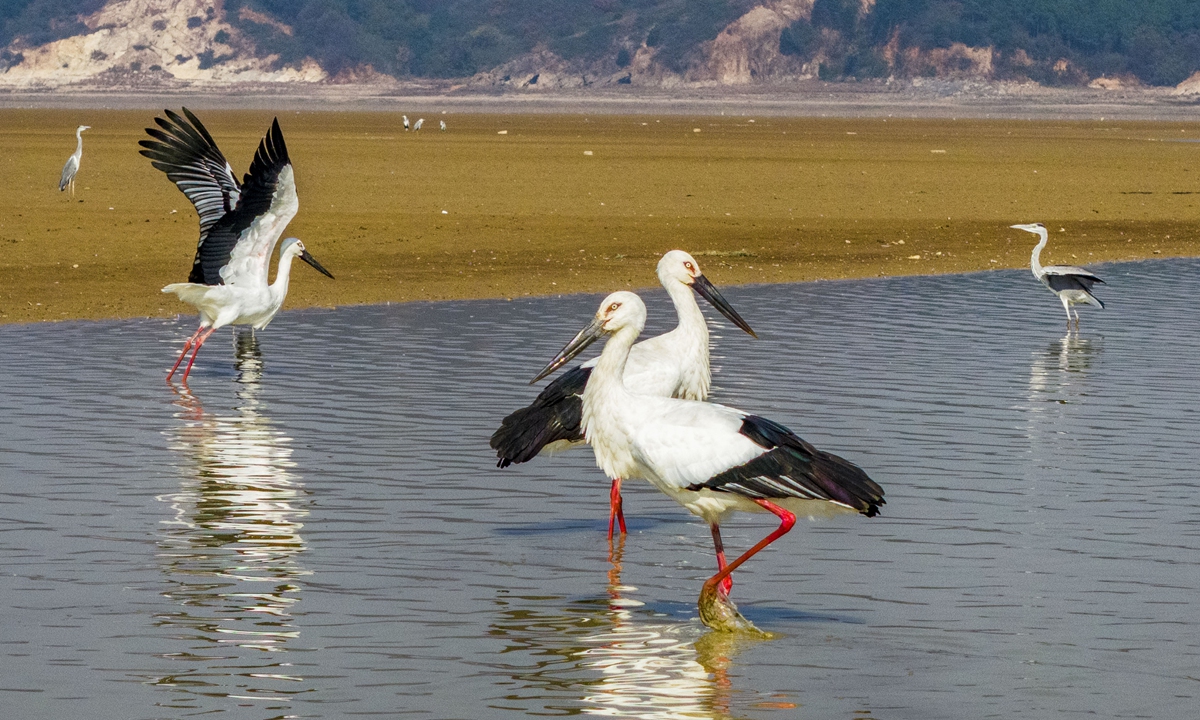
On November 14, 2025, Oriental storks photographed in the Poyang Lake Wetland, Duchang County, Jiangxi Province. Photo: VCG
"A series of actions to protect migratory bird species in Poyang Lake, China's largest freshwater lake, epitomize China's contributions to biodiversity conservation, serving as a testament to China's dedication to providing public good, solutions, and contributions to the global community," Ronnie Brathwaite, a Senior Agricultural Officer from the United Nations Food and Agriculture Organization (FAO), told the Global Times on Monday.
Poyang Lake Wetland Park in Wucheng town, East China's Jiangxi Province, covers three-fifths of the total area of the Poyang Lake natural reserve. Each year, it hosts more than one-third of the migratory bird species, that flock here to breed, stop over, or stay for the winter in the entire Poyang Lake region. Additionally, more than 80 percent of oriental white storks and over 70 percent of the white-naped cranes worldwide overwinter here, according to the Wucheng protection and management station of Poyang Lake national nature reserve.
The Global Times reporter made an onsite visit to the park on Monday, where the reporter learned that concerted efforts have been made by local authorities and residents, all working together to protect these migratory bird species.
The local nature reserve administration, for instance, implemented water management and control measures in ahead of time, diverting water from the Gan River, which winds through the city of Nanchang, capital of Jiangxi Province, to provide ecological flow replenishment to key areas of migratory bird activity.
From 2014 to 2024, a total of nearly 50 million yuan ($7million) has been invested to the implementation of 95 projects. These projects have facilitated the restoration, supplementation, and enhancement of over 4,000 mu (approximately 267 hectares) of wetlands, creating high-quality wintering habitats for overwintering migratory birds, the Global Times learned from the Wucheng protection and management station.
In recent years, affected by extreme weather, rare and endangered species such as Siberian cranes and lesser swans have faced food shortages in winter. To address this, the locals have planted submerged plants like spiny bitter grass in key dish-shaped lakes, creating "cafeterias" for migratory birds.
"Relevant staff have also used technological to cultivate dried grasses as additional feed for the birds. This means that even when artificial planting cannot keep up with demand, we can still ensure the supply of food for migratory birds," Yao Chunsheng, a Portfolio Officer from the Global Environment Facility told the Global Times on Monday.
Yao noted that the wetland park also uses advanced technologies such as 5G and drones to combine manual patrols with tech-assisted monitoring. "By comprehensively strengthening the monitoring of migratory bird activities in key wetlands, the overall capacity for risk early warning and prevention has been enhanced," he said.
Additionally, the Global Times noticed that the park has set up an integrated smart wetland information management platform and a wetland bird protection monitoring system.
Mohamed Manssouri, Director of FAO Investment Centre, said providing essential habitat conditions for birds is an essential requirement for preserving biodiversity. "When natural conditions are limited, local authorities proactively employ technological means to create favorable conditions, these measures underscore their commitment to biodiversity conservation," he told the Global Times
A professional bird hospital has been established by the local health center, the Global Times learned. The medical team is on standby 24 hours to ensure timely and effective treatment.
Since 2022, a total of 105 rescued rare overwintering migratory birds have been returned back into the wild, according to the center.
Brathwaite was visiting the wetland park for the first time, and the Global Times noted that during the visit, he repeatedly used the word "amazing" to describe local measures for the overwintering of migratory birds.
He told the Global Times that the local government has taken comprehensive considerations - from providing a suitable environment to ensuring timely rescues - demonstrating a level of thoughtful care that truly reflect a genuine dedication to cherishing wildlife.
In addition to protecting biodiversity through concrete actions, Wucheng also leverages its distinct birds resources to develop tourism while promoting the importance of biodiversity conservation.
Every autumn and winter, as migratory birds arrive, a series of events such as the Poyang Lake International Bird Watching Season Event, the Wucheng Half Marathon, and the Poyang Lake cycling tour will be successively held.
An official surnamed Xiong said the purpose behind organizing these activities is to allow visitors to enjoy the beauty brought by coexisting with nature, thereby inspiring collective efforts in protecting biological diversity.
Yao also mentioned that by boosting tourism, former fishermen can gain alternative sources of income, achieving dual benefits.
Echoing with Yao, Carlos Aldeco, FAO representative in China, told the Global Times that while protecting biodiversity, China is also actively working to improve local livelihoods, providing new solutions for other countries.
China's efforts extend far beyond protecting migratory birds, fostering harmonious coexistence between humanity and nature through coordinated actions across all stakeholders, Carlos said.
RELATED ARTICLES