Japanese diplomat visits China amid strong responses, intensifying measures from Chinese side
By and Chi Jingyi Published: Nov 17, 2025 11:18 PM

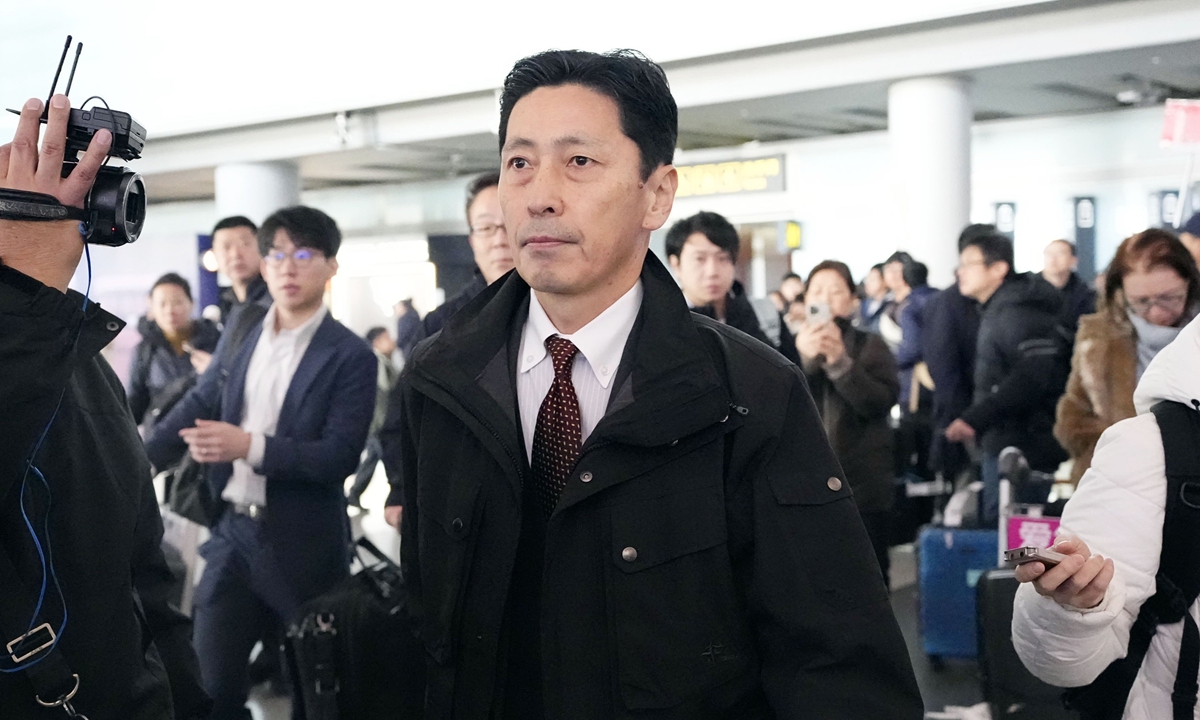
Masaaki Kanai, director-general of the Asian and Oceanian Affairs Bureau at the Japanese Ministry of Foreign Affairs, arrives in Beijing on November 17, 2025 for a possible meeting with Chinese officials. Photo: VCG
Amid strong responses and intensifying countermeasures from the Chinese side against Japanese Prime Minister Sanae Takaichi's erroneous and reckless remarks on the Taiwan question, Masaaki Kanai, director-general of the Asian and Oceanian Affairs Bureau at the Japanese Ministry of Foreign Affairs, arrived in China on Monday for a possible meeting with Chinese officials, media reported on Monday.
In response to media inquiry over Kanai's visit, Chinese Foreign Ministry spokesperson Mao Ning said on Monday that "On the talks you mentioned, we will release timely information when available."
Regarding Takaichi's wrongful remarks on Taiwan, Mao said China has and will continue to lodge strong démarches and protests with Japan, seriously ask Japan to immediately reflect on and correct its wrongdoing, retract the wrongful remarks and stop making provocations on China-related issues.
Takaichi claimed at a Diet meeting on November 7 that the Chinese mainland's "use of force on Taiwan" could constitute a "survival-threatening situation" for Japan. She refused to retract her remarks which imply the possibility of armed intervention in the Taiwan Straits.
Multiple Chinese ministries and government agencies have condemned the Japanese side's related moves and remarks, warning that Japan would face a resolute response if it dared to meddle in the Taiwan question.
Sincerity needed
After landing in Beijing, Kanai was surrounded by journalists waiting at the airport. A video clip from Chinanews.com shows Kanai looking grave and remaining silent in the face of the reporters' questions.
According to NHK, it is expected that the talks will be held with Director-General of the Department of Asian Affairs of the Foreign Ministry Liu Jinsong, and others.
During the talks, Kanai will explain that recent remarks by Takaichi regarding Taiwan do not alter Japan's consistent stance, while also conveying the position that "even if there are differences in positions between the two sides, efforts should be made to avoid impacting personnel exchanges," per NHK.
The Kyodo News reported that Kanai will stress that Takaichi has not altered Japan's stance as stated in a 1972 joint communique, which recognized the People's Republic of China as the sole legitimate government of China, citing government sources close to the matter.
Japan's proactive decision to send diplomats to China demonstrates that, to some degree, Tokyo has recognized the seriousness of the situation and is attempting to cool things down while signaling an intent to manage risks, said Xiang Haoyu, a distinguished research fellow at the Department for Asia-Pacific Studies of the China Institute of International Studies.
Lü Chao, head of the Institute of American and East Asian Studies at Liaoning University, observed that compared to the intense coverage by Japanese media, Chinese media has remained relatively subdued, with virtually no advance reporting.
This suggests that Japan is eager to hold face-to-face talks with China, while Beijing fully understands that, unless Takaichi formally apologizes for and retracts her remarks that crossed China's red lines, any visit by Japanese officials to China is unlikely to yield substantive results, he added.
"As a heavyweight 'China hand' and someone deeply familiar with China-related affairs, Kanai should be perfectly aware of where the real stakes lie," said Lü.
The Chinese side is expected to make it abundantly clear to Japan that there is absolutely no room for negotiation on the Taiwan question, which means Japan will be demanded to act prudently, and Takaichi in particular needs to take concrete steps to correct her mistakes, Xiang said.
Tamura Norihisa, the acting chairman of the Liberal Democratic Party's (LDP) Policy Research Council, said on a Fuji TV program that "the Prime Minister herself is reflecting on the parts where the background was not fully explained. There probably won't be such statements going forward," the Sankei Shimbun reported on Sunday.
Her reckless remarks have directly challenged China's red lines and risk dragging China-Japan relations to their lowest point since the normalization of diplomatic ties. Moreover, her words effectively amount to revive the ghost of Japanese militarism and broke the boundaries observed by every previous Japanese prime minister, Lü said.
"If such provocations are not firmly countered, it would only embolden the anti-China tide from Japan's right wing," the expert stressed.
Rectifying cognitive distortion
When asked whether Chinese Premier Li Qiang would meet with the Japanese Prime Minister during the G20 meeting, spokesperson Mao Ning said on Monday's press briefing that "A meeting with the Japanese leader is not on Premier Li Qiang's agenda."
Meanwhile, repercussions from Takaichi's wrongful remarks continue as Tokyo has taken no substantive action to correct the mistake.
CZ news, which is affiliated to the Zhejiang Media Group, on Monday reported that the screening of two Japanese films in the Chinese mainland in cinemas has been postponed.
Several Chinese travel agencies have warned that trips to Japan may be affected and some tour products could be suspended, as the Global Times confirmed on Monday, with repercussion caused by Japanese Prime Minister Sanae Takaichi's wrongful Taiwan remarks continuing to unfold, prompting traveller concerns and driving firms to reassess their Japan-bound offerings.
So far, the Ministry of Foreign Affairs and Chinese Embassy and consulates in Japan, China's Ministry of Culture and Tourism and Ministry of Education have issued alerts advising Chinese nationals to avoid traveling or studying in Japan.
On Monday, some of Japan's biggest tourism and retail-related stocks plunged, the first trading day after China's travel and study warning released on Friday and Sunday.
Shares in Japanese department stores were hit hard, with the parent company of the Mitsukoshi and Isetan chains plunging by almost 12 percent. Other well-known brands like cosmetics company Shiseido also fell sharply, BBC reported.
Shares in department store chain Takashimaya, and the owner of global fashion chain Uniqlo closed more than 5 percent lower.
Carriers Japan Airlines and ANA Holdings were also down. Shares in Oriental Land, the theme park company that runs the Tokyo Disney resort, ended the day 5.8 percent lower.
In the third quarter of 2025, tourists from the Chinese mainland were the top spenders among all foreign visitors to Japan, totaling 590 billion yen ($3.8 billion), an increase of 18 percent year-on-year, accounting for around 27 percent in total inbound consumption, also the largest contributor, according to statistics from the Japan Tourism Agency.
"Under the efforts of the former Ishiba Shigeru cabinet, China-Japan relations had been steadily improving through contacts and cooperation in political, economic, cultural, and many other fields. However, this positive momentum has now been severely damaged by Takaichi's extreme right-wing remarks." Lü said. "It is Takaichi, not China, who should bear responsibility for this."
It is not only the tourism sector that will suffer as Takaichi's erroneous words could similarly harm other industries, said the expert.
Xiang Haoyu said China will likely calibrate the intensity of its countermeasures based on Japan's subsequent behaviors.
The Japanese side cannot take for granted that it can wantonly discuss - let alone attempt to militarily intervene in - China's core interests, particularly the Taiwan question, without facing serious consequences. China's countermeasures and diplomatic pushback are also designed to rectify the cognitive distortions prevalent among certain Japanese politicians and compel them to once again carefully recalculate the costs and benefits of such actions, experts said.
RELATED ARTICLES