China launches full construction of its first Hualong One nuclear unit equipped with a cooling tower
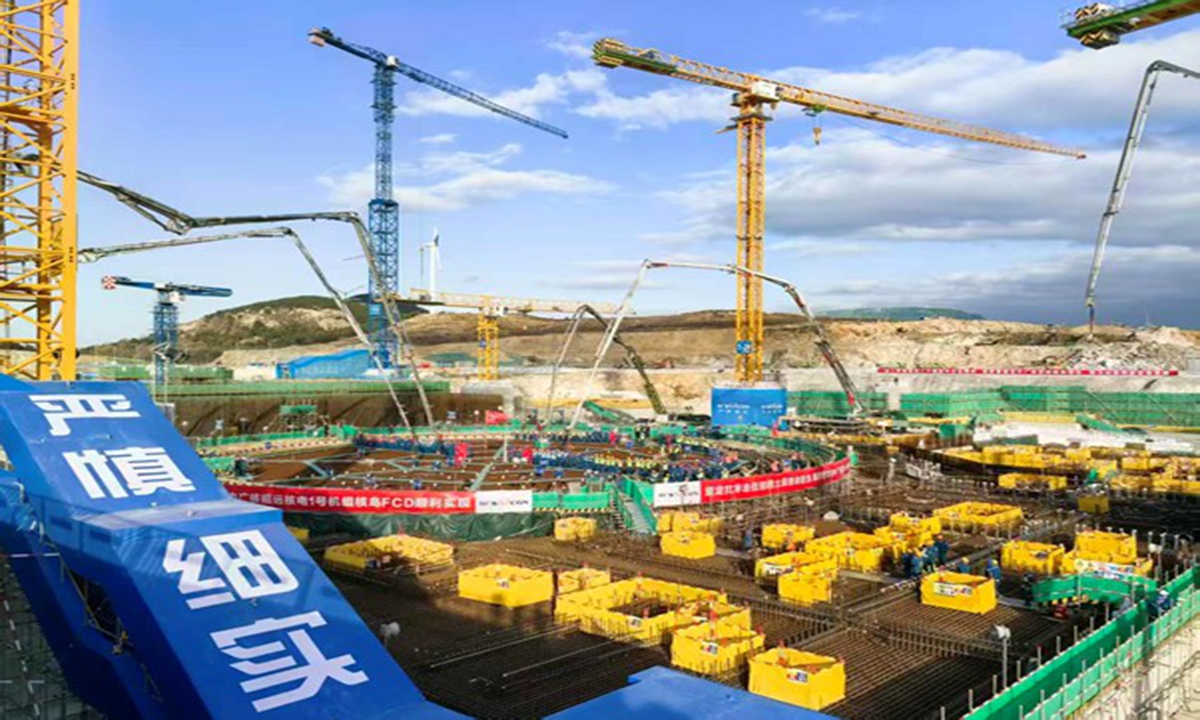
Construction work is underway at Unit 1 of Zhaoyuan Nuclear Power Project in East China's Shandong Province on November 18, 2025. Photo: courtesy of China General Nuclear Power Group
China General Nuclear Power Group (CGN) on Tuesday began full-scale construction of its first Hualong One nuclear power unit to be equipped with a cooling tower, as the first concrete was poured for the reactor building of the Zhaoyuan Nuclear Power Plant Unit 1 in East China's Shandong Province, according to a statement CGN sent to the Global Times.
At a press briefing, Yu Xiangdong, Party secretary and executive director of Shandong Zhaoyuan Nuclear Power Co, told reporters that the project's most distinctive feature is its 203-meter natural draft cooling tower with a spray area of 16,800 square meters. "This is the first time secondary-circuit cooling technology has been applied to a Hualong One unit," he said.
Yu explained that the tower shifts the conventional island cooling source from the ocean to the atmosphere, using an atmospheric heat-sink effect to carry away residual heat from the thermal cycle, while seawater serves only as a supplementary source. The design enables water to be reused, significantly reduces pumping height and energy consumption, and minimizes drift, he said.
"By adopting this technology, the Zhaoyuan project expands the siting possibilities for nuclear facilities and provides new reference experience for China's future nuclear development," he said.
"Thanks to the water reserve of the high-level natural draft cooling tower, the unit can continue operating for at least two hours even under scenarios where external water supply is lost, providing a crucial buffer for a safe shutdown in extreme scenarios," said Yang Yazhang, a member of the Party committee and deputy general manager of CGN Power Engineering Co. He added that the project is also the first Hualong One unit to be equipped with a nuclear-grade mechanical draft cooling tower, whose large on-site water tank can sustain reactor cooling for at least 30 days without replenishment.
"These two systems together form a 'natural + mechanical' secondary-circuit cooling configuration, creating a comprehensive, dual-layer cooling-source protection system that covers both the conventional and nuclear islands," Yang said.
Hualong One, China's domestically developed third-generation nuclear technology, is the world's most widely deployed reactor type in operation and under construction. The unit where construction was launched on Tuesday is Unit 1 of Phase I of the Zhaoyuan project, which according to plans will build six Hualong One reactors with a total installed capacity of about 7.2 million kilowatts, according to the statement.
Once all units are completed, the project is expected to generate 50 billion kilowatt-hours of electricity annually, enough to meet the yearly production and household needs of about 5 million people. It will be equivalent to cutting standard coal consumption by roughly 15.27 million tons and reducing carbon dioxide emissions by about 46.2 million tons each year, an environmental benefit comparable to planting more than 110,000 hectares of forest, the statement said.
"Cooling towers are standard for coal-fired units and are essential for inland nuclear plants," Lin Boqiang, director of the China Center for Energy Economics Research at Xiamen University, told the Global Times on Tuesday. He explained that coastal nuclear plants typically rely on direct seawater cooling, which is more economical, and only under special circumstances — such as environmental requirements or limited seawater resources — would a coastal facility need a cooling tower.
"For inland projects, cooling towers serve as the primary means of heat removal, and similar systems are widely used internationally," Lin said. He added that China's nuclear power sector has played a major role in the country's low-carbon energy transition. "By integrating China's strong manufacturing base with Hualong One technology, the industry is well-positioned to support a more sustainable energy transformation."
RELATED ARTICLES