China’s jobless rate among workers aged 16-24 goes down to 17.3% in October: official data
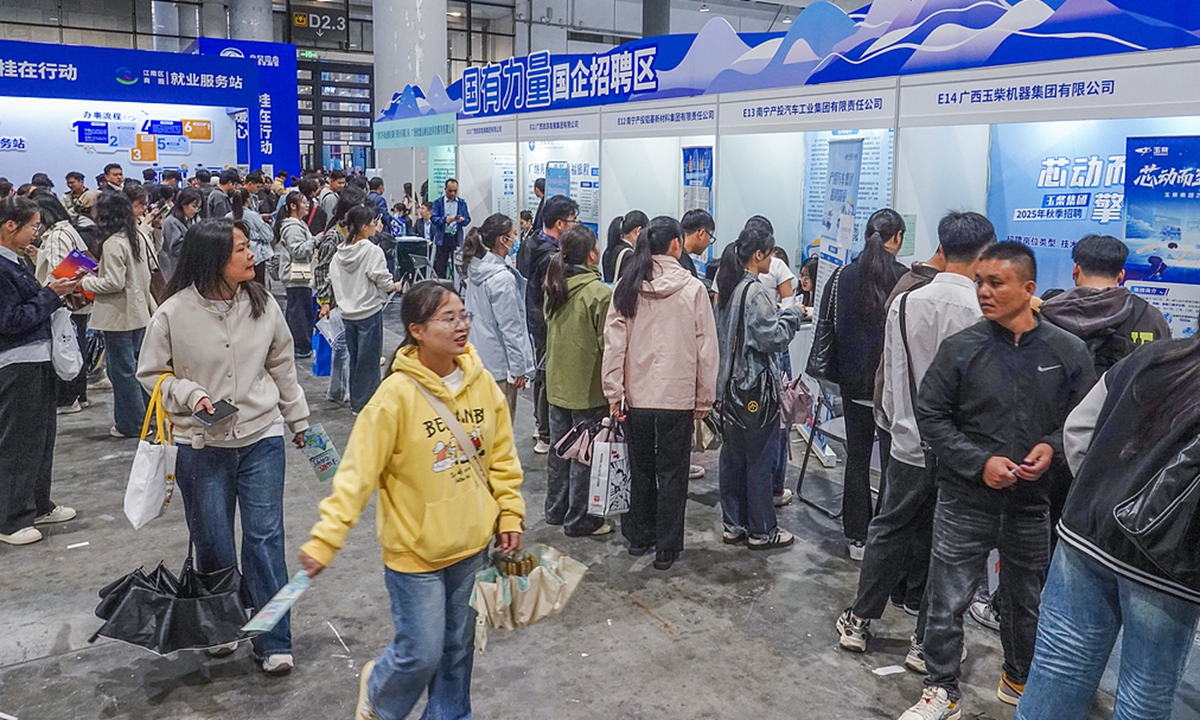
Job seekers look for positions at a recruitment fair at the Nanning International Convention and Exhibition Center in Nanning, South China's Guangxi Zhuang Autonomous Region on November 18, 2025. More than 400 state-owned and leading enterprises joined the event, offering over 20,000 positions and drawing more than 30,000 applicants. Photo: VCG
China's unemployment rate among key job-seeking groups improved in October compared with one month earlier, and the authorities are accelerating the rollout of a set of pro-employment measures to ease labor market pressure.
The National Bureau of Statistics (NBS) said that the jobless rate for urban workers aged 16-24, excluding students, stood at 17.3 percent in October. The figure compared with 17.7 percent in September, marking a modest decline of 0.3 percentage points.
In addition, the jobless rate for urban workers aged 25-29, excluding students, was 7.2 percent in October, while the rate for the 30-59 age group was 3.8 percent, according to the NBS.
This year, China has rolled out a series of policy documents aimed at stabilizing urban employment, forming a comprehensive package that covers fiscal, tax, financial and industrial tools, providing a solid policy cushion for the labor market. Notably, unemployment among workers aged 16-24 —typically higher between July and September due to seasonal reasons—has eased from August's 18.9 percent.
In the first nine months, the temporary reduction of unemployment insurance contributions lowered labor costs for firms by 138.4 billion yuan, while 19.6 billion yuan in job-stabilization subsidies and 16.6 billion yuan in labor training spending were disbursed, an official from the Ministry of Human Resources and Social Security (MOHRSS) said earlier.
The ministry implemented the 2025 "rural service support" program for college graduates, recruiting 42,500 participants nationwide.
Recently, many provincial governments have stepped up efforts to introduce support measures to ease employment pressure. On October 31, Southwest China's Sichuan Province issued a guideline calling for deeper reforms to promote high-quality employment.
The document urged the creation of jobs through multiple channels, underscoring the need to strengthen the role of market-based employment mechanisms, expand job opportunities in tandem with high-quality economic development, and foster an employment-friendly growth model.
From January to September, China created 10.57 million new urban jobs, completing 88 percent of the yearly target. The surveyed urban unemployment rate went down to 5.2 percent in September, a drop of 0.1 percentage point from the previous month, according to the ministry.
China on November 10 announced more measures to further boost private investment and support their business development. The measures focus on widening market access, removing institutional bottlenecks and strengthening financial support to create a more enabling environment for private investors.
Bian Yongzu, executive deputy editor-in-chief of Modernization of Management magazine told the Global Times on Tuesday that the core driver of China's employment remains the private sector, particularly small and medium-sized enterprises, which should serve as the main stabilizing force in the job market.
He noted that against this backdrop, improving employment—especially sustaining higher employment levels—requires expanding the development space for SMEs and enhancing their competitiveness so they can absorb more labor.
Bian said the government should roll out more policies that support SMEs and entrepreneurship, such as tax and fee reductions in order to reduce operational burdens and lower barriers for new businesses. At the same time, improving SMEs' access to financing would help accelerate their growth.
As China's economy reaches a more advanced stage now, Bian said the services sector will shoulder a greater share of future job creation. Areas such as culture, healthcare and education hold significant potential. He added that the government could reduce unnecessary entry restrictions and ease hurdles for start-ups, allowing more SMEs and young entrepreneurs to enter these industries and help create more job opportunities.
RELATED ARTICLES