Takaichi will only become a laughingstock in history if she continues to indulge her far-right genes
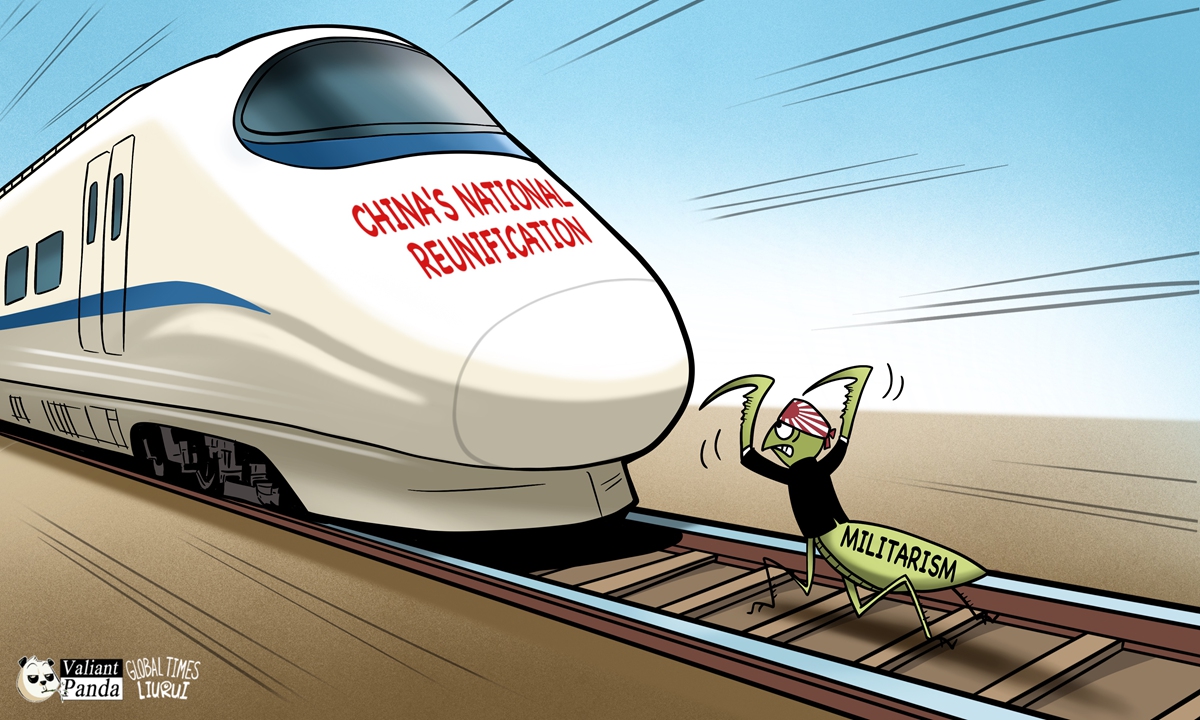
Illustration: Liu Rui/GT
The fallout continues over the erroneous remarks on Taiwan by Japanese Prime Minister Sanae Takaichi. Takaichi is a staunchly right-leaning figure, which determines that her actual policies after assuming office inevitably bear the same obvious imprint, more radical than the "Abe legacy" she inherited in terms of political and diplomatic dimensions.
Lian Degui, director of the Center for Japanese Studies at Shanghai International Studies University, said that it is really worrying that Takaichi mentioned the "survival-threatening situation" as Japanese prime minister. In July 2015, despite strong domestic protests, Japan's parliament forcibly passed a new security legislation submitted by the government of former prime minister Shinzo Abe, which aimed to lift the ban on exercising collective self-defense, and cooked up the "survival-threatening situation." But even at that time, Abe did not use the "Taiwan contingency" as an example of a "survival-threatening situation," nor did any of the subsequent Japanese governments.
Takaichi is the first Japanese prime minister to make such remarks. As China has solemnly pointed out, the Japanese militarism historically repeatedly used the alleged "survival-threatening" as a pretext to launch external aggression, including brazenly creating the September 18th Incident and provoking the war of aggression against China on the grounds of exercising "the right to self-defense," which brought grave disasters to the people of Asia and the world, including China.
Takaichi claims to be the successor to Abe. During his tenure, Abe made many moves in amending the Constitution and lifting the ban on collective self-defense, which aroused criticism and vigilance from neighboring countries and even the international community. But at least he made some political balance in diplomacy. For example, faced with increasing pressure to improve relations with neighboring countries, especially China, the Abe government reached a four-point principled agreement with China in 2014.
Lian pointed out that if Takaichi aims to achieve stable governance, she must discard the dross of the "Abe legacy." How to restrain her far-right ideology and beliefs is an issue Takaichi must seriously reflect upon and address. Should she continue to let her far-right genes stir up trouble, or even engage in overambitious and unwise actions under the illusion that interfering in Taiwan affairs could hinder China's reunification, she will only become a laughingstock in history.
RELATED ARTICLES

