Foreign firms bullish on consumer boom
Huge market, complete industrial and supply chains provide confidence
By Published: Nov 18, 2025 10:58 PM

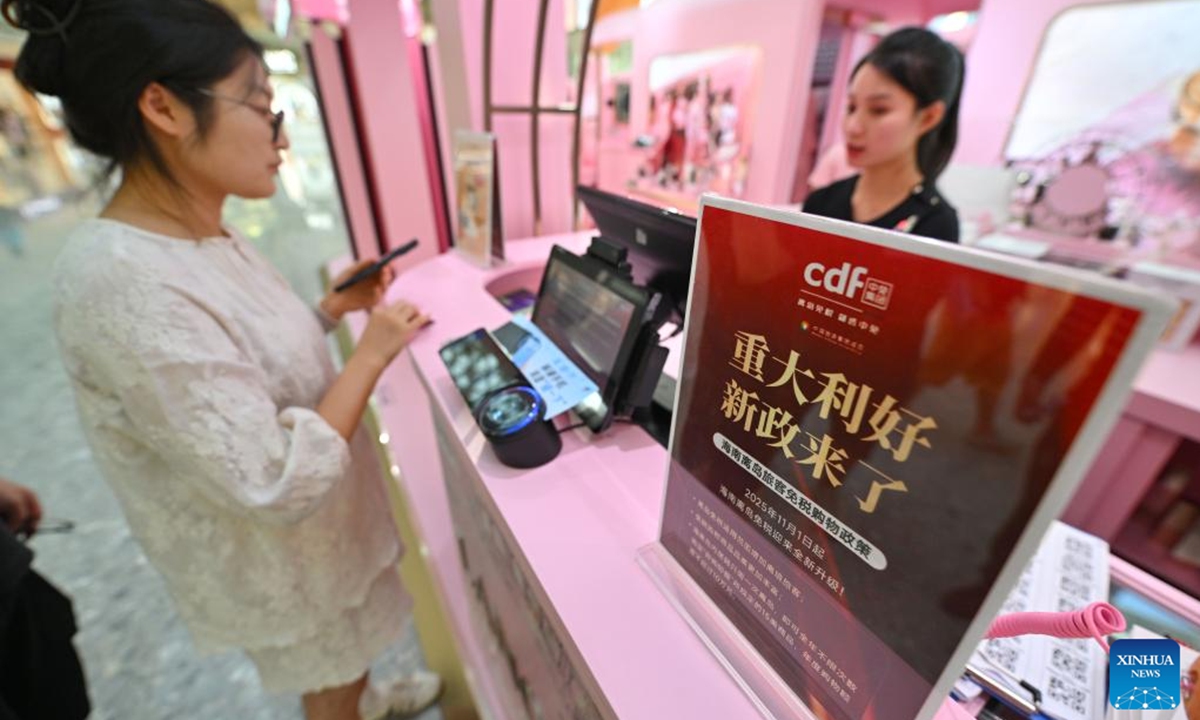
A customer shops at a duty-free shopping mall in Sanya, south China's Hainan Province, Nov. 9, 2025. (Xinhua/Guo Cheng)
South Korean food company Pulmuone announced on Tuesday that driven by strong sales of frozen foods and noodle products, the total September sales of its Chinese subsidiary increased by 31.7 percent year-on-year to 84.3 billion Korean won ($6.29 million), with operating profit rising by 66.7 percent, the Yonhap News Agency reported.
Previously, pasta and tofu were the main products of Pulmuone's Chinese subsidiary, but in the third quarter, frozen foods and noodle products accounted for 34 percent of total sales, the report said.
It is the latest example of how overseas giants are putting heavy weight on the Chinese consumption market, showing continuous confidence in the second-largest economy.
On Monday, L'Oréal announced an agreement to make a minority investment in Chinese clean beauty brand LAN. The investment was made through Shanghai Meicifang Investment Co, with support from BOLD (Business Opportunities for L'Oréal Development), L'Oréal Groupe's strategic corporate venture capital fund.
"We have always firmly believed that investing in China is investing in the future. With a long-term commitment, we will continue to invest in the Chinese market, partnering with more local brands to collectively shape the future of beauty and meeting the expectations of savvy Chinese consumers," according to Vincent Boinay, president of the North Asia Zone and chief executive officer of L'Oréal China.
Yum China Holdings, the parent company of KFC and Pizza Hut in China, said on Monday that it will continue a strong campaign to open stores and improve profitability in the coming years, with smaller cities a major target for its businesses, according to Reuters.
The group said that it would add more than 600 net new Pizza Hut stores annually over the next three years and expected to double operating profit in China for the brand by 2029 compared with 2024.
Despite a competitive market in China, Yum China sees huge potential and the company is targeting its reach from one-third of the population to one-half in the medium term, CEO Joey Wat said at a media event in Shenzhen, South China's Guangdong Province.
The vitality of China's consumer market and its continuously expanding scale are attracting foreign enterprises to deepen their strategic presence, Bian Yongzu, a senior researcher at the China Institutes of Contemporary International Relations, told the Global Times on Tuesday.
In his view, China's super-large market, a complete and efficient industrial and supply chain system, and a continuously improving innovation environment provide multinational companies with favorable conditions and fertile ground for investing in China, laying a solid foundation for stabilizing foreign investment.
China's retail sales rose 4.3 percent year-on-year in the first 10 months of 2025, data from the National Bureau of Statistics (NBS) showed in November.
As China is at a critical stage of upgrading its consumption structure, there is broad potential for growth in sectors such as cultural tourism and healthcare, while the rapid rise of the silver and debut economies is injecting new momentum into consumption expansion, according to NBS spokesperson Fu Linghui.
KPMG, in a report on the top 10 macroeconomic trends for 2025, emphasized that China's pivotal role in global supply chains and the potential of its consumer market are the core drivers behind the continuous increase in foreign investment.
According to data from the Ministry of Commerce, 30,014 new foreign-invested enterprises were established in China in the first half of this year, a year-on-year increase of 11.7 percent.
As of the end of June, the total number of newly established foreign-funded enterprises in China had reached 229,000, an increase of 25,000 compared with the total for the entire 14th Five-Year Plan period (2021-25).
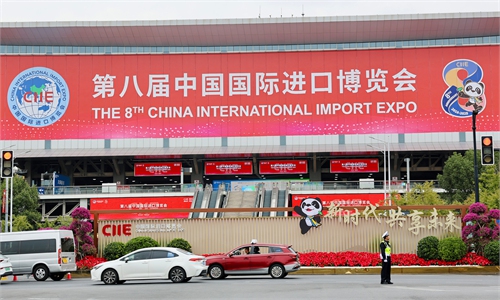
In the just-closed 8th China International Import Expo in Shanghai, the intended transactions stood at $83.49 billion on a one-year basis, up 4.4 percent from the previous edition and hitting a new record high, the Xinhua News Agency reported.
The fair also set records with the exhibition area and the number of enterprises. Among them, 290 involved the world's top 500 companies and industry leaders, and 180 have attended all eight editions of the expo.
RELATED ARTICLES