Illustration: Xia Qing/GT
Recently, Japanese Prime Minister Sanae Takaichi claimed in the Diet that a Taiwan emergency involving the use of military vessels and military force from the Chinese mainland could constitute a "survival-threatening situation" for Japan. According to legislation, Japan's Self-Defense Forces could exercise the right of collective self-defense if such a situation is recognized as "survival-threatening." These unprecedentedly arrogant remarks in Japan's postwar history represent an absurd fallacy that must not be tolerated.
Why are Takaichi's remarks wrong? Let us examine the relevant legal framework more closely.
First, the Taiwan question is purely China's internal affair, as acknowledged in the 1972 Sino-Japanese Joint Statement. Article 2 of the Joint Statement states that "the Government of Japan recognizes that Government of the People's Republic of China as the sole legal Government of China." Article 3 clearly states that "Taiwan is an inalienable part of the territory of the People's Republic of China. The Government of Japan fully understands and respects this stand of the Government of the People's Republic of China, and it firmly maintains its stand under Article 8 of the Potsdam Proclamation."
From this historical context, since 53 years ago, the Japanese government, by pledging to uphold Article 8 of the Potsdam Declaration, has recognized that the Taiwan region is a territory rightfully belonging to China. Takaichi's reckless remarks trample on the historical facts, and show a disregard for the basic principles of international law.
Takaichi's arrogant remarks are tantamount to declaring that Japan is considering launching another war of aggression against China in the form of a preemptive strike. Many voices within Japan have sharply criticized Takaichi's claims, with some Japanese media outlets even suggesting that her very presence as prime minister poses a crisis for Japan's survival. It has also been stated that Takaichi's policy intentions are becoming increasingly clear: She disregards the welfare of the Japanese people, follows the US step by step and seeks to fully strengthen military expansion.
If Japan were to launch a preemptive strike against China without having been attacked, China would naturally not remain passive. Once war breaks out, the consequences would be unimaginable. The conflict would inevitably bring hellish results.
Anyone who makes such reckless statements that could easily drag Japan into war isn't qualified to serve as prime minister.
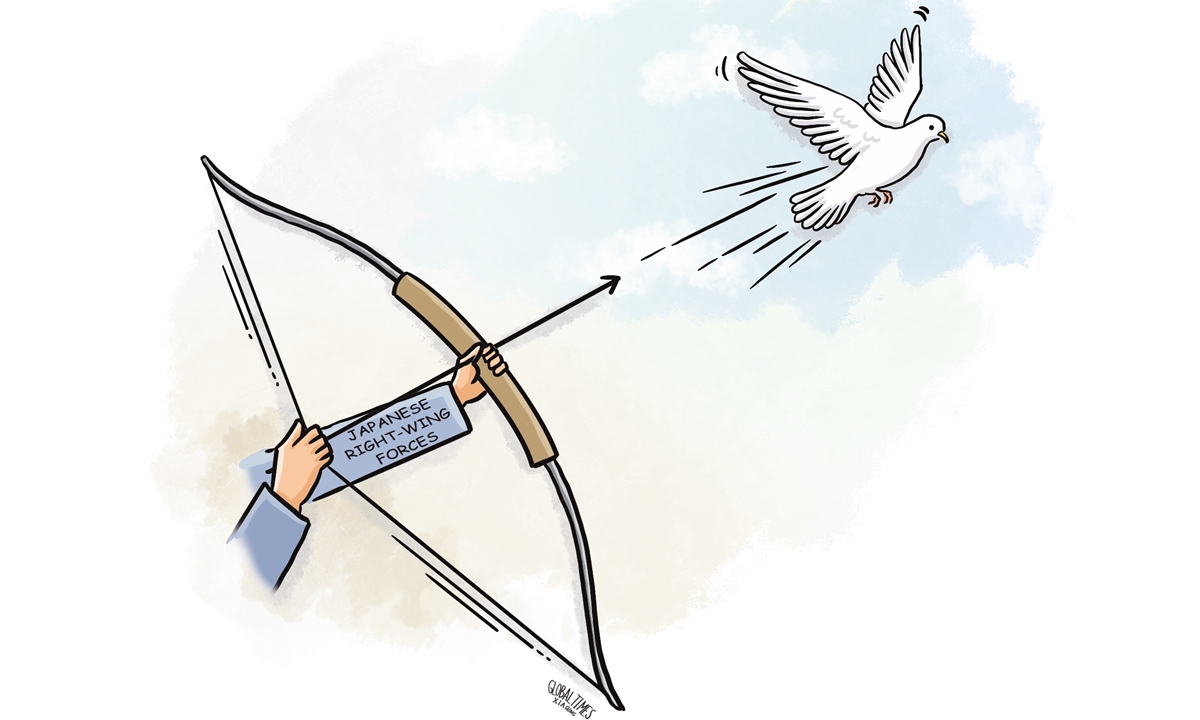
Takaichi has consistently advocated for revising Article 9 of the constitution, with her policy orientation clearly deviating from the basic direction of postwar Japan's peaceful development. Although Japan's constitution has not yet been revised into the version Takaichi desires, in practice, she is systematically undermining the constitution and attempting to weaken the constraints imposed by the pacifist constitution. This risks pushing Japan backward toward a pre-war state.
From this perspective, Takaichi's actions already constitute a violation of domestic Japanese law. Criticism from opposition parties against her is mounting, and the pressure she faces will only grow over time.
For a long time, Japanese historical revisionism has been on the rise, with attempts to glorify the history of aggression and downplay Japan's wartime responsibilities. Against this backdrop, Takaichi's erroneous remarks have raised concerns within the international community - Japan may bring even greater dangers to the world. Takaichi's presence as Japanese prime minister is extremely dangerous; she is likely to steer Japan toward a more perilous direction.
Japan, due to policy mistakes in the past, took the path of war, and through aggression and colonial rule, caused tremendous harm and suffering to the people of Asian countries. Since the end of WWII, Japan has embarked on a new path as a peaceful nation. This peaceful process must never be interrupted. Regardless of which political faction comes to power, Japan must never again be dragged into war. This is the most important mission and responsibility of the Japanese people who pursue peace.
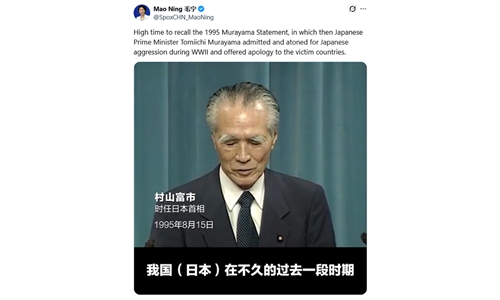
This article was compiled by Global Times reporters Xing Xiaojing and Wang Wenwen, based on an interview with Takakage Fujita, the Secretary-General of the Association for Inheriting and Propagating the Murayama Statement. opinion@globaltimes.com.cn
RELATED ARTICLES