More economic sectors of Japan feel pinch over Takaichi’s wrongdoings; Chinese FM warns further measures if Japan coninues wrong course
By and Feng Fan Published: Nov 19, 2025 11:47 PM

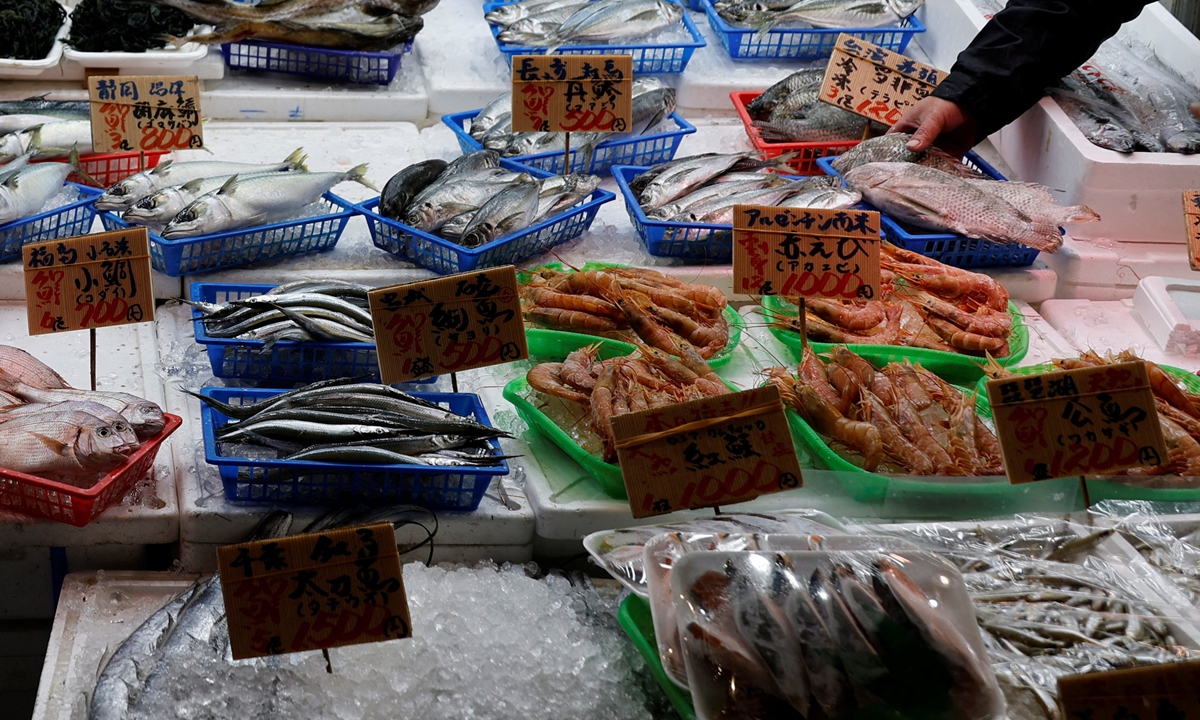
A vendor arranges seafood in his store on November 19, 2025, in Tokyo, Japan. Photo: IC
The tension between China and Japan caused by Japanese Prime Minister Sanae Takaichi's egregious remarks on Taiwan question continues to simmer. A Chinese foreign ministry spokesperson said on Wednesday that if Japan refuses to retract them or even continue to pursue the wrong course, China will have to take strong and resolute countermeasures and all consequences arising therefrom will be borne by Japan.
Responding to another question that what further countermeasures China will take, Chinese Foreign Ministry Spokesperson Mao Ning said that Japan needs to, first and foremost, retract the erroneous remarks and take practical steps to redress the wrongdoing. Otherwise, China will have to take further measures.
In addition to impact on tourism-related industries, more Japanese economic sectors are starting to feel the pressure caused by Japanese Prime Minister's wrong words and actions.
China has informed Japan of suspension of seafood imports, reported Kyodo News on Wednesday, citing source. In response to a related question, Mao Ning said on Wednesday that Japan made a commitment to fulfill the regulatory responsibility of guaranteeing the quality and safety of its aquatic products exported to China. This is the prerequisite for China's import of Japanese aquatic products. However, Japan has so far been unable to provide the technical materials under its commitment.
"Let me reiterate that because of Japanese Prime Minister Sanae Takaichi's egregious moves and erroneous remarks concerning Taiwan and other major issues of principle, there has been strong outrage and condemnation from the Chinese people. Under current circumstances, there will be no market for Japanese aquatic products even if they enter China," Mao said.
On the same day, Japan's Kyodo News learned from multiple government sources that intergovernmental talks on resuming exports of Japanese beef to China had been canceled at the request of the Chinese side.
Chinese expert warned that if Takaichi continues to pursue an extreme political agenda at the expense of Japan's economy, the damage to Japanese society will be enormous.
Takaichi claimed at a Diet meeting on November 7 that the Chinese mainland's "use of force on Taiwan" could constitute a "survival-threatening situation" for Japan. She refused to retract her remarks which implies the possibility of armed intervention in the Taiwan Straits, according to Japanese media the Asahi Shimbun.
Multiple Chinese ministries and government agencies have condemned the Japanese side's related moves and remarks, warning that Japan would face a resolute response if it dares to meddle in the Taiwan question.
More criticisms
Speaking at the UN General Assembly's plenary meeting on Security Council reform on Tuesday, China's permanent representative to the United Nations Fu Cong said Japan is "totally unqualified" to seek a permanent seat on the UN Security Council.
Fu said that Takaichi recently made a "brazen, provocative" statement on Taiwan at the Japanese Diet. Takaichi's remarks are "extremely erroneous and dangerous" and constitute a gross interference in China's internal affairs and a serious breach of the one-China principle and the spirit of the four political documents between China and Japan, Fu said.
Russian Foreign Ministry spokesperson Maria Zakharova said in an exclusive interview with the Xinhua News Agency on Tuesday that Takaichi's recent remarks regarding Taiwan are extremely dangerous, and Japan should deeply reflect on history and learn from the lessons of World War II.
Zakharova said that the war of aggression launched by Japanese militarism brought profound disasters to Asia and the world, and also inflicted heavy costs on Japan itself. She urged Japanese political figures, including Takaichi, to engage in deep reflection on history and to remain vigilant against the serious consequences that could arise from erroneous words and actions.
The reported China's notification to Japanese side on suspending Japanese seafood import is a "strong warning signal," Lü Chao, director of the Institute of American and East Asian Studies at Liaoning University told the Global Times. China had previously halted imports in response to Japan's discharge of nuclear-contaminated wastewater from the Fukushima nuclear plant into the ocean, and partially lifted the ban in June. The reimposition of the ban suggests that the prospects for Japanese seafood and agricultural exports to China have now darkened considerably, he said.
Lü added that if Takaichi refuses to withdraw her remarks, the impact could spread to other sectors of bilateral trade. If more industries are affected, the Japanese economy would face substantial damage, he said.
Heavy blow
Japan's Jiji Press reported on Wednesday that China's ban is expected to affect not only Japan's domestic seafood businesses, which had anticipated market expansion, but also Japan's broader export strategy.
Japan's stores and tourism businesses that rely heavily on inbound visitors have also voiced concerns about the impact on their performances after China issued alerts advising Chinese nationals to avoid traveling or studying in Japan, Japanese media reported, noting that many in the industry also say they are watching closely to see how the Chinese government will act going forward.
Concerns are also growing in tourist destinations like Kyoto about the upcoming Lunar New Year, which begins in mid-February next year. On Tuesday, Kyoto's Arashiyama district was crowded with foreign visitors enjoying the autumn foliage. A woman in her 50s who manages a souvenir shop said, "There's no impact right now, but many Chinese tourists visit during the Lunar New Year. If this advisory drags on…" she said with concern, Jiji Press reported on Wednesday.
Concerns are also growing among tourism operators in Okinawa after the Chinese Foreign Ministry urged its citizens to refrain from traveling to Japan. Okinawa expects to welcome a record 10.88 million tourists in 2025, and the prefecture remains highly popular among Chinese travelers. Many in the industry fear that "hotels and duty-free shops may be affected," Japan's Nikkei reported.
When asked about the potential impact of Takaichi's remarks on the Taiwan question on the local economy, a representative from the Okinawa Convention & Visitors Bureau told the Global Times: "As an organization promoting tourism, we consider this development very unfortunate and will be closely monitoring the responses from both the national government and Okinawa Prefecture. Above all, we hope the situation stabilizes soon."
Assuming that the number of visitors from the Chinese mainland and Hong Kong to Japan falls by 25.1 percent year-on-year over the next year - similar to the decline seen during the 2012 dispute over Diaoyu Dao - inbound spending would decrease by 1.79 trillion yen for the year. This would translate into a 0.29 percent drop in Japan's real GDP for the same period, Takahide Kiuchi, a researcher at Nomura Research Institute predicted, according to the official website of the institute.
Domestic oppositions
Ichiro Ozawa, a member of the House of Representatives from the main opposition Constitutional Democratic Party of Japan (CDPJ), sharply criticized Takaichi's remarks on the Taiwan question on Tuesday, Tokyo Shimbun reported.
Ozawa urged Takaichi - his former "subordinate" - to recognize the gravity of a prime minister's words, which can determine the fate of the nation, and called on her to take the initiative to improve the worsening Japan-China relations.
Ozawa said, "As a lawmaker, whether you're right-wing or left-wing, it's fine to express your own views."
He continued, "But you are the prime minister, and you must take responsibility for the nation and the lives of the people. You have to judge the situation carefully before you speak or act."
Katsuya Okada, a member of Constitutional Democratic Party of Japan, updated his YouTube channel by Tuesday to once again explain the exchange he had with Takaichi during Diet meeting on November 7.
Okada stressed that the designation of a "survival-threatening situation" should be applied only in highly limited circumstances, warning that "if Japan were to engage in the use of force, it would mean sacrificing the lives of Self-Defense Forces personnel and citizens," Japanese media outlet 'Sponichi Annex' reported.
Okada added, "I had expected Ms. Takaichi to answer that such designations must remain limited, but instead she gave an extremely forward-leaning response. I cannot understand why she did not answer more cautiously. I find it deeply regrettable."
Kazuo Shii, Chairman of the Japanese Communist Party and Member of the House of Representatives wrote on X on Wednesday that "the current escalation of tensions during the day is directly caused by the prime minister's remarks, which need to be retracted."
Japanese Defense Minister Shinjiro Koizumi emphasized on Tuesday that the Japanese government "firmly upholds the Three Non-Nuclear Principles as a policy guideline" in response to inquiry regarding Japanese Prime Minister Sanae Takaichi's attempt to review the long-standing policy.
During a press conference on Tuesday, Koizumi said that regarding the review of the "non-introduction," one component of Japan's Three Non-Nuclear Principles of "not possessing, not producing, and not allowing the introduction of nuclear weapons," he would follow the position expressed in a 2010 Diet meeting by then Japanese Foreign Minister Katsuya Okada, Sankei Shimbun reported.
As Japan is already paying the price for Takaichi's misguided remarks and actions, many Japanese politicians are voicing concern and trying to prevent the negative effect from escalating further, Lian Degui, director of the Center for Japanese Studies at Shanghai International Studies University, told the Global Times.
He warned that if Takaichi continues to pursue an extreme political agenda at the expense of Japan's economy, the damage to Japanese society will be enormous.
The risks will only grow if Takaichi insists on steering the country toward a more militaristic path, under such circumstances, it will be difficult for her cabinet to remain stable for long, said Lü.
In an interview with the TV program The Prime of Fuji News published on YouTube on Sunday, Japanese conservative politician Toru Hashimoto said that "Since China has stated its position so unequivocally, if we can no longer offer any rebuttal, then we shouldn't have made such remarks in the first place."
While claiming that personal views are one matter, Hashimoto continued that "but when the prime minister of government speaks, it carries entirely different weight."
RELATED ARTICLES