Japan should be very careful about involving itself again in hostility toward China: former Australian ambassador to Japan
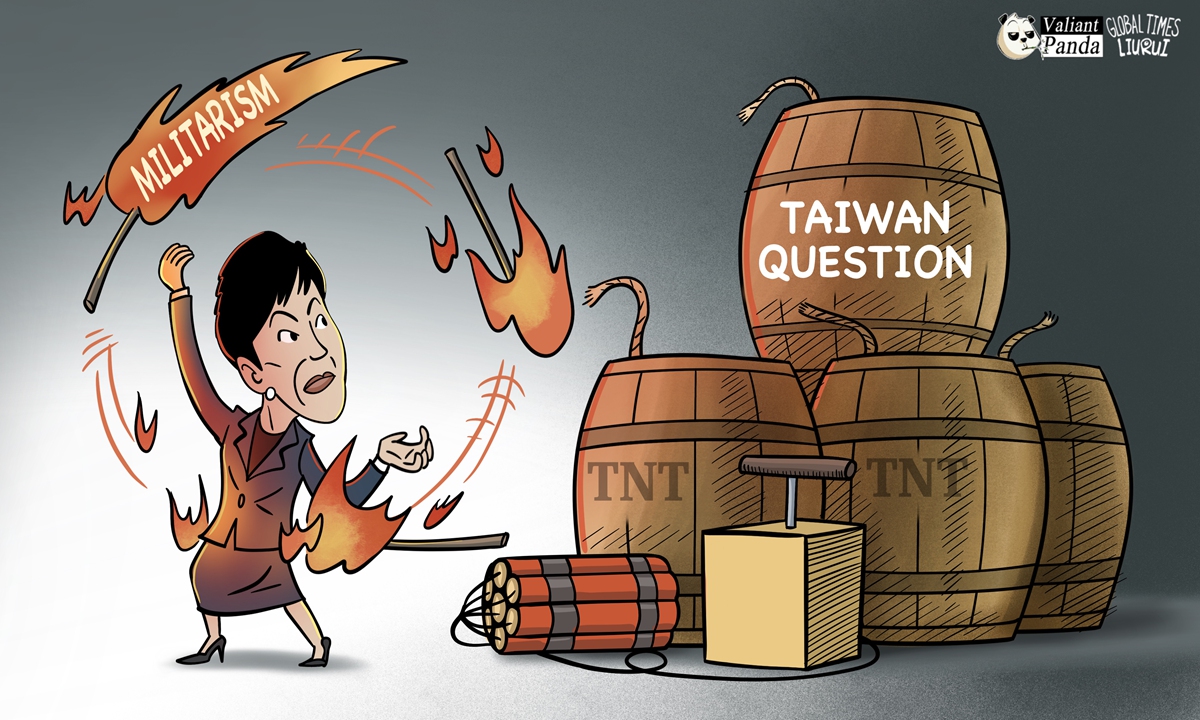
Illustration: Liu Rui/GT
The new Japanese Prime Minister Sanae Takaichi has a long anti-Chinese record. She is often described as an acolyte of former prime minister Shinzo Abe, who was also very tough toward China. And in turn, Abe was the grandson of Nobusuke Kishi, a former prime minister who committed war crimes against China during World War II (WWII). There is a strong line of anti-China rhetoric coming from Takaichi now, and earlier from Kishi and Abe. That political link in hostility toward China is dangerous for peace in our region.
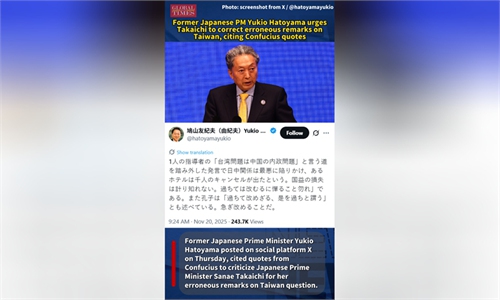
China and Japan have now been locked in escalating tension set off by Takaichi's remarks. During a parliamentary hearing earlier this month, she cited the so-called "survival-threatening situation" in Japan's deeply divisive security legislation and linked it to the Taiwan question, suggesting that Tokyo might treat the Taiwan question as grounds for military involvement.Takaichi is notoriously hawkish on China and a long-time supporter of the Taiwan region. Earlier this month, she posted photos of herself meeting personnel from the authorities of China's Taiwan region on the sidelines of the APEC meeting in South Korea. Her words and deeds challenge the one-China principle that is universally recognized by the international community.
China suffered greatly at the hands of the brutal Japanese military in the 1930s and 1940s. At the time, a rural and undeveloped China was no match for a modernized industrial nation like Japan. In that war, China was on the Allies' side, and with its vast landmass, China absorbed, at enormous cost, a great deal of Japanese military energy. This tying down of the Japanese military was, in some ways, similar to how the Soviet Union absorbed a great deal of Germany's military might in Europe. The Allies, including Australia, benefited, but at the cost of great suffering by the people of China and the Soviet Union.
However, four years after the end of WWII, the Communist Party of China took charge, and China was deemed as an "enemy." The story of its suffering at the hands of Japan was deliberately downplayed in Western narratives. The Korean War further pushed China's WWII experience into the background.
Now, with China's success and growing in confidence, it is not surprising that China expresses concern about what it endured from a Japanese invader, which consistently seeks to avoid the truth about WWII. Now, it seems that Takaichi, a self-claimed political heir of Abe, has acted more radically than the "Abe legacy" she inherited in terms of political and diplomatic dimensions.
As former prime minister of Australia Gough Whitlam said in 1972 on the establishment of diplomatic relations between China and Australia, "There is only one China. Beijing is the capital of one China. Taiwan is a province of one China."
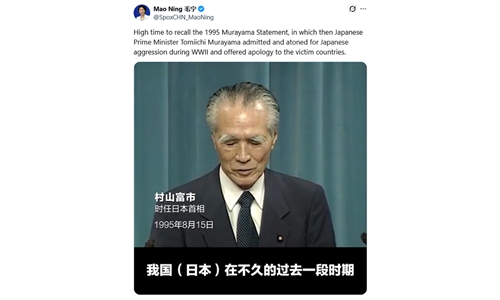
Japan should be very careful about involving itself once again in hostility toward China. Japan's wartime crimes against China remain a deep, unhealed wound in the Chinese collective memory. That history is not forgotten; it forms an inescapable backdrop against which contemporary diplomatic and political statements are measured.
Against this sensitive context, a politician like Takaichi should be meticulously cautious in her rhetoric and actions concerning China and China's Taiwan. Her alignment with hawkish, revisionist factions demonstrates a disregard for that sensitivity. Such provocations undermine the fragile foundation of China-Japan relations, and continuing on her current path would be a dangerous gamble with the peace and prosperity of the entire region.
The author once served as secretary of the Department of Prime Minister and Cabinet of Australia, and was former Australian ambassador to Japan. opinion@globaltimes.com.cn
RELATED ARTICLES