China's 2026 college graduates to hit 12.7 million; localities mobilize quality employment: MOE
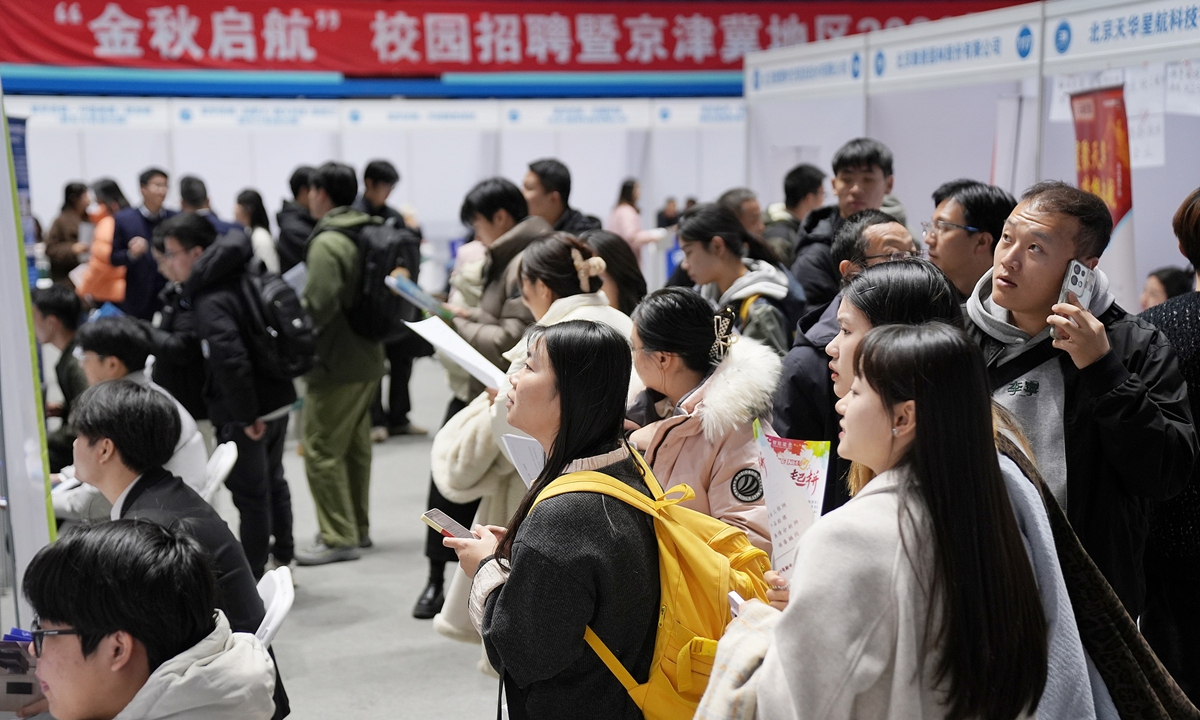
Participants attend a large job fair for 2026 college graduates in the Beijing-Tianjin-Hebei Region on November 19, 2025, at Beijing University of Technology. More than 200 employers from the region are offering over 4,000 job vacancies. Photo: VCG
The number of college graduates in 2026 is expected to reach 12.7 million, an increase of 480,000 compared with this year, according to data released by China's Ministry of Education (MOE), China Central Television reported on Thursday. The MOE has coordinated actions across regions and universities to promote high-quality and sufficient employment for college graduates.
To support this effort, the MOE has launched a nationwide "employment expansion and quality improvement" initiative for the 2026 graduating class. Key priorities include accelerating the implementation of pro-employment policies, intensifying efforts to stabilize and expand job opportunities, supporting entrepreneurship to drive employment, and deepening industry-education integration, improving supply-demand matching and providing targeted assistance for key groups.
Since the start of the autumn semester, the MOE has guided localities and universities to hold the "Golden Autumn Launch" campus recruitment month series for 2026 graduates, offering more than 12 million job openings.
Meanwhile, the MOE has strengthened a rapid-response mechanism to better match talent supply with market demand. Universities have been instructed to add new "micro-majors" and vocational skills training courses based on industry needs to help graduates quickly improve their employability.
Multiple localities also introduced measures to boost job opportunities for graduates. At a November 10 press conference, Wang Qingwang, Party secretary and director of the Beijing Municipal Human Resources and Social Security Bureau, said that since the start of the 14th Five-Year Plan (2021-2025), departments at all levels of the capital city have coordinated across sectors and adopted targeted and precise measures, making every effort to promote multi-channel employment and entrepreneurship for college graduates. As a result, employment levels or college graduates in Beijing have remained generally stable.
Wang noted that for five consecutive years, Beijing has introduced additional policies to support employment and entrepreneurship for college graduates. It has maintained a stable scale of positions in government agencies and public institutions, encouraged state-owned enterprises to expand recruitment, and incentivized all types of market entities to stabilize and increase job posts. Each year, more than 100,000 graduate-targeted positions are released.
In North China's Shanxi Province, state-owned enterprises have added 2,000 new positions for fresh graduates on top of their original recruitment plan of 10,000. At least 30 percent of posts in civil service and public institution exams are reserved for this year's graduates. To provide strong financial backing, the provincial government has allocated 340 million yuan in advance, raising subsidies for small and micro enterprises hiring graduates, distributing more than 100 million yuan in one-time job-search subsidies to eligible 2025 graduates.
In Southwest China's Guizhou Province, authorities have leveraged key industries such as big data and baijiu to establish 10 employment training alliances, promoting the alignment of "discipline clusters with industrial chains." University presidents have visited more than 12,000 enterprises to expand job opportunities, with a special focus on securing more than 20,000 positions suitable for graduates facing difficulties. In addition, Guizhou has distributed 200 million yuan in one-time job-search subsidies at a standard of 1,500 yuan per person to graduates from disadvantaged backgrounds.
On Tuesday, the National Bureau of Statistics (NBS) released data showing that China's unemployment among key job-seeking groups improved in October compared with September, as authorities accelerated the rollout of a set of pro-employment measures to ease labor market pressure.
According to the NBS, the jobless rate for urban workers aged 16-24, excluding students, stood at 17.3 percent in October, down from17.7 percent in September, a decline of 0.3 percentage points.
Global Times
RELATED ARTICLES