With US decision to resume nuclear testing, are we stepping into the nuclear abyss?
By Published: Nov 21, 2025 09:00 PM

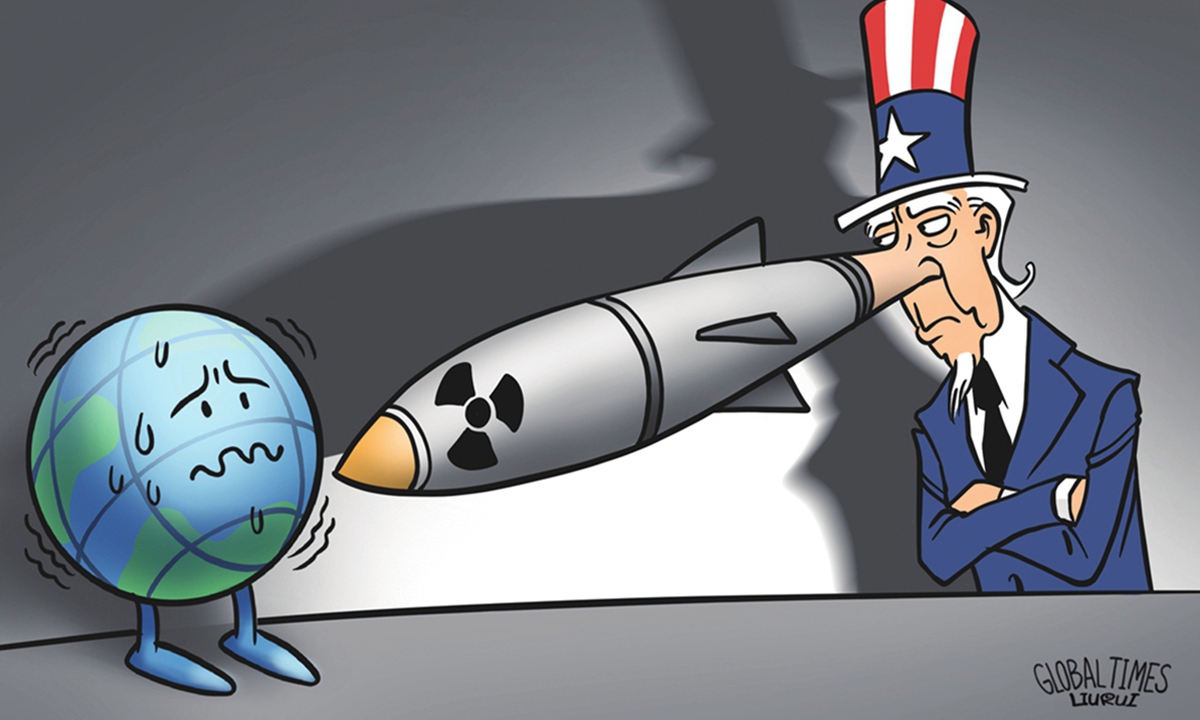
US nuclear power Illustration: Liu Rui/GT
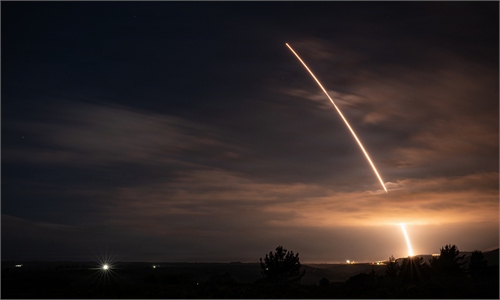
It was recently announced by Washington that the US would resume nuclear weapons testing for the first time since 1992, directing the Department of War to begin the necessary preparations as soon as possible. We still do not know exactly when and even if the US will indeed resume full-fledged nuclear tests - not too many specific details on Washington's plans have been released by US officials over the last weeks.
Some experts believe that the US is really committed only to testing new strategic delivery means rather than nuclear warheads themselves and that its militant statement is nothing but a reaction to recent successful tests of Russia's most advanced strategic systems, such as the Burevestnik missile and the Poseidon nuclear-powered unmanned underwater vehicle. Others argue that restoring technical capabilities to conduct nuclear tests at the Nevada National Security Site would take time. There is also a comforting view that the US referred to subcritical experiments and simulation validation that are conducted on a routine basis by all major nuclear powers and do not imply actual underground explosions.
However, the matter is too serious to whistle past the cemetery. Let us assume that the US really means what it says and that the nuclear test site in Nevada will indeed be put back in operation as soon as it is technically doable. This is at least how they assess the worst-case scenario in Moscow. After Washington announced its plan to resume nuclear testing, Russia vowed to "act accordingly" if the US went ahead with the plans. No doubt, the Russian side had concerns about future US intentions regarding nuclear tests and the Russian test site on the Novaya Zemlya archipelago has been kept ready for the potential resumption of testing.
The most evident negative consequence of Washington and Moscow getting back to full-scale tests of their nuclear arsenals would be the further decay of their strategic interaction, which has already been under severe pressure for at least the last 15 years. It looks highly unlikely that the two sides can continue their nuclear arms control business as usual in parallel to resuming nuclear testing. All the remaining trust between the two sides will be lost. The odds are that in this case, after the extended New START Treaty expires on February 5 next year, there will be nothing left of the once rich and diverse bilateral strategic arms control infrastructure.
Moreover, resumption of tests is likely to become a major catalyst for a new cycle of the US-Russia arms race. This does not mean that the two nuclear superpowers will hastily deploy many thousands of new nuclear warheads as they were doing back in the 1960s and 1970s. Instead, they will likely continue to compete with each other in modernizing their strategic arsenals, including both warheads and delivery means. In particular, resuming low-yield nuclear tests is going to further erode the red line between nuclear and conventional weapons and subsequently lower the so-called nuclear threshold. Considering other technological breakthroughs in the military field looming on the horizon, it is easy to predict that the likelihood of a nuclear war between the US and Russia will grow higher.
The implications of resuming nuclear tests will not be limited to US-Russia relations only. The future of the Treaty on the Non-Proliferation of Nuclear Weapons (NPT) will also be put into question. As a result, temptations to acquire nuclear weapons might become irresistible for nations concerned about their security in many corners of the world - from North East and South East Asia to the Middle East and North Africa.
For instance, in South Korea, more than 70 percent of the population supports the idea of building national nuclear weapons, according to the Center for Strategic and International Studies. Sanae Takaichi, the new Japanese prime minister, recently hinted that the "three non-nuclear principles" that have been guiding Tokyo's approach to nuclear weapons (not to produce, not to deploy and not to host them) were not carved in stone. These days, nuclear options are also being discussed in countries like Saudi Arabia and Turkey. Under such circumstances, resumed US nuclear tests can become a catalyst, triggering a chain reaction of proliferation and undermining the 11th NPT Review Conference that is scheduled for late spring of 2026.
Today, humankind can either step into the security abyss by accepting resumption of full-yield detonations of nuclear weapons as a part of the "new normal" or step back from the abyss by strengthening treaties against the test and spread of nuclear weapons and by putting pressure on the US administration to reconsider its irresponsible and dangerous position on nuclear tests and to return to the strategic arms control negotiating table. It is still not too late to make the right decision.
The author is a member of the Russian International Affairs Council. opinion@globaltimes.com.cn
RELATED ARTICLES