What did the world see through this Chinese sporting event?: Global Times editorial
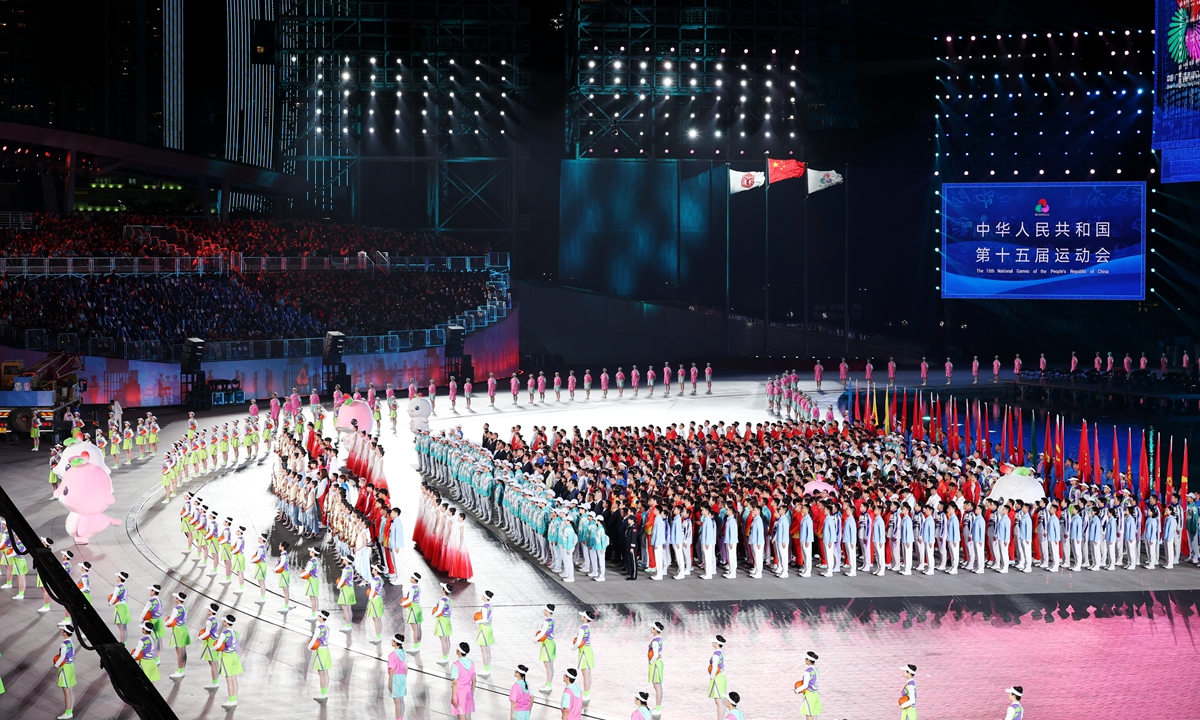
Closing ceremony of China's 15th National Games. Photo: Cui Meng/GT
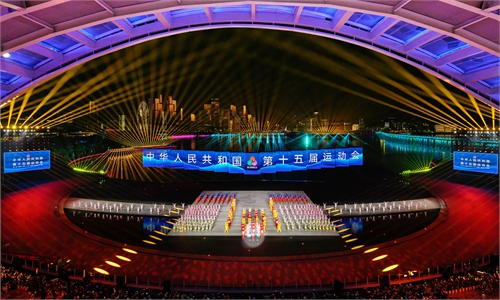
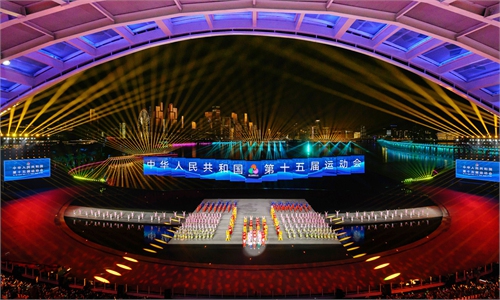
On November 21, China's 15th National Games concluded successfully in Shenzhen, South China's Guangdong Province. Over the course of nearly two weeks of exciting competitions, young rising athletes reached new heights, the concept of "National Games for All" lit up the Greater Bay Area, and vivid expressions such as the "XiLe Pack" and "Dawan Chicken" helped people remember the athletes' fighting spirit, while showcasing vibrant cultural creativity. Notably, the attention came not only from within China. How did a domestic sports event capture global attention? From keywords highlighted in foreign media - "technology," "unity," and "regional coordination" - one can see part of the answer.
Competitive sports are highly appealing around the world, and China embodied the Olympic spirit through the 15th National Games. As some foreign media noted at the start of the Games, if you were wondering where China's top athletes have vamoozed to for the next fortnight, the answer was the National Games. Today, China has become a major sporting power globally. As the country's largest-scale and highest-level comprehensive sporting event, the 15th National Games brought together more than 20,000 participants competing in 34 elite sports and 23 mass participation events. They set eight world records, five world junior records, and 13 Asian records, while winning performances in 12 events surpassed the winning marks set at the Paris Olympics - fully demonstrating China's achievements in competitive sports. The related organizational capacity and infrastructure development have also, unsurprisingly, drawn the attention of the international community.
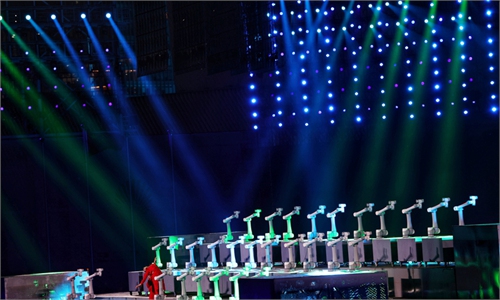
In foreign media reports on the 15th National Games, technology stood out as a highlight. Humanoid robots serving as "torchbearers" and acting as "award assistants" became a topic of great fascination for foreign journalists. From air-conditioning-free cooling systems and precise indoor seat positioning to smart wearable devices, elements of a "high-tech National Games" were visible everywhere. The showcase of brands and products from Guangdong, Hong Kong, and Macao also offered a concentrated spotlight for "Bay Area-made" innovations. If during the competitions the Games served as a stage presenting technological products, it was also a vivid microcosm of Digital China. Outside of the arenas, the 15th National Games also sounded the starting whistle for the tech industry to chase new records of its own.
A major sporting event requires thorough coordination and close collaboration. In reporting on the 15th National Games, many Chinese and foreign media outlets used terms such as "a first of its kind," largely focusing on the joint hosting by Guangdong, Hong Kong, and Macao. This pioneering "Greater Bay Area co-hosting" model is a first in the history of China's National Games. World Aquatics President Husain Al Musallam, who watched the Games in China, openly praised the approach, saying that the model of "cross-boundary" hosting merits wider adoption.
More than 6,000 athletes from the mainland were expected to compete in Hong Kong and Macao, while more than 3,000 from the two SARs were scheduled to travel to the mainland; the Games spanned 19 cities across the Greater Bay Area, with the road cycling events passing through the Hong Kong-Zhuhai-Macao Bridge, and the marathon crossing Shenzhen and Hong Kong. For the first time, the Games introduced the "one race across three jurisdictions" and "seamless border clearance" models. These innovative practices not only served the competitions but also opened key channels for commuting, logistics, and industrial cooperation within the Bay Area. Each stage reflected a spirit of "working together with one heart," which, as foreign media noted, goes far beyond logistical support - it is a symbol of unity.
As one of China's most open and economically dynamic regions, the Guangdong-Hong Kong-Macao Greater Bay Area boasts highly efficient, interconnected infrastructure and deepening "soft connectivity" in rules and mechanisms, vividly illustrating the practice of "one country, two systems" in the new era and on the new journey. As one description goes: first, enjoy morning tea in Guangdong while watching swimming; then head to Hong Kong for fresh shrimp wonton noodles and fencing; finally, visit Macao for Portuguese egg tarts and table tennis. The ongoing "sports-plus" effect, along with the deep integration of culture with technology and culture with tourism, bore fruit during the Games. Through this joint hosting across three regions, the international community also sees that "one country, two systems" is a form of institutional innovation continuously put into practice.
The successful hosting of the 15th National Games has significance beyond the event itself, and its influence extends far beyond the closing ceremony. Through this National Games, the international community learned that China's per capita sports facilities have doubled over the past 20 years and that mass sports activities are flourishing. While witnessing the vibrant vitality and remarkable achievements of Chinese modernization, they also shared in the sense of participation, fulfillment, and well-being experienced by the Chinese people. What the Games leave behind is not only spectacular performances but also a collective imprint of nationwide participation and shared development, which is an expression of the vitality and spirit of the Chinese people. And as the final note of the Bay Area symphony jointly composed by the three regions echoed across the "stars and the sea," what remained was not a farewell but the beginning of a new journey.
The 15th National Games took place just after the successful convening of the fourth plenary session of the 20th Central Committee of the Communist Party of China. The recommendations for the 15th Five-Year Plan (2026-30) clearly stated, "We should support Hong Kong and Macao in better integrating into and contributing to the country's overall development. Cooperation between the mainland and Hong Kong and Macao in economic and trade affairs, science and technology, culture, and other fields should be strengthened." These development-related plans, goals, expectations, and efforts were plainly visible throughout this grand sporting event, and brought to life through vivid practice. In this sense, aren't the 15th National Games also a lens through which to observe "Chinese governance"? The reason this national sports event has captured so much global attention becomes clearer in this light.
RELATED ARTICLES