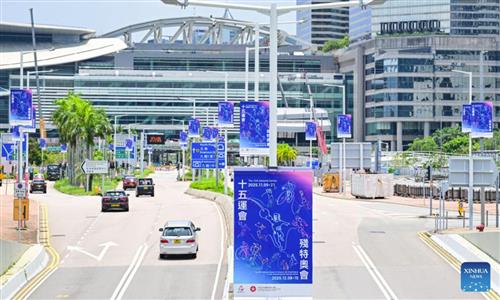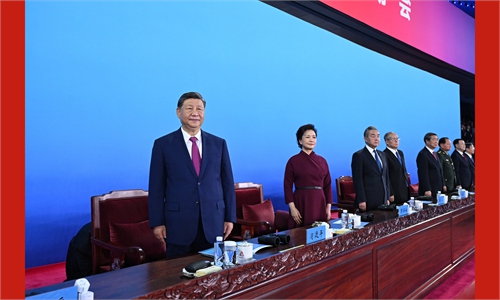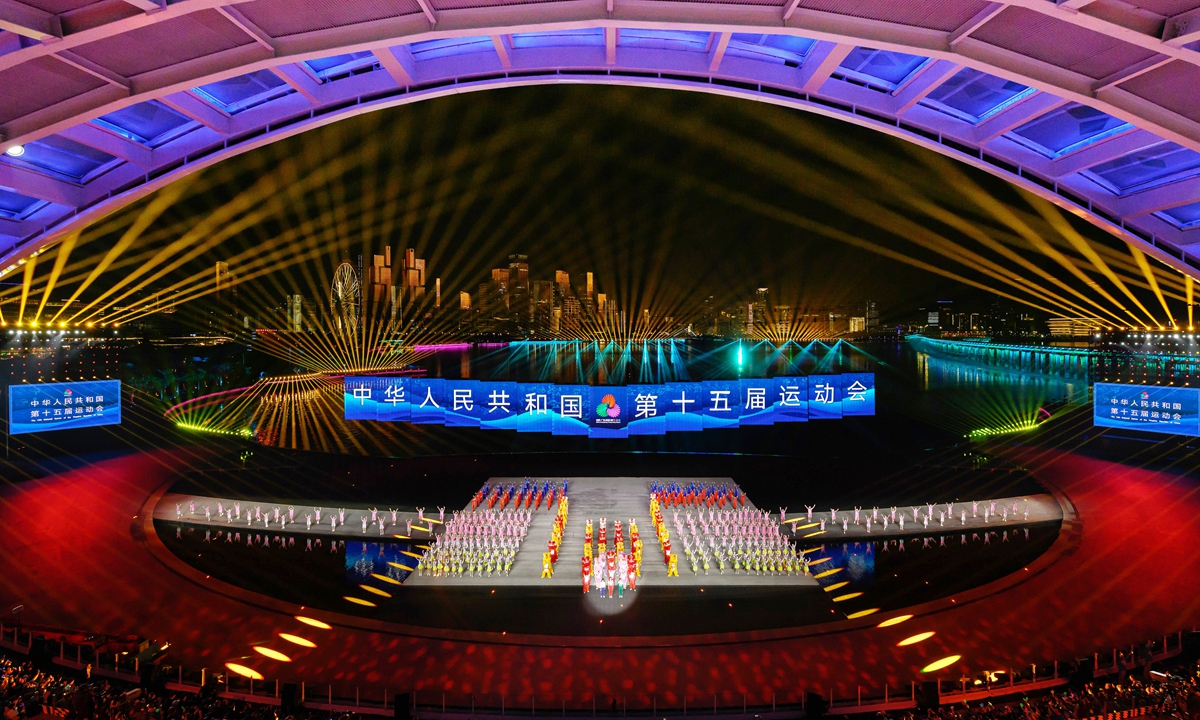
This photo taken on November 21, 2025 shows the general view of the closing ceremony of China's 15th National Games in Shenzhen, South China's Guangdong Province. Photo: Cui Meng/GT
The 15th National Games, the first cross-boundary edition of the country's premier multi-sport event, concluded in Shenzhen on Friday with a landmark ceremony that underscored the event's cross-boundary integration across Guangdong, Hong Kong and Macao, and highlighted China's rising generation of athletes.
Wang Huning, a member of the Standing Committee of the Political Bureau of the Communist Party of China (CPC) Central Committee and chairman of the National Committee of the Chinese People's Political Consultative Conference, announced the closing of the event at the Joyful Theater, a venue featuring a striking water-stage and a petal-shaped seating layout facing the sea, embodying the Games' theme of shared enjoyment and regional cohesion in the southern coastal city in South China's Guangdong Province.
The ceremony also featured a series of cutting-edge technological elements delivered through immersive interactions, from artificial flames simulated with electric lights to naked-eye 3D effects and holographic projections.
Cross-boundary competition
While the closing ceremony dazzled with technology, the lasting legacy of the 15th National Games lies in its unprecedented cross-boundary organization.
Marathon runners, for instance, ran from Shenzhen into Hong Kong, and road cycling events sped across the iconic Hong Kong-Zhuhai-Macao Bridge.
The organizers used face-recognition and pre-check systems to enable smooth boundary crossing, without athletes stopping or slowing down during the competition despite its cross-boundary nature.
In addition to the athletic achievements, the cost control and sustainable legacy of the Games were also widely hailed, as about 90 percent of the venues used during the Games were existing facilities, minimizing new construction.
Tong Lixin, vice-director of the National Games organizing committee and vice-minister of the General Administration of Sport, said at a news conference on Friday that participating athletes at the National Games have set multiple records, including eight new world records and 13 Asian records.
"The winning results in 12 disciplines exceeded the gold-medal winning performances at the Paris Olympics," Tong said, demonstrating China's growing competitiveness on the global stage.
A defining feature of the Games was the strong performance by young athletes, often born in 2005 or 2010, Tong said.
Zhang Zhanshuo, an 18-year-old swimmer of the Shandong team, won five gold medals in freestyle swimming, making him the most-decorated male athlete of the Games.
In women's gymnastics, Ke Qinqin, competing in her first National Games, earned five golds for the Guangdong team, emerging as the Games' top female medalist.
This momentum helps the country not only showcase talent but also prepares the next crop of Olympians, Tong said.
However, he also noted that there's no place for complacency in domestic sports as there is still room for improvement.
"We must also recognize that in some disciplines there was no obvious progress. The gap with the world's top level remains large," Tong noted. "Some disciplines do not have enough young reserve talent and face the challenge of generational transition."
As rising stars stepped into the spotlight, this edition of the Games also saw emotional goodbyes from veteran athletes.
One example was the swansong of sprinter Su Bingtian. The Asian record holder in the men's 100 meters had his last race on Thursday night, which drew a near-capacity attendance at the Guangdong Olympic Sports Center Stadium of 43,924 people.
Strengthening GBA ties
Chan Kwok-ki, Hong Kong's chief secretary for administration, said that co-hosting the Games reaffirms the successful practice of "One Country, Two Systems", and strengthens the Greater Bay Area's integration.
"The successful staging of this National Games has not only strengthened Hong Kong's capability to host major international sporting events, but will also foster deeper integration and collaboration among cities in the Greater Bay Area," Chan told reporters on Friday.
"This will further boost the overall competitiveness of the Greater Bay Area and contribute to the country's development."
O Lam, Macao's Secretary for Social Affairs and Culture, echoed that sentiment, noting on Friday that Macao hosted hundreds of competition events, contributed 3,500 volunteers, and drew more than 2 million visitors during the National Games, blending sport, tourism, and culture.
"The enthusiasm for sports has translated into momentum for cultural and tourism consumption. Preliminary estimates show more than 2 million tourists visited Macao during the Games period to watch competitions and travel," O Lam said.
Zhang Bin, a Beijing-based sports commentator, said the successful co-hosting of the National Games could pave the way for even more ambitious events.
"The National Games closed not just as an athletic test for domestic athletes and inspiration for younger generations, but also as a symbol of cross-boundary cooperation and sustainable planning," Zhang told the Global Times.
"The record-breaking performances of the athletes and seamless integration across the Guangdong-Hong Kong-Macao Greater Bay Area suggest a new model for mega-sporting events, which opens the discussion for a possible bigger multi-sport event being held in the region."
RELATED ARTICLES