Japan faces another choice – to act unilaterally or return to path of reason: People's Daily 'Zhong Sheng' commentary
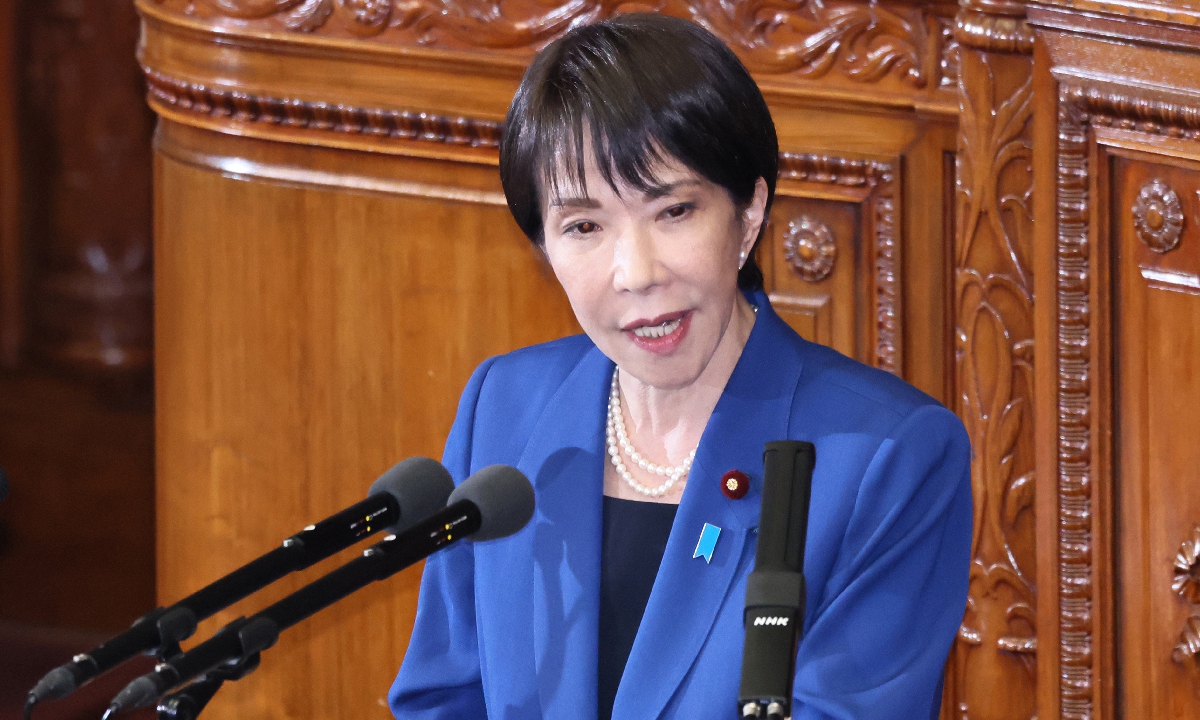
Japanese Prime Minister Sanae Takaichi delivers her first policy speech since taking office during the plenary session of the House of Representatives at the National Diet in Tokyo, on October 24, 2025. Photo: VCG
Japanese Prime Minister Sanae Takaichi's absurd claim that a "contingency in Taiwan" could constitute a "crisis of survival" for Japan, implying the possibility of military intervention in the Taiwan question, and her refusal to correct this stance despite China's strong protests, is a serious violation of basic norms of international relations. It has raised concerns and alarm in the international community regarding Japan's strategic direction, and its negative impact has already begun affecting Japan's economy and society.Some Japanese media outlets have bluntly stated that "Takaichi's very presence as prime minister poses a crisis for Japan's survival." This assertion underscores the dangers inherent in Takaichi as a right-wing politician - her governing direction is leading Japan into a perilous situation where warmongering inevitably lead to its downfall.
Takaichi's words and actions on the Taiwan question constitute a blatant interference in China's internal affairs, a serious departure from international law and the basic norms of international relations, and a disruption to regional and global peace and stability. As a defeated nation in World War II, Japan should strictly abide by its "Peace Constitution" and insist on never waging war again; this is the responsible attitude it should have toward history and the world. However, in this important year marking the 80th anniversary of the victory of the Chinese People's War of Resistance Against Japanese Aggression and the World Anti-Fascist War, Takaichi openly issued a threat of force against China. This not only shows a lack of respect for history but also constitutes a direct challenge to peace. Such politicians, who disregard national and global stability for personal political gain, will ultimately harm themselves, their country, and the world.
Takaichi's use of the Taiwan question for political gain reveals underlying political calculations. Some Japanese observers have pointed out that Takaichi clearly has a political agenda: to consolidate her support base by continuously promoting the "China threat" and "China alert" rhetoric, thus stabilizing her base through a hardline stance. She has fully inherited, and even intensified, the "political legacy" of Japanese right-wing politicians, turning serious national policies into tools for personal political performances and using the Taiwan question, which concerns the foundation of China-Japan relations, as a bargaining chip for seeking private gain. This approach of tying the country's future to personal political ambitions will only lead Japan astray and cause it to suffer heavy losses.
Takaichi's stance highlights the persistent rise of Japan's right-wing forces and the lingering specter of militaristic ideology. After World War II, the Potsdam Proclamation explicitly stipulated that Japan was forbidden to "re-arm," and Japan's "pacifist constitution" established the principle of "exclusively defense-oriented policy." However, right-wing forces in Japan have continuously sought to break through these constraints - from substantially increasing defense budgets and pursuing the development of offensive capabilities to attempts to abandon the "Three Non-Nuclear Principles." They are moving ever further down the path of military expansion. Takaichi's amplification of the so-called "crisis of survival" is, in essence, a pretext to push for military deregulation, constitutional revision, and armed forces expansion. This dangerous trend poses a serious challenge to the post-war international order and risks placing the Japanese people in perilous circumstances of war and conflict.
Takaichi's words and actions have harmed China-Japan relations and are forcing the Japanese people to pay the price for her political ambitions. China is Japan's largest trading partner, second-largest export destination, and largest source of imports. If Japan refuses to correct course, China will have no choice but to take more severe and resolute countermeasures. According to media reports, influenced by factors such as the outlook for Japan's fiscal situation and the turbulence in China-Japan relations caused by Takaichi's erroneous remarks regarding Taiwan, risk aversion in the capital markets has increased significantly, with a sharp sell-off in the Japanese market. Japanese economists estimate that if the number of Chinese tourists visiting Japan drops significantly, Japan's GDP could decline by 0.36 percent, resulting in economic losses of up to 2.2 trillion yen (approximately 100 billion yuan), which would further impact Japan's already struggling economy.
Eighty years ago, the Potsdam Declaration warned Japan: "The time has come for Japan to decide whether she will continue to be controlled by those self-willed militaristic advisers whose unintelligent calculations have brought the Empire of Japan to the threshold of annihilation, or whether she will follow the path of reason." Rereading it today, these words still resonate powerfully. If Japanese right-wing politicians continue to be obstinate, they will inevitably face the historical fate of "those who love war will perish."
Zhong Sheng is the People's Daily international news commentary column. opinion@globaltimes.com.cn
RELATED ARTICLES