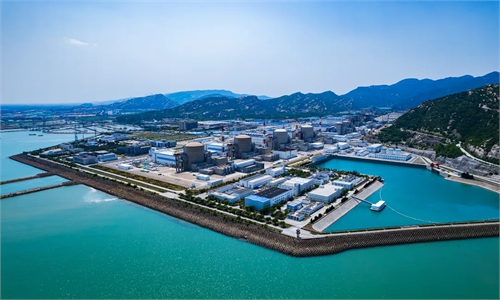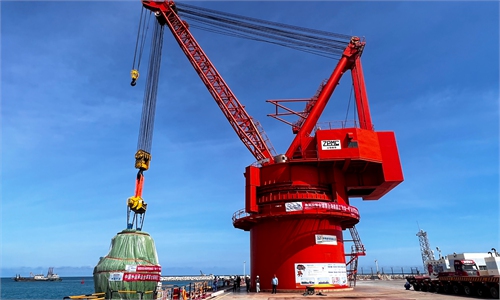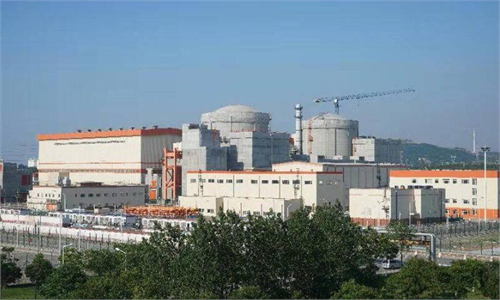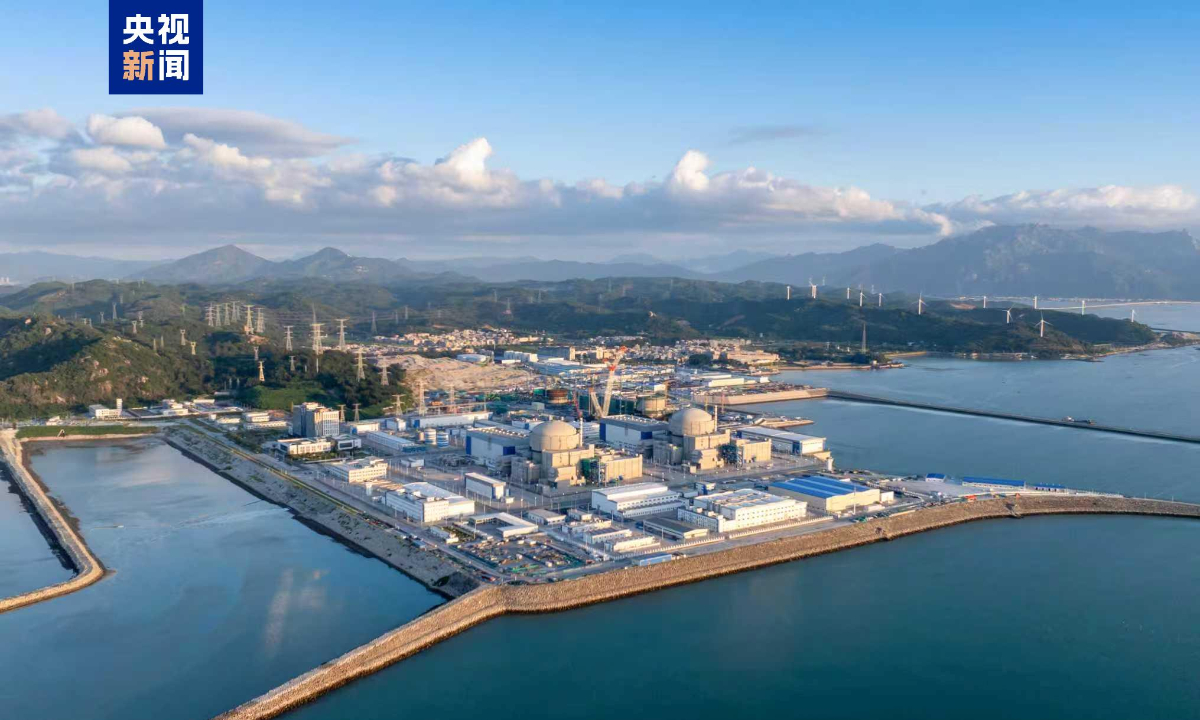
A photo of the No.2 Unit of Zhangzhou nuclear power plant, located at the world's largest Hualong-1 base in East China's Fujian Province Photo:CMG
The No.2 Unit of Zhangzhou nuclear power plant, located at the world's largest Hualong-1 base in East China's Fujian Province, was successfully connected to the State Grid for the first time on Saturday, marking a major step forward in the mass deployment of the Hualong One reactor series, according to a statement from China General Nuclear Power Group (CGN) sent to the Global Times.A Chinese expert said the progress represents a crucial step in China's move toward the large-scale rollout and full localization of its domestically developed nuclear technology, a milestone that carries far greater strategic significance than simply expanding clean power supply.
After the initial grid-connection test on Saturday, on-site checks confirmed that the unit was operating stably and that all technical indicators met design standards.
The reactor will now undergo a series of scheduled tests to further verify its performance and ensure it meets all conditions for commercial operation, CGN said.
The Zhangzhou nuclear power plant is the starting point for the mass deployment of the Hualong-1 reactor series and is currently the world's largest Hualong-1 nuclear power base, with six reactor units planned.
Once completed, the facility is expected to supply more than 60 billion kilowatt-hours of clean electricity annually — enough to meet about 75 percent of the combined power demand of Xiamen and Zhangzhou in southern Fujian, according to the statement.
Hualong-1 meets the safety, technological sophistication and cost-efficiency standards expected of third-generation reactors and gives China full control over the technology for exporting it abroad, positioning it as a genuinely competitive offering in the global nuclear market, Lin Boqiang, director of the China Center for Energy Economics Research at Xiamen University, told the Global Times on Saturday. "It has effectively become China's flagship brand as the country expands its role in international nuclear-power cooperation."
Lin noted that among the few countries capable of mass-producing third-generation reactors — chiefly China, the US and France — Hualong-1 now stands on par with leading designs worldwide. China's nuclear sector also holds clear advantages in construction timelines, manufacturing capacity, engineering efficiency and overall cost competitiveness, he added.
Hualong-1, China's domestically developed third-generation nuclear technology, is the world's most widely deployed reactor type in operation and under construction.
Construction of the No.2 Unit of Zhangzhou nuclear power plant began on September 4, 2020, and the reactor was loaded with nuclear fuel on October 11, 2025.
"For more than a decade, China has been virtually the only country consistently building nuclear plants at scale, placing its construction capability firmly at the forefront globally," Lin told the Global Times.
As demand for stable, low-carbon energy intensifies — driven by AI, advanced manufacturing and global decarbonization efforts — international appetite for nuclear projects is rising. In this context, Lin said, the globalization of Chinese nuclear technology "is becoming an inevitable trend."
He added that Hualong-1 marks a crucial milestone in China's push toward full localization and large-scale deployment of its nuclear technologies and serves as a pivotal step in expanding the country's footprint in overseas nuclear markets. The reactor, Lin said, is poised to play a strategic role in strengthening China's long-term competitiveness in the global nuclear power industry.
RELATED ARTICLES