G20 summit adopts declaration on opening day despite US boycott
Chinese premier urges G20 to uphold free trade, build open world economy
By and Li Yu Published: Nov 23, 2025 09:54 PM
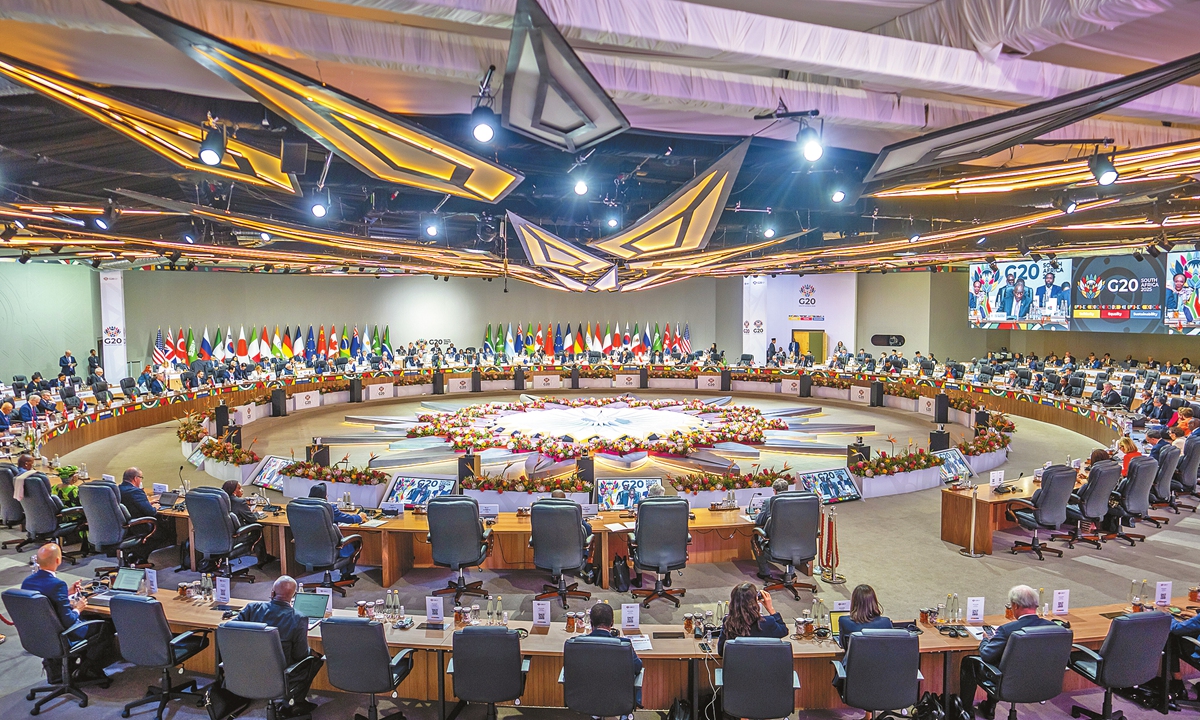
The G20 Leaders' Summit in Johannesburg, South Africa enters its second and final day on November 23, 2025. Photo: VCG
The Group of 20 (G20) summit opened in Johannesburg, South Africa on Saturday local time, the first held in Africa. Despite the US' boycott and pressure, global leaders attending the event reached a broad consensus on urgent issues including disaster resilience, debt sustainability, just energy transitions and critical minerals, and adopted the G20 South Africa Summit's Leaders' Declaration on the opening day.
Chinese observers highlighted that the adoption of the joint declaration, over the objections of the US and its summit boycott, signals that China and other Global South countries have become increasingly important in terms of global governance, giving them a bigger seat at the table. Behind this lies broad consensus among Global South countries that the China-proposed Global Governance Initiative (GGI) has won wide support and is playing a key role in promoting true multilaterism, along with highly effective efforts that have been made to this end.
This year's G20 gathering is themed "Solidarity, Equality and Sustainability." According to the Xinhua News Agency, the two-day event highlights a pivotal moment for Africa as it seeks to elevate its role in global governance and advance development priorities shared across the Global South.
"It is an honor and a privilege to welcome you all to the first G20 Leaders' Summit to be held on African soil. We gather here at the Cradle of Humankind to affirm our common humanity. We gather here to affirm the value of partnership and cooperation, to finding common solutions to shared problems," South African President Cyril Ramaphosa said in his address at the opening of the G20 Leaders' Summit, according to a transcript on the G20's website.
"The G20 underscores the value and relevance of multilateralism," the South African president remarked, adding that "the adoption of the declaration from the summit sends an important signal to the world that multilateralism can and does deliver. It sends a message of hope and solidarity."
According to the declaration, G20 leaders recognized the need to increase global investment to meet the climate goals of the Paris Agreement and to rapidly and substantially scale up investment and climate finance from billions to trillions globally from all sources, Xinhua reported.
"We reaffirm the commitment to the swift, full and effective implementation of the Kunming-Montreal Global Biodiversity Framework adopted at the COP15 to the Convention on Biological Diversity and encourage other countries to do the same," reads the joint declaration.
The declaration underlines the empowerment of women and girls in achieving gender equality. "As we celebrate the 30th anniversary of the Beijing Declaration and Platform for Action, we reaffirm our commitment to its full, effective and accelerated implementation," it said, adding that G20 leaders welcome the Global Leaders' Meeting on Women held in October in Beijing to carry forward the spirit of the Beijing conference.
US absence
South Africa assumed the rotating G20 presidency on December 1, 2024, becoming the first African nation to hold the position. The US is scheduled to take over the presidency on December 1, 2025, according to Xinhua.
Washington boycotted the gathering of world leaders in South Africa over several issues, including the widely discredited claim that the host country's white minority are the victims of large-scale killings. The South African government has strenuously denied these allegations, according to the Guardian on Saturday.
The US has also rejected the host country's agenda of "promoting solidarity and helping developing countries adapt to weather disasters, transition to clean energy and cut their excessive debt costs," the Singapore-based Strait Times reported.
Ramaphosa said he would have to hand over the rotating presidency to an "empty chair." The South African presidency has rejected the White House's offer to send the US charge d'affaires for the G20 handover, the report said.
Pursuing policies steeped in a new form of isolationism, the US is showing indifference toward global governance processes. This has gradually placed the US on the opposite side of the vast majority of countries in the world, especially most G20 members, Li Haidong, a professor at China Foreign Affairs University, told the Global Times on Sunday.
"The declaration was adopted unanimously. It is usually adopted at the end of the summit, but there was a feeling during bilateral negotiations on Friday and Saturday that it was necessary to adopt the declaration first and then move on to other issues," a source familiar with the matter told Russian news agency Sputnik.
The BBC analyzed that in many ways, South Africa's presidency of the G20 is part of a wider debate around multilateralism and its effectiveness. If South Africa is able to convince other G20 members to issue a joint declaration, it might have succeeded in proving that consensus can be reached without the participation of the world's most powerful country.
Reuters also pointed out that while fearing that a loss of participation from its most powerful member would scupper a declaration at the G20, some analysts still saw an opportunity for the South African hosts, determined to set an agenda for global leaders in the face of the US' hostility to multilateral diplomacy.
"The multilateral platform cannot be paralyzed on the basis of the absence of someone who was invited," South African Foreign Minister Ronald Lamola told public broadcaster SABC, per CNN.
China injects certainty
While addressing the first session of the 20th G20 Summit in Johannesburg, Chinese Premier Li Qiang on Saturday urged G20 economies to stay committed to solidarity, firmly uphold free trade and build an open world economy in the face of a sluggish global economic recovery.
Today, the world economy is once again confronted with major challenges, marked by a rise in unilateralism and protectionism, as well as escalating trade restrictions and confrontations, Li Qiang said, Xinhua reported.
The Chinese premier called for concerted efforts to properly handle disputes and frictions through consultation on the basis of equality when facing differences and contradictions.
China's propositions undoubtedly provide the world with certainty and sufficient confidence amid the current complex and turbulent global situation, some observers noted.
This confidence enables countries around the world to coordinate and unite more closely in order to jointly address the challenges facing all of humanity, Li Haidong said.
In an article published local time on Saturday, the Associated Press commented that some analysts say developing countries could take the US boycott as evidence of their need to further increase ties with others, especially China.
China's role has been absolutely pivotal and it is no exaggeration to call it the "stabilizing needle" of this G20 process, He Wenping, a director of the Institute of West Asian and African Studies under the Chinese Academy of Social Sciences, told the Global Times on Sunday.
Since South Africa assumed the G20 presidency, China has participated in every single event throughout the year, from the opening forums at the beginning of the year to the Leaders' Summit now. Foreign ministers' meetings, finance ministers' meetings, and all thematic tracks - China has never been absent. More importantly, China has firmly supported every single initiative put forward by Africa, not just with words, but with concrete actions, He Wenping said.
According to Xinhua, China has released an action plan for implementing the G20 Initiative on Supporting Industrialization in Africa and Least Developed Countries, Li Qiang noted, stressing China's endeavor to promote common development among all countries.
China supports the reduction of debts in developing countries, and has jointly initiated with South Africa a cooperative initiative to support Africa's modernization, Li Qiang said, adding that China will also establish the Institute of Global Development.
It is precisely this tangible support that has ensured that legitimate demands from South Africa, and indeed the whole of Africa, receive strong backing on the global stage, particularly at the G20, and are translated into real, on-the-ground results. China has truly been the most reliable and powerful pillar behind both this G20 summit and Africa's broader development agenda, He Wenping noted.
RELATED ARTICLES