SPORT / FOOTBALL
2025 season could be a turning point for Chinese Super League: pundits
Shifting momentum in stadiums
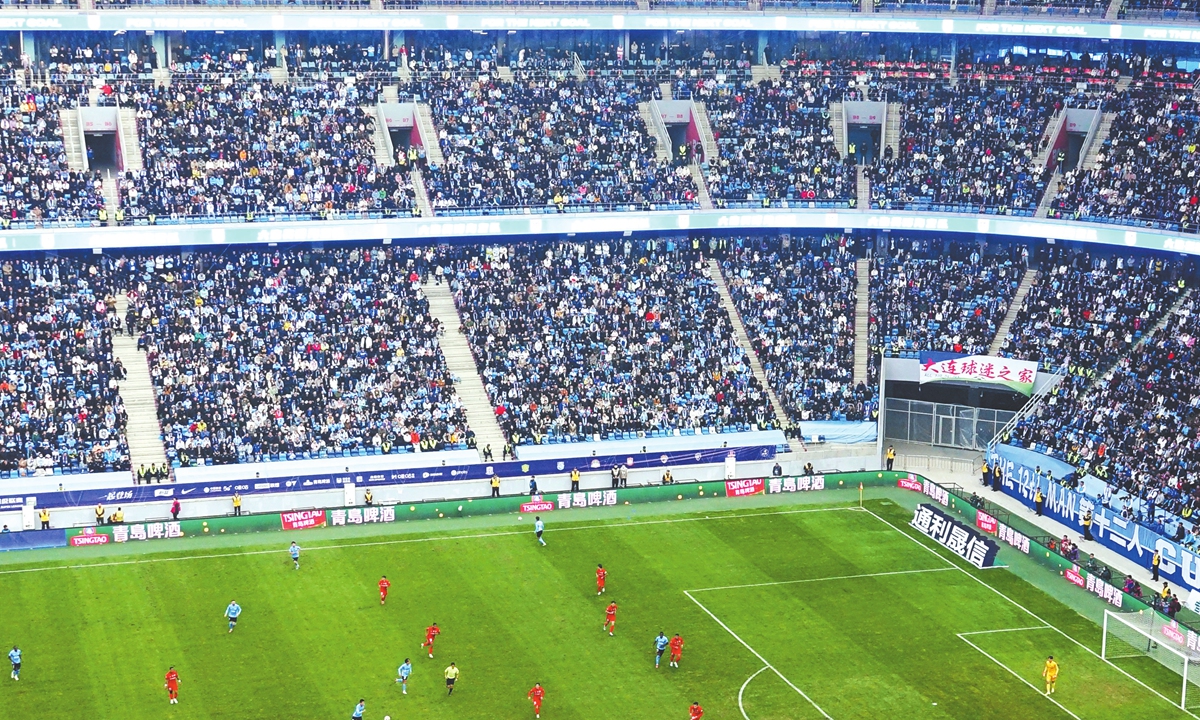
Tens of thousands of fans cheered for the Dalian Yingbo at the Dalian Suoyuwan Stadium on November 22, 2025. Photo: IC
An emotional Wu Lei burst into tears at the Suoyuwan Stadium in Dalian on Saturday, as his club Shanghai Port won the Chinese Super League (CSL) title by collecting 66 points after completing 30 games. The star forward was beleaguered this season due to injury, playing only six games this season and making only one goal.
His tears reflect the hard-fought campaign for Shanghai Port, who edged out cross-city rival Shanghai Shenhua - whom they had been locked in a title duel - to win the title in a decisive 1-0 away win against Dalian Yingbo.
Yet beneath the surface of Port's triumph - their third consecutive league title - this season revealed deeper, systemic shifts in Chinese football - a revival of fan culture, looming governance challenges, and a renewed sense of public relevance for the top flight.
Port's dominance in the league did not go unchallenged. Behind them, Shenhua surged with a maturing structure, while Chengdu Rongcheng's steady rise gave the race a competitive edge. Beijing Guoan, the half-season leader, eventually fizzled out due to the head coach's rigid tactical habits.
In the scoring charts, foreign players continued to shape the league's arc. Guoan's Brazilian striker Fabio claimed the Golden Boot with 28 goals.
Among domestic talents, Zhejiang FC's Wang Yudong stood out. His 11-goal haul allowed him to sit at eighth place among the top 10 scorers, making him the only Chinese player in the echelon.
Wang, who turns 19 on Sunday, is expected to start his overseas journey next season after he penned a managing deal with an European sports management agency in November, which thrilled Chinese football fans.
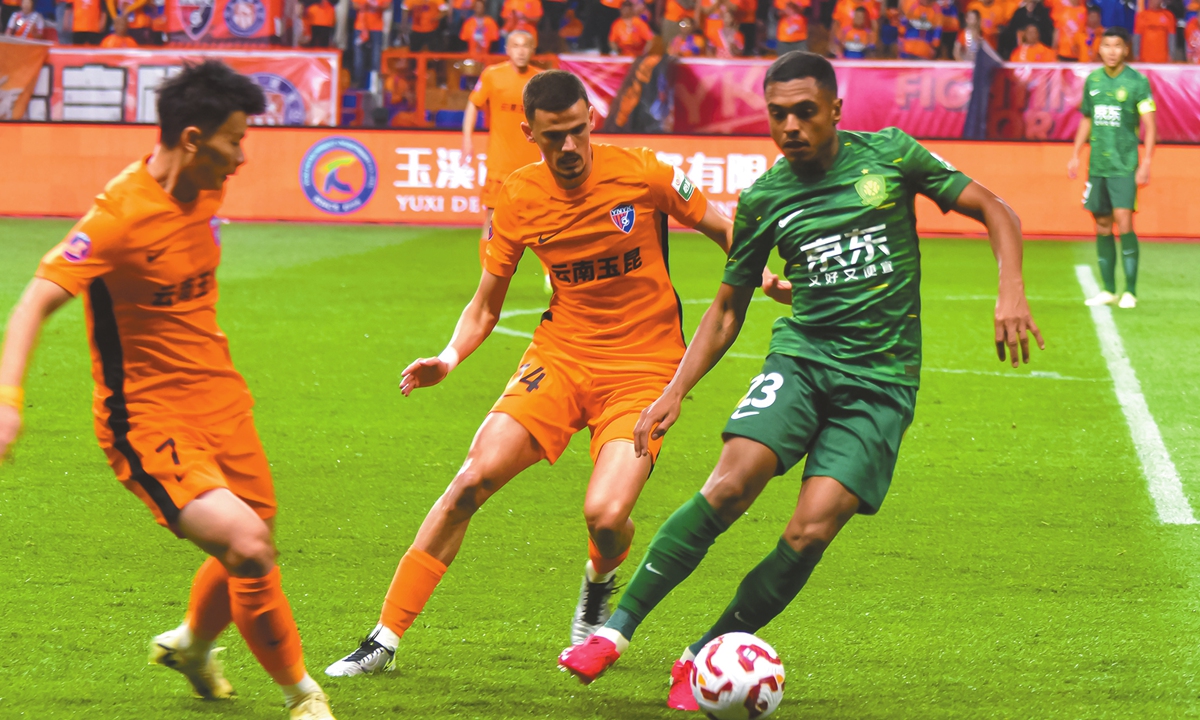
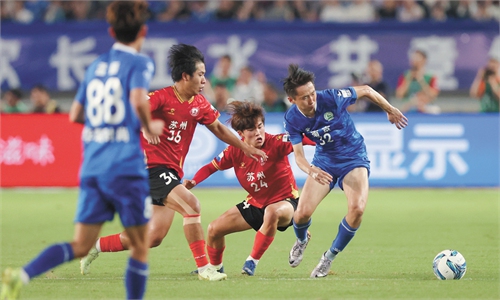
The Beijing Guoan faced the Yunnan Yukun in Yuxi, Southwest China's Yunnan Province on February 22. Photo: IC
Reviving atmosphere
If the on-field story was one of consolidation, the off-field narrative spoke of revival. The 2025 season saw a marked rebound in fan engagement and attendance, a sign that Chinese football is regaining its social pulse.
Yingbo, playing their first CSL season this year, stole headlines by turning the Suoyuwan Stadium into a fortress of support.
Nine of the top 10 stadium attendance figures came from Dalian, with the season-ending game seeing a record of 62,330 people, a figure not only setting a club record but ranking as the second-highest attendance in CSL history.
This revival is more than numbers. The "We are Dalian" tifos that stretched across the stands became a vivid symbol of collective identity and community pride. Such scenes weren't limited to Dalian. At the Workers' Stadium in Beijing, Phoenix Hill Stadium in Chengdu as well as the Shanghai Stadium, similar works also decorated the stands.
Zhu Meng, a Beijing-based sports commentator, told the Global Times that the rebound of fan engagement could provide a stronger foundation for clubs.
"The attendance boom demonstrates the multifaceted value of the league not just as a sporting competition but as a cultural institution," Zhu said. "It validates the investments in football and provides a stronger foundation for clubs and the national team."
Strict measures
Yet for all the revival, the season wasn't without its darker moments. The reemergence of stadium energy brought renewed responsibility, and sometimes, tensions.
In a disturbing incident in October, fans of Chengdu Rongcheng hurled insults at Ghanaian striker Frank Acheampong, who at the time was playing for Henan FC.
The league's governing body, the Chinese Professional Football League, responded by fining the club 500,000 yuan ($70,350) for the discriminatory behavior.
Another major flashpoint in the 2025 season came when a Tianjin supporter used a loudspeaker to hurl insults at Rongcheng's forward Wei Shihao, crossing a line that put a harsh spotlight on fan conduct.
According to official statements, the fan, identified as Jiang, was administratively detained for seven days by the police and was also banned from attending future matches.
The episodes were sharp reminders that passion, if left unchecked, can slide into prejudice, and that rebuilding fan culture also means rebuilding civic norms.
Discipline from the league was firm, but the incident underscores a broader governance challenge: How to foster fan enthusiasm without tolerating intolerance.
"The fact that such behavior still exists suggests that while the league is winning back hearts, the work of education and culture-building remains unfinished," Zhang Bin, a Beijing-based sports commentator, told the Global Times.
"As much as attendance statistics reflect a revival, they also cast a spotlight on the persistence of social issues within the stadium."
Looking ahead
As the curtain falls on 2025, the CSL finds itself in an optimistic but precarious moment.
Though domestically the league operated competitively in the intra-continental Asian Champions League, Chinese football clubs staged mediocre performances, indicating the league still lacks pace in terms of playing.
Sun Yuxuan, a Beijing-based football commentator, told the Global Times that clubs still need to strengthen their squad depth if want to deliver better results.
"To compete better in Asia, the clubs must continue to raise their level to attain deeper squads, sharper tactical flexibility and greater rigor in youth development," Sun said.On the social front, the CSL's revival brings both opportunities and obligations.
"The rising crowd numbers and recharged stadiums are proof that Chinese football still matters, as entertainment and as part of local identity," Zhang told the Global Times.
"But as the incidents have revealed, that revival cannot succeed without a parallel recovery in sports education. Clubs, leagues, and authorities must work not only to fill seats, but to ensure that stadiums are welcoming, inclusive arenas."
RELATED ARTICLES