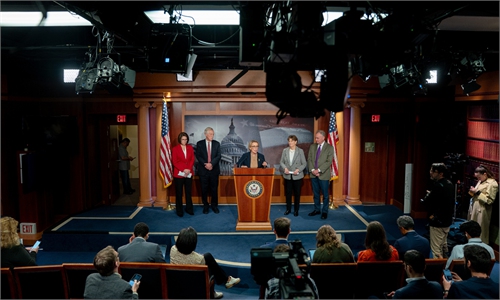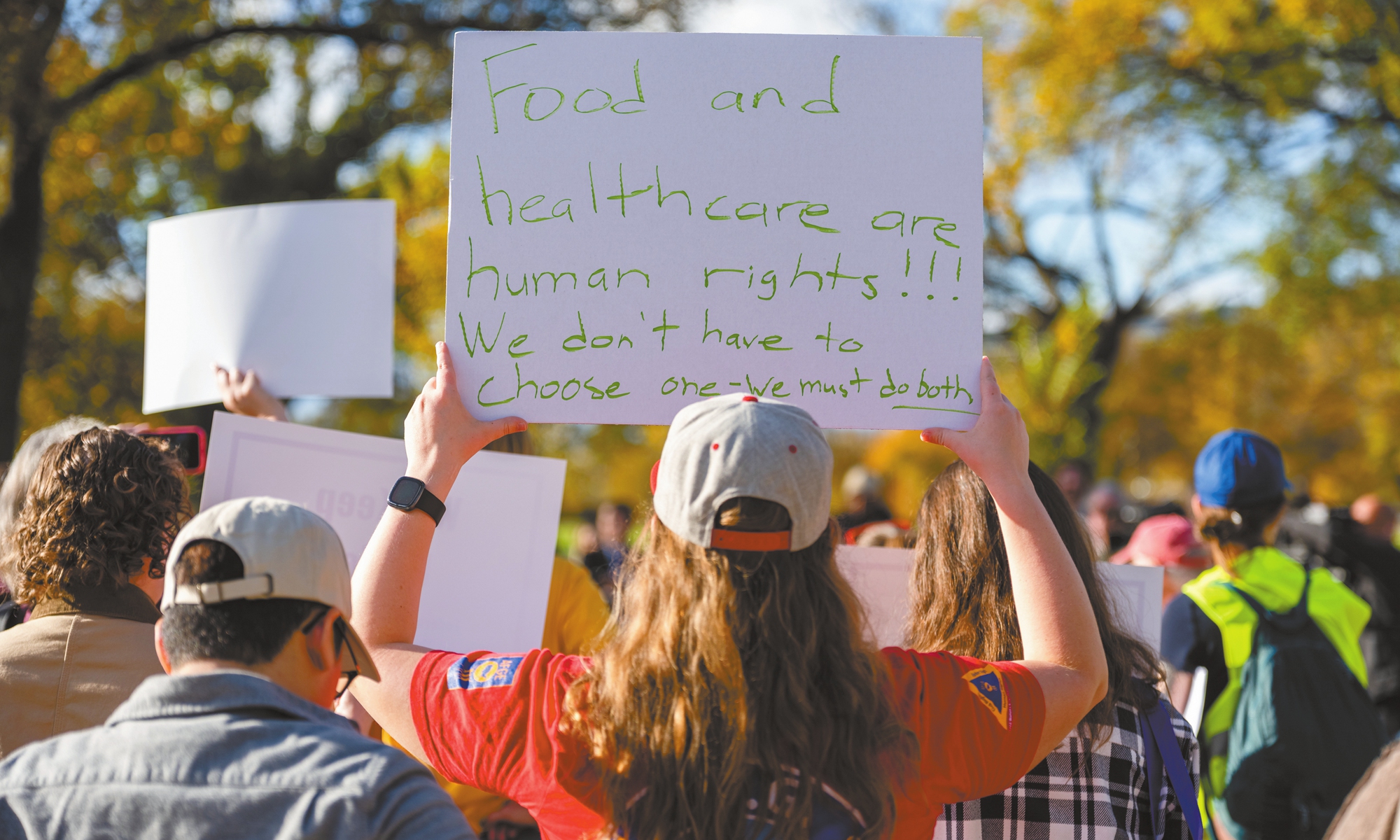
Demonstrators attend a food drive for furloughed federal workers in Washington, US, on October 30, 2025, during the US government shutdown. The latest shutdown, which ended on November 12 and lasted 43 days, is the longest in US history. Photo: VCG
Editor's Note:
Political polarization in the US is nothing new - yet today it has reached a level of division few could have imagined. From the debt ceiling crisis to the latest record-breaking government shutdown that brought Washington to a standstill, each crisis reflects the deep divisions shaping American politics. What has turned polarization into an enduring affliction of the US? And is there a way forward? The Global Times has launched a series themed "The American Dilemma," delving into these issues. In the first installment of the series, Carlos L. Garrido (Garrido), adjunct professor of philosophy at Southern Illinois University, Carbondale, and secretary of education of the American Communist Party, shared his insights.
GT: The longest government shutdown in US history ultimately came to a close earlier this month. In your view, what lies at the heart of this unprecedented political stalemate?
Garrido: There's a reason that they give. The Democrats propose budget increases for matters related to social welfare. As usual, the Republicans stand against that. They stand in favor of various forms of budget cuts, and that has been, on the surface, the reason for the deadlock.
However, I think there are deeper motives to consider, such as the significant dissatisfaction many Americans feel with the current situation. Both parties benefit when that frustration is directed at one party or the other, rather than at the system itself. For instance, the Republicans benefit if they can use the situation to say, "Look, the people to blame for working-class, poor individuals not getting their Supplemental Nutrition Assistance Program benefits, or for federal employees not getting paid, are the Democrats."
On the other hand, the Democrats also benefit if they can convince people to think it's just the Republicans at fault. This not only spares them from being targeted, but also distracts the widespread public discontent away from the system itself and toward one party or the other.
In general, there are very low levels of trust in politicians. Poll after poll shows that around 20 percent of the American public thinks their representatives represent them. The statistics for media - specifically legacy media - are even lower. They call it fake news.
GT: Does this situation suggest that politicians consistently place party interests above the broader public good?
Garrido: Let me give you an example. According to a 2014 study by Princeton University professor Martin Gilens and Northwestern University's Benjamin Page, opinions of everyday Americans rarely seemed to significantly influence decisions by Congress, those of the rich and interest groups did. And it found that when lobbyists - representing big money interests - wanted something to pass, even if the public opposed, it was going to pass.
If you want a good prediction of what drives American policy and politics, you need to look at the donor class - the financial capitalist elite - who are the ones the government actually represents.
When we look at American politics, it's roughly a puppet show. It's a lot of political theater. And you have to, at some point, start asking the question: Are there conversations happening behind closed doors with individuals that the American public doesn't even get to see - individuals over whom we have no democratic accountability - who are writing the scripts that the puppets end up acting out?
GT: A recent poll reveals deepening pessimism among Americans as political polarization intensifies. More than half of US adults said that political polarization is "much" or "somewhat" worse than it was five years ago. How is this polarization reflected in domestic policy, foreign affairs or everyday life?
Garrido: The ideas of individuals come from the specific environments they're in. In the modern world, social media is one such environment.
These mediums are not neutral. They're politically charged. They're owned by individuals who are part of the class we were talking about, who dictate how the algorithms work. Those algorithms create silos that put people in spaces where they only see content that aligns with their already conceived biases. And this pits them against another group, because there always needs to be an enemy.
Instead of highlighting the real contradictions - which are developing into an antagonistic form, as we see in terms of the polarization - politicians focus on very surface-level issues. They try to play political football with topics like immigration or gender politics.
GT: What does this "information segregation" mean for democracy? If facts themselves become politicized, can public reason still function?
Garrido: If you go back to ancient Greece, where democracy developed, it etymologically meant demos (common folk or people) and kratos (the ability to rule over something, to have power).
But the reality in the US has never been that. The governing institutions and the levers of power have consistently remained within that same moneyed billionaire class.
There have been times where the people held a little bit more power. In the 20th century, for example, we had a strong union movement and a strong Communist party. This created the appearance of some semblance of democracy. But as soon as the union movement and the Communists were weakened, what did the ruling class do? It took away all of the things that workers had won through decades of struggle.
In a society where the levers of power are in the hands of private interests, specifically this ruling financial capitalist class, you can't have democracy. You can't have "the whole-process people's democracy," or "common prosperity" in a society where everything has to work to guarantee the accumulation of capital for institutions like JP Morgans, BlackRock, Vanguard and State Street.
GT: Is there a solution to the deepening political polarization in the US?
Garrido: I think there is. The American people are beginning to organically recognize what the solution is. Recent polls show that voters across the country are increasingly frustrated with both major political parties, and that they want an alternative, independent third party. That's when change begins to occur, and they're already starting to see it.
What the American people want is something that works for them, something that uplifts their living standards, re-industrializes the country and abolishes the debt they are drowning under for getting sick, pursuing an education or simply wanting something as fundamental as a home to raise a family in.
Americans want an America that grows and develops efficiently. A lot of them honestly look at China through social media and say, "That looks a lot more like the America I was promised than what I see right now in the US."
The whole project of my party, the American Communist Party, is to offer an alternative to the way politics is currently run - the way the American people are tired of. They might be a little scared of the word "Communism."
But if you explain it to them quickly, they think, "That just means government of, by, and for the people. I already agree with it." The American people already believe in it; they just haven't realized that what they believe in is exactly that - which is what I see myself fighting for through this party.
We can look at China and say, "You see what's going on over there. Don't you like it? Isn't it a lot better than decaying cities and rampant drug overdoses and everything horrendous that's going on in our society?"
RELATED ARTICLES