Japan’s UN letter attempts to shift focus, shows no introspection on Takaichi’s erroneous remarks: expert
By Published: Nov 25, 2025 01:43 PM


Latest news
After China's permanent representative sent a letter to the UN Secretary-General outlining China's position on Japanese Prime Minister Sanae Takaichi's erroneous remarks on Taiwan region, Japan also submitted a letter to the UN, claiming that China's statements are "inconsistent with the facts." A Chinese expert on Tuesday slammed Japan's accusation of being detached from reality. The move attempted to mislead the international community, which also showed the country lacks introspection on Takaichi's erroneous remarks and bilateral ties.
In the letter sent on Monday local time to António Guterres, Japan's Permanent Representative to the UN Kazuyuki Yamazaki claimed that "the assertions made by China in the letter appear to be inconsistent with the facts and unsubstantiated," and said he was submitting the present letter "in response, based on instructions from the Japanese Government," according to a release from the website of Permanent Mission of Japan to the UN.
In his letter, Yamazaki claimed that "Japan's fundamental defense policy is a posture of passive defense, which is exclusively defense-oriented, contrary to the Chinese side's claims." He also claimed that the remarks by Takaichi are grounded in this position and argued China's assertion that Japan would exercise the right of self-defense even in the absence of an armed attack is "erroneous."
On November 21, Ambassador Fu Cong, Permanent Representative of China to the UN, sent a letter to the UN Secretary-General António Guterres, noting that Takaichi's provocative remarks on Taiwan marked the first time since Japan's defeat in 1945 that a Japanese leader has advocated in an official setting the notion that "a contingency for Taiwan is a contingency for Japan" and linked it to the exercise of the right of collective self-defense; the first time Japan has expressed ambitions to intervene militarily in the Taiwan question; and the first time Japan has issued a threat of force against China, openly challenging China's core interests, according to a release from the website of China's Permanent Mission to the UN.
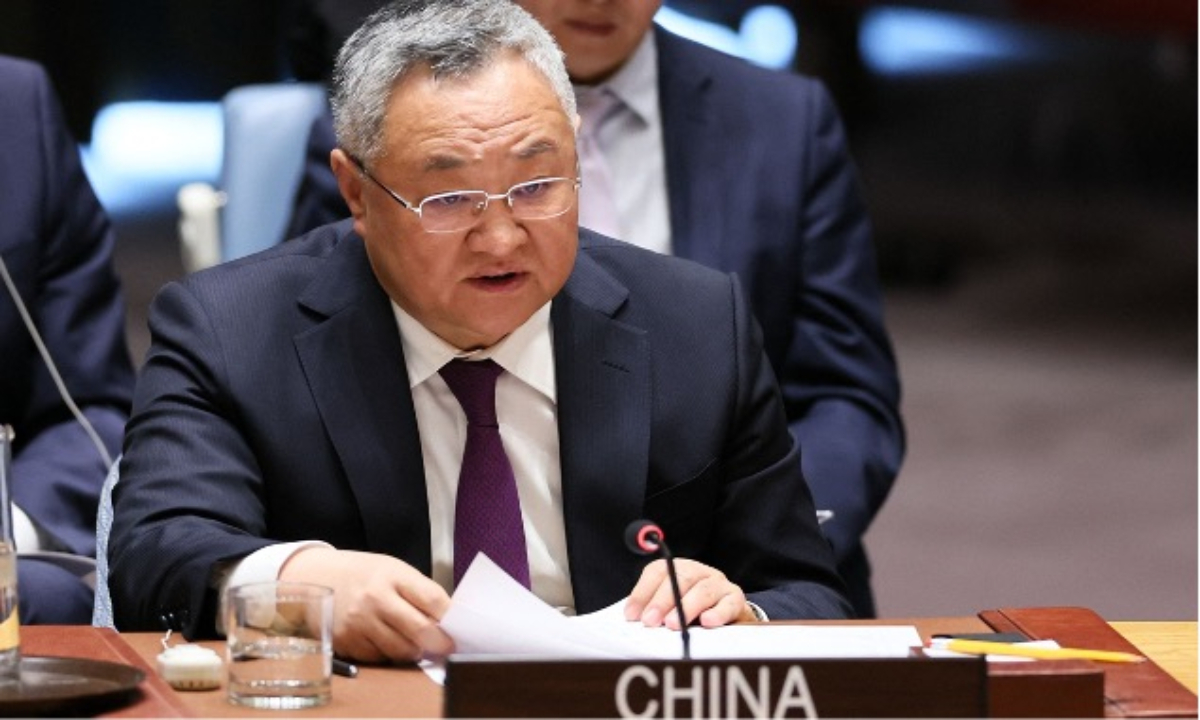
Fu Cong, Permanent Representative of China to the UN Photo: VCG
These remarks are gravely erroneous and extremely dangerous, with a profoundly malicious nature and impact, Fu said. Despite China's repeated démarches and protests, the Japanese side refuses to repent or retract its wrongful statements. China expresses strong dissatisfaction and resolute opposition, said Fu.Fu stressed that Takaichi's remarks constitute a grave violation of international law and basic norms governing international relations, seriously undermine the post-war international order, and represent an open provocation to the more than 1.4 billion Chinese people and to the peoples of other Asian countries that once suffered from Japanese aggression.
China's position is firmly grounded in facts and reflects legitimate concerns. Japan's latest accusation is an attempt to invert right and wrong — a tactic aimed at muddying the waters, downplaying the seriousness of its erroneous remarks and shifting attention away from the real issue. Yet its arguments fall apart under scrutiny, Xiang Haoyu, a distinguished research fellow at the Department for Asia-Pacific Studies of the China Institute of International Studies, told the Global Times on Tuesday.
Japan has deliberately sought to undermine its so-called exclusively defense-oriented policy. Yet its recent acceleration of military expansion shows that Tokyo is not only blurring the boundaries of this principle, but also eroding it piece by piece through a gradual, incremental approach — leaving the doctrine largely hollow and meaningless in practice, said Xiang.
The expert noted that the "survival-threatening situation" Japan refers to is essentially a self-created pretext for expanding collective self-defense. In effect, Japan could use force without being attacked, so long as it unilaterally defines a "crisis." Japan has sought room to justify military buildup, which should be alerted by neighboring countries and the international community.
Moreover, Japan is revising its security policies and acquiring offensive capabilities — including Tomahawk missiles, upgraded Type-12 missiles, and planned hypersonic weapons — that far exceed defensive needs and contradict its claim, said Xiang.
Japan's ruling Liberal Democratic Party began discussions on November 20 to revise key security documents, including the National Security Strategy, with plans to lift defense spending above 2 percent of GDP. The review has also revived debate over the "three non-nuclear principles," sparking concern among hibakusha and officials in Hiroshima and Nagasaki, according to The Asahi Shimbun.
Also, Japan's Defense Minister Shinjiro Koizumi recently inspected a Self-Defense Forces base in the Ryukyu Islands and announced that the plan to deploy Type 03 Chu-SAM missiles on Yonaguni Island would move forward. Ishigaki city assembly member Shiro Hanatani told the Global Times in a previous interview with evident concern that many residents oppose deploying missiles capable of striking other countries' territory.
Yamazaki's remarks once again reflect Tokyo's increasingly assertive security agenda. Such statements appear designed to mislead international community, shift focus away from the core issue, and attempt to ease the pressure Japan facing within Japan and from China and other countries. This suggests that Japan still lacks introspection and has yet to take meaningful steps to work with China to reduce tensions and address the matter constructively, said Xiang.
Such behavior deserves close attention and high vigilance in the region, said the expert.
RELATED ARTICLES