Illustration: Chen Xia/GT
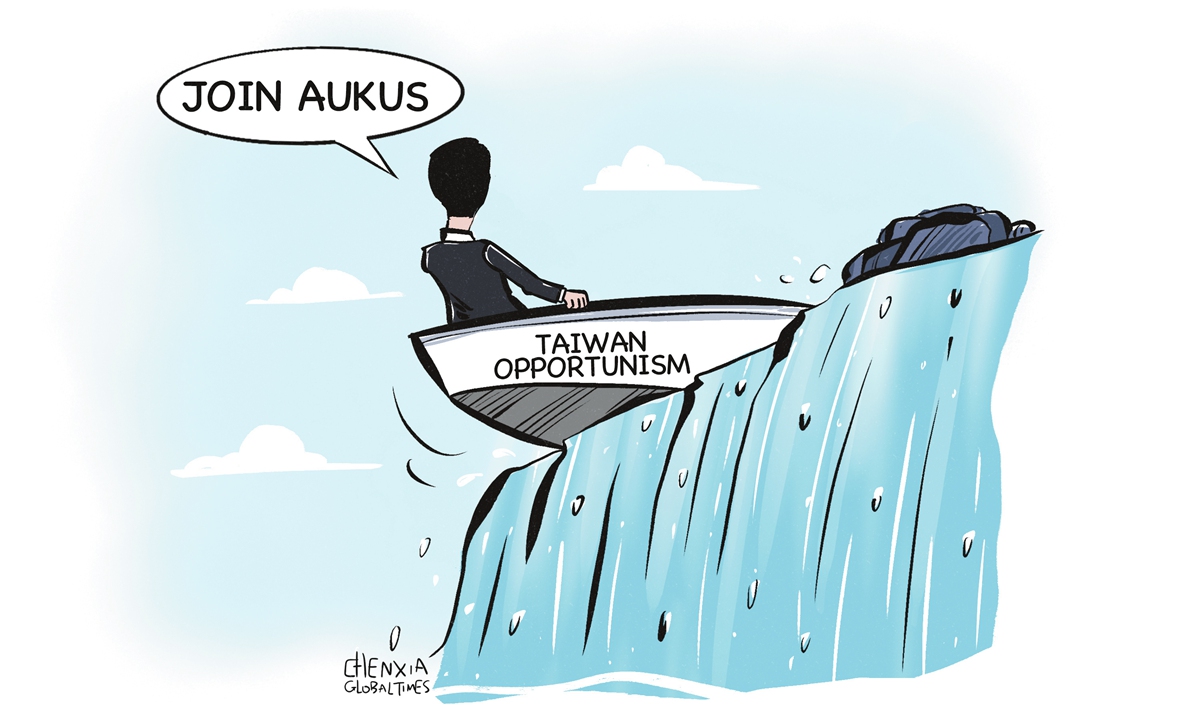
According to a report by the Australian Financial Review on Monday, Douglas Hsu, the chief representative of the Taipei Economic and Cultural Office in Australia, is urging the Albanese government to include the island of Taiwan in the AUKUS security pact between the US, Britain and Australia. He claimed that the Taiwan authorities had expressed interest in joining Pillar II of AUKUS.
It is worth noting that Taiwan's demand came against the backdrop of the ongoing spat between China and Japan triggered by Japanese Prime Minister Sanae Takaichi's recent erroneous remarks regarding the Taiwan question. Takaichi claimed that a "Taiwan contingency" could constitute a "survival-threatening situation" for Japan, sending wrong signals to Taiwan independence separatists.
By seeking to join AUKUS and warning against "coercive behavior" from the mainland, Taiwan is embarking on an opportunistic path to stage a political stunt, according to Chinese experts the Global Times interviewed.
Now on the island of Taiwan, anxiety over its security is growing amid increasing uncertainty about support from countries like the US. The authorities of the Democratic Progressive Party (DPP) therefore need to demonstrate its ability to integrate Taiwan into the security network of the US, UK, and Australia, Chen Hong, director of the Australian Studies Centre of East China Normal University, told the Global Times on Tuesday.
Chen also pointed out that the timing of Taiwan's request to join AUKUS also coincided with Zhao Leji, chairman of China's National People's Congress Standing Committee, visiting Australia. This suggests that Taiwan's move may be intended to sow discord in China-Australia relations, which have seen notable improvement over the past three years.
Noticeably, Chinese experts believe there is little chance that Taiwan will be included in AUKUS. The three countries - the US, Britain and Australia - would invite significant trouble if they were to approve Taiwan's request to join. Such a move would represent a deviation from the one-China principle, which serves as the political foundation and essential prerequisite for the establishment and development of diplomatic relations between China and these three countries. Allowing Taiwan to join AUKUS would be perceived as crossing China's red line. China's reactions following Japanese Prime Minister Takaichi's erroneous remarks have demonstrated its firm resolve regarding the Taiwan question.
Taiwan's petty calculations regarding joining AUKUS reflect its malicious intention of seeking more room and external support for "independence" on the international stage. However, "Taiwan independence" separatists should recognize that there is no room for reckless actions.
The notion of "Taiwan independence" is not a viable political option, it is something that must be decisively opposed. Attempting to rely on joining AUKUS for external support will prove futile, as it will not provide the security guarantees that "Taiwan independence" forces desire. Furthermore, the future of AUKUS itself is uncertain, with an ongoing US review of the pact casting doubt on its stability.
Engaging in political stunts is merely self-deception that will lead to embarrassment for "Taiwan independence" secessionists. They should abandon any illusions of relying on external powers and recognize the reality that there is only one China in the world, and Taiwan is an integral part of it.
RELATED ARTICLES