
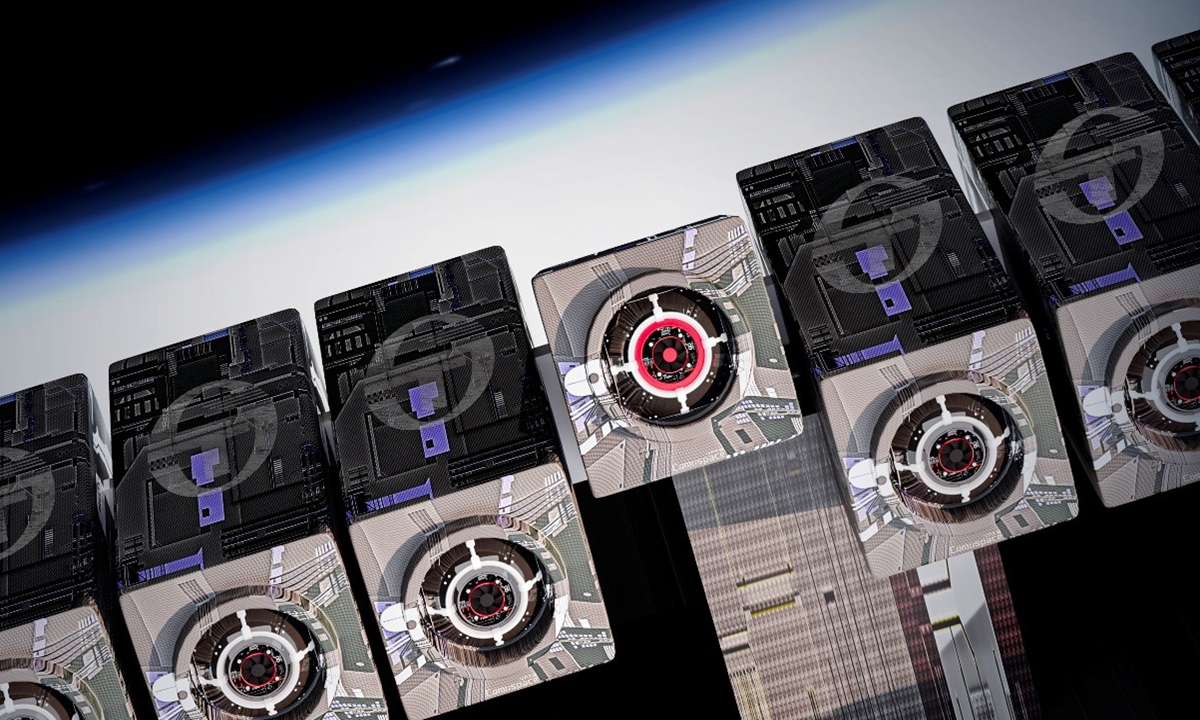
Laser Communication Array for Space-Based Supercomputing Center Illustration: Courtesy of the Institute of Computing Technology, Chinese Academy of Sciences
The concepts of orbital data centers and artificial intelligence (AI) satellites have become a heated topic recently, following US startup Starcloud's successful deployment of a refrigerator-sized satellite containing a powerful NVIDIA H100 graphics processing unit (GPU) into orbit via a rideshare mission by the SpaceX Falcon 9 in early November. The feat came just days after US tech billionaire Elon Musk said his SpaceX could be capable of deploying data centers as early as next year through its Starlink program.
According to NBC News on November 20, while discussing the future of the AI computing industry, Musk said again that "perhaps in the four or five-year time frame, the lowest-cost way to do AI compute will be with solar-powered AI satellites." He made the remarks while sharing a stage with Nvidia CEO Jensen Huang and Saudi Arabia's Minister of Communications and Information Technology Abdullah Alswaha. The CEO of xAI and Tesla announced a massive new data center project in Saudi Arabia on Wednesday.
China deployed its first homegrown AI-enabled satellite Dongfang Huiyan Gaofen 01 as early as December 2024, preceding US and laying the groundwork for a future space-based supercomputing center, said Han Yinhe, the program leader and a research professor at the Research Center for Intelligent Computing Systems of the Institute of Computing Technology, Chinese Academy of Sciences (CAS), in an exclusive interview with the Global Times.
The AI large-scale model onboard the Chinese satellite is codenamed JigonGPT. "We have taken the lead globally by achieving on-orbit generative remote-sensing analysis capabilities and pioneering the validation of satellite-ground intelligent interaction," Han said.
For example, the "Weibo Digital Human," powered by the onboard JigonGPT large vision-language model (LLM) can engage in real-time conversations with other users on social media platforms. This breakthrough has demonstrated both the feasibility of deploying generative LLMs in orbit and highlights their potential in ultra-low-latency response scenarios.
Han also noted that "this is not simply stacking of chips; instead, it focuses on building multi-GPU array architectures with domestically developed, high-efficiency GPUs to achieve an exponential leap in computing power per satellite - an indigenous innovation accomplished under the US chip embargo.
"Our solution places greater emphasis on modular design, system-level integration, and overcoming extreme challenges in thermal management and power consumption. The ultimate goal is to lay the foundation for future space-based supercomputing centers," he noted.
When asked to comment on the US startup's development, Han said that the Starcloud directly leverages the existing US technology ecosystem. "It relies on the mature NVIDIA H100 chip supply chain and delivers high peak performance per card. However, in essence, it is merely a transplantation of existing US technology into space, lacking architectural redesign," Han said.
"Our technical path is fundamentally different. At its core is a breakthrough in a fully indigenous 'single-satellite, multi-GPU array' space-based supercomputing architecture," he said.
Explaining why computing power and AI systems should be placed in outer space, Han said the goal is to eliminate the bottleneck of satellite-to-ground data transmission, especially in scenarios requiring ultra-low latency responses, such as disaster monitoring and early warning.
Han said China upholds the principle of open cooperation, and our achievements are fully worthy of sharing and should be shared. China can share the benefits with the international community by participating in joint scientific exploration missions, providing low-latency space data products and services and promoting interoperability and compatibility of technical standards, according to the program leader.
According to Han, the construction of space AI being pursued by the world's major spacefaring powers by no means a simple technological competition, but rather a struggle over who gets to set the standards for the next-generation space information infrastructure, the significant of which is no less profound than the global positioning satellite competition decades ago.
Han explained that whoever first masters mature on-orbit real-time capabilities in perception (seeing), cognition (understanding) and decision-making will seize the strategic initiative in the space era, a contest that directly affects national security and the right to shape future development.
In 2026, Han's team will carry out the orbital launch and in-orbit validation of the "single-satellite, multi-GPU array" space-based supercomputing technology demonstration platform. The team will also complete the tape-out and full validation of radiation-hardened, high-efficiency, domestically developed space-grade computing chips.