Influenza surge triggers public health alerts in multiple Chinese cities; expert notes seasonal levels with no virulent evolution
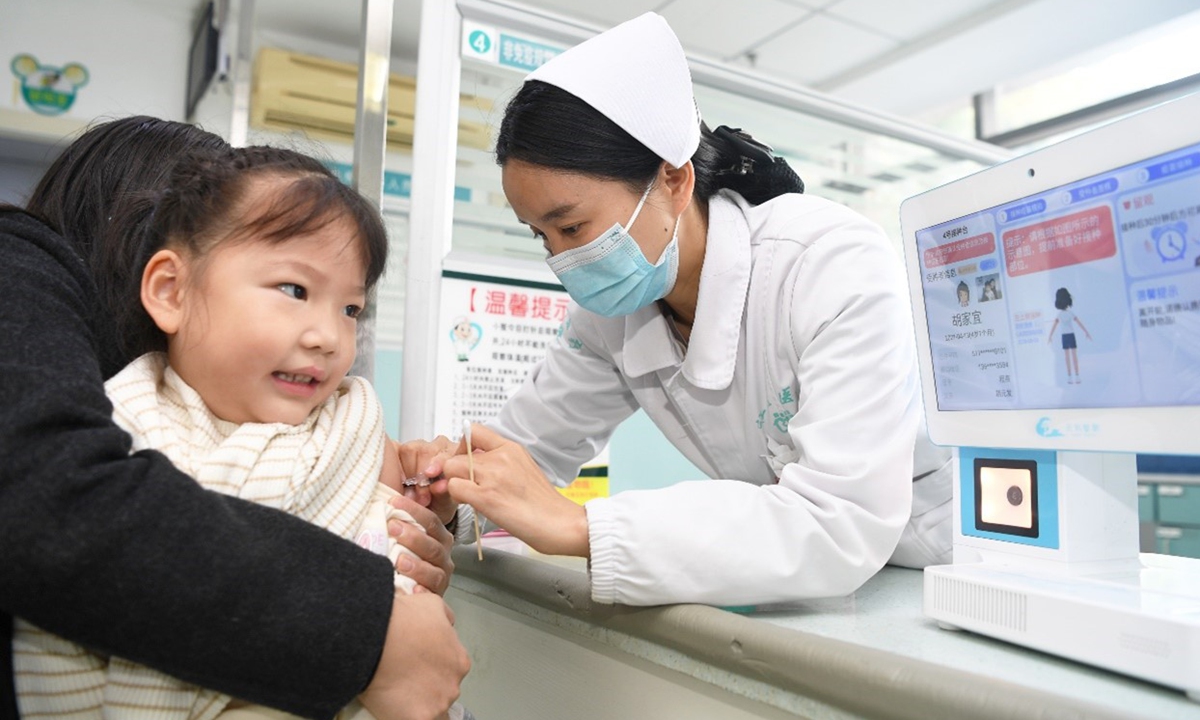
A nurse administers influenza vaccine to a child at a local clinic in Guiyang, Southwest China's Guizhou Province on November 13, 2025. Photo: VCG
As respiratory viruses have recently entered an active phase, the Chinese Center for Disease Control and Prevention (China CDC) and several local health commissions have issued health advisories, noting that influenza activity across the country has entered a period of comparatively rapid upsurge, with children being the primary affected group.
Due to the influenza surge, schools in cities such as Yangzhou, Nanjing, and Nantong, East China's Jiangsu Province have recently issued class suspension notices, the Paper reported on Wednesday. The report cited a school notice posted by a parent on social media, stating that a class was suspended for four days due to multiple students exhibiting symptoms such as fever, cough and vomiting.
The latest influenza surveillance weekly report released by the China CDC shows that influenza A (H3N2) holds an absolute dominance among the circulating strains, the Xinhua News Agency reported.
According to data from China CDC, influenza activity has entered a period of comparatively rapid upsurge, with most provinces reaching a medium epidemic level and some a high epidemic level, Xinhua reported.
Of the 3,439 influenza-positive specimens detected in southern Chinese provinces, 3,362 were influenza A, while of the 3,563 influenza-positive specimens detected in northern provinces, 3,535 were influenza A, the report said.
The H3N2 subtype is a relatively common viral variant, and even within the same epidemic season, influenza A (H1N1), H3N2 subtypes, or influenza B viruses may alternate in dominance, Zhuang Shilihe, a Guangzhou-based medical expert, told the Global Times on Wednesday.
He added that the virus is prone to mutation, leading to annual influenza outbreaks, yet these remain at seasonal epidemic levels and do not imply progressively stronger evolution.
The pathogens detected at this stage are all known common pathogens, with no unknown pathogens or emerging infectious diseases caused by them identified, Xinhua reported, citing data from China CDC's weekly report.
The number of reported influenza cluster outbreaks in childcare facilities and schools nationwide has shot up, and the positive detection rate of influenza viruses in the 5 to 14 age group is notably higher than in other age groups.
China's influenza peak season this year will potentially appear in mid-to-late December and early January, Wang Dayan, a researcher at the Institute for Viral Disease Control and Prevention under China's CDC, said at a press conference on November 10, state broadcaster CCTV News reported.
The Henan Provincial Health Commission issued a health reminder on its official WeChat account on Monday, stating that according to monitoring data from the provincial CDC, influenza in Central China's Henan remains on the rise recently, noting that this is generally consistent with the national trend and aligns with the pattern of high incidence of respiratory infectious diseases during past winter and spring seasons.
The health reminder said vaccination is the most effective way to prevent influenza, and seeking early medical consultation after symptoms appear is crucial.
Although the transmission influenza viruses has entered a peak season, receiving vaccination at this stage remains meaningful as it can bolster protective effects, Zhuang said.
Individuals with influenza-like symptoms (without a confirmed diagnosis) or those who have recovered from a previous influenza are still eligible for the vaccine, he added.
RELATED ARTICLES