Illustration: Xia Qing/GT
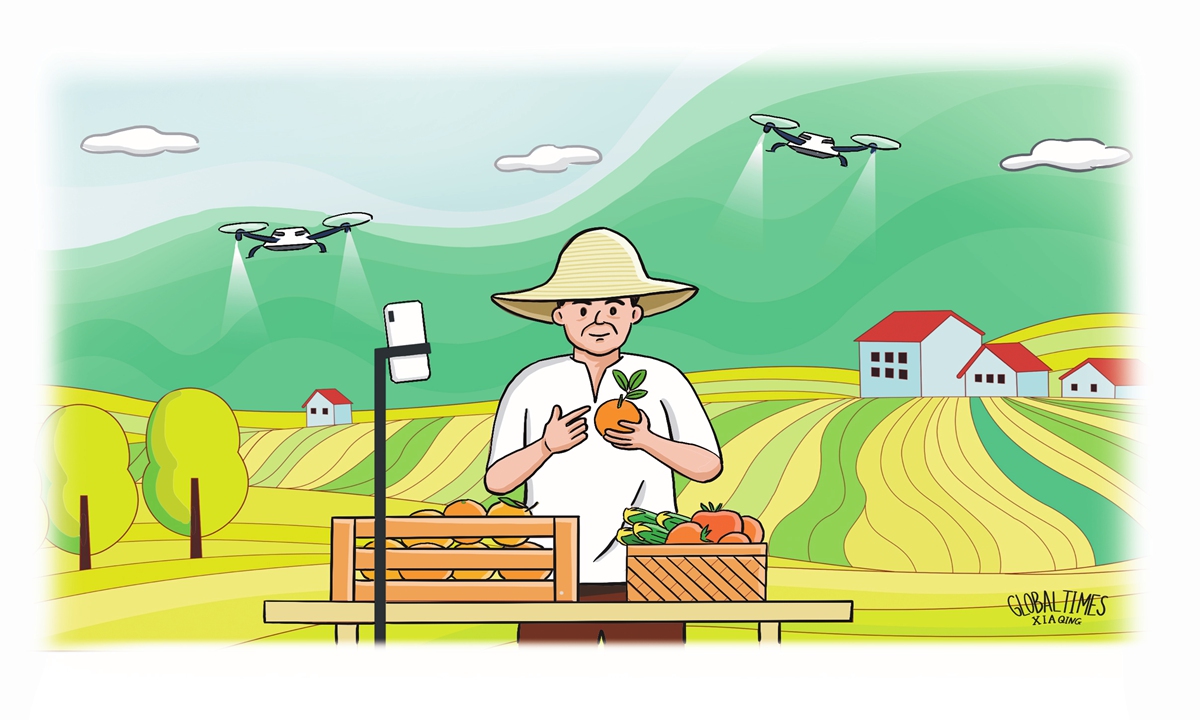
In Chongyang village, East China's Zhejiang Province, an experiment in e-commerce has become a revealing lens on a much larger transformation. According to the Xinhua Daily Telegraph, more than 50 villagers have supplemented their incomes by selling agricultural products through livestreaming; smartphones, the report notes, have effectively become a new kind of farm tool.For foreign observers accustomed to viewing China's tech ecosystem through the prism of corporate giants and sweeping national strategies, this micro-story underscores a more granular reality: Digital technologies are beginning to reroute value toward producers across different layers of the economy, and are doing so through increasingly low-cost, low-risk means.
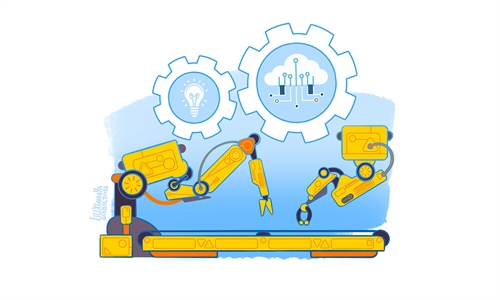
That shift is being reinforced by broader advances in artificial intelligence (AI), sensors and data analytics. As these technologies diffuse rapidly across industries, China's digital economy has begun to penetrate agriculture, the capillaries of the country's economic system. The process is uneven and still far from mature, but the direction is unmistakable: Digital tools are penetrating deeper into rural production in the hope of raising efficiency, strengthening supply chains and stabilizing household incomes.
Chongyang's story is far from unique. According to CCTV News, drones, BeiDou-enabled devices and automated monitoring systems are emerging as the latest "farm tools" from East China's Anhui Province to Southwest China's Sichuan Province.
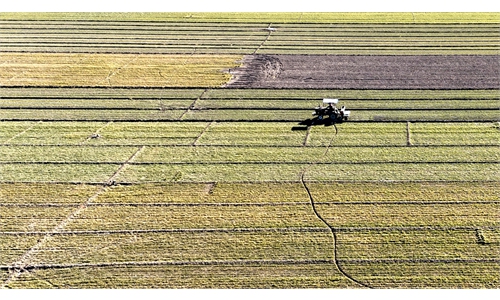
In some of Anhui's high-standard farmland, for instance, seeders equipped with BeiDou navigation systems are capable of fully autonomous operation. Taken together, these examples highlight how technological progress is beginning to reshape the way China grows, manages and transports food - and how that shift is likely to deepen in the years ahead.
Agriculture, by nature, is sensitive to cost and price swings. The growing use of digital farm tools illustrates how technological progress can make low-cost and broadly accessible innovations more viable. In Central China's Hubei Province, for example, farmers now deploy agricultural drones to transport navel oranges and spray pesticides. Such shifts are driven by economics, not novelty. Farmers will not invest in equipment that fails to deliver a return; for drones to gain traction, their purchases and operating costs must be outweighed by the cost savings, the efficiency gained, or the losses avoided.
The fact that these tools are emerging in cost-conscious rural areas suggests that digitalization is reaching an important inflection point: It is becoming not only technically feasible but also economically sensible for farmers operating under tight cost and price constraints.
While challenges remain, the broader adoption of new digital technologies in agriculture is beginning to deliver tangible benefits. Precision tools, automated systems and data-driven platforms are helping Chinese farmers optimize planting, reduce waste and manage inputs more efficiently - results that gradually translate into higher productivity, lower costs and more stable incomes. These developments demonstrate that technological progress can be inclusive, supporting smaller-scale producers and rural communities.
The broad-based development of digital technologies in China's agriculture not only supports domestic farming but also carries international relevance. According to the Xinhua News Agency, China's agricultural machinery exports have maintained strong momentum this year. Data from Chinese customs show that in the first half of the year, the total trade of agricultural machinery and components reached $9.98 billion, a year-on-year increase of 21.5 percent. These figures suggest that China's advances in agricultural technology are creating new opportunities for international cooperation and contributing to agricultural development beyond China's borders.
China's digital economy is creating new opportunities for international cooperation through the trade of agricultural machinery and technologies, particularly with developing countries. Farmers in these countries often need affordable digital tools that can help improve productivity, enhance crop yields and strengthen local food systems.
The broad-based development of digital technologies continues to directly benefit farmers. An expanding range of affordable, high-tech products is being integrated into new farm tools, from smartphones to drones and BeiDou-enabled equipment. If such approaches are encouraged and scaled, they could bring broader benefits to global agriculture, fostering more inclusive, productive and resilient farming systems.
The author is a reporter with the Global Times. bizopinion@globaltimes.com.cn
RELATED ARTICLES