Volkswagen opens first overseas full test workshop in China, showing foreign firms’ deepening integration with Chinese supply chains
By Published: Nov 26, 2025 11:12 PM
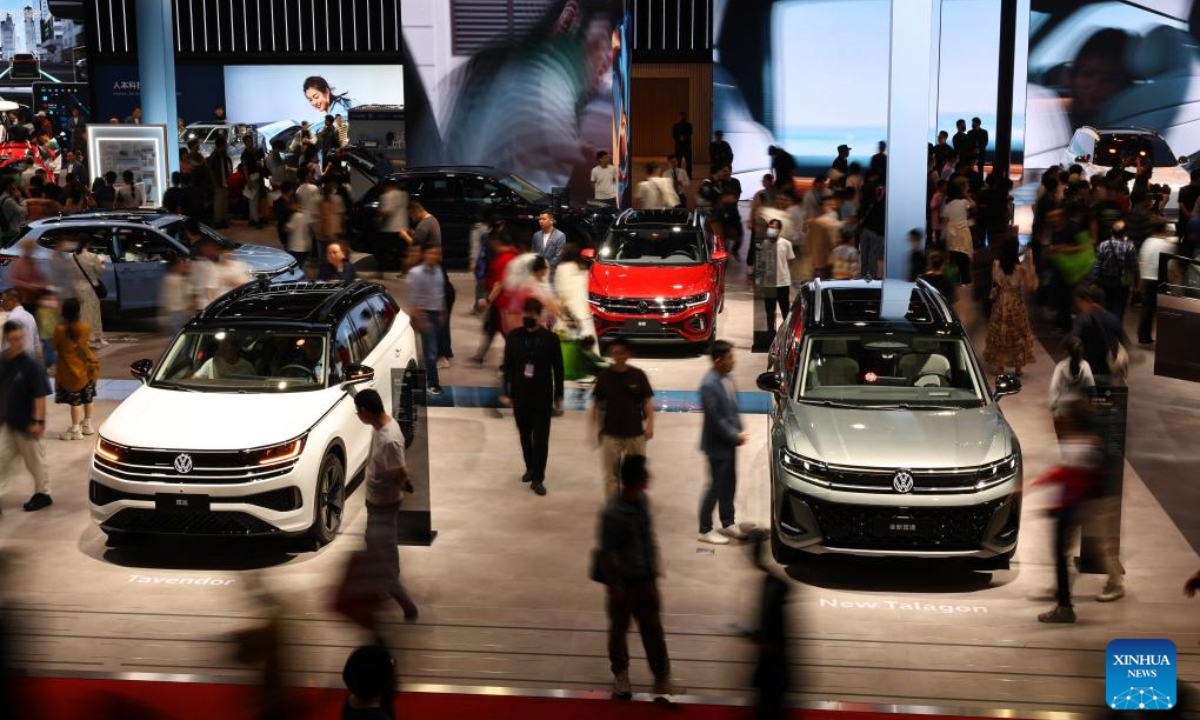
Visitors look at Volkswagen cars on the 21st Shanghai International Automobile Industry Exhibition in east China's Shanghai, May 1, 2025. People visit the auto show here on the first day of the May Day holiday. (Xinhua)
Foreign companies are ramping up investment in Chinese supply chains and research and development (R&D) facilities amid the nation's innovation boom, highlighted by the opening of German carmaker Volkswagen Group's first overseas full test center in China.
A Chinese analyst said on Wednesday that the trend underscores China's emergence as a global innovation hub, driven by the country's ongoing industrial transformation and policy support to accelerate innovation-driven growth.
On Tuesday, German carmaker Volkswagen Group announced the opening of its first full test workshop, Volkswagen Group China Technology Co (VCTC), in Hefei, East China's Anhui Province, with about 100,000 square meters of space and more than 100 advanced laboratories integrating software-hardware testing, battery and powertrain validation, and full-platform verification.
The opening signals the final expansion stage, and the new facilities significantly expand the group's local R&D strengths, the company said in a press release sent to the Global Times on Wednesday.
For the first time in Volkswagen Group's history, new vehicle platforms and key technology can be fully developed and brought to market readiness with all approval processes outside Germany, read the press release.
The new center in Hefei further strengthens the group's commitment in China by enabling earlier and more comprehensive validation of core vehicle systems, while also validating products and technology for export to regions such as ASEAN and the Middle East, the company said.
Enabled by the all-new Software-Defined-Vehicle development process, the overall vehicle development cycle can be shortened by 30 percent. Leveraging local development and early supplier integration during the concept phase of new cars and technologies, the cost of a new model can be reduced by up to 50 percent in specific key projects, said the German carmaker.
Highlighting the advantages of the Chinese supply chains, according to a report by the Financial Times on Tuesday, the company said that it can produce an electric vehicle entirely made in China for half the cost of doing so elsewhere.
The company plans to export cars developed and made in China to more overseas markets and has started exporting China-made internal combustion models to the Middle East about six weeks ago, Reuters reported.
US-based electric carmaker Tesla is another foreign automaker tapping into China's supply chain and innovation ecosystem. In a Sina Weibo post on Wednesday, Tesla Vice President Tao Lin praised Chinese supply chain partners, emphasizing that the cost-effectiveness of Tesla in the Chinese market stems from the intelligent manufacturing at its Shanghai Gigafactory, which enables domestic consumers to buy Model 3 and Model Y vehicles at the lowest prices globally.
"Tesla takes pride in collaborating with more than 400 local supply chain partners in China... delivering outstanding products to millions of users in China, the Asia-Pacific region, and Europe," Tao said, adding that "we are also honored to have integrated more than 60 of these suppliers into Tesla's global procurement system."
Chinese analysts said that as the nation continues to expand its opening-up despite global complexities, a growing number of foreign firms are embedding themselves in China's ecosystem rather than merely exporting goods. This trend aligns with the country's climb up the innovation ladder, supported by policy focus, corporate participation, and a continuously open and competitive environment.
In terms of policy support, a report by the Xinhua News Agency on October 27 noted that in China's consumer goods trade-in program for automobiles, foreign brands such as Tesla accounted for one-third of vehicle trade-in sales.
Bian Yongzu, a senior researcher at the China Institutes of Contemporary International Relations, told the Global Times on Wednesday that increasing R&D investment in China has become a crucial strategy for foreign companies to maintain global competitiveness, highlighting the country's role as "not a mere sales outlet, but a critical strategic hub."
Bian added that China's vast consumer market, with rising incomes and evolving demand, plays a significant role in driving product development and innovation. By expanding R&D in China, foreign firms gain access to highly skilled researchers with solid foundational knowledge and international perspectives.
In recent years, many multinational corporations have chosen China as a preferred location for their R&D centers, both to cater to the vast domestic market and to serve global demand. Since 2023, China has further intensified efforts to attract foreign investment through a series of business promotion activities, as reported by Xinhua.
China saw 53,782 newly established foreign-invested firms in the first 10 months of 2025, a year-on-year increase of 14.7 percent, the Ministry of Commerce announced on Friday. Actual foreign direct investment inflows totaled 621.93 billion yuan ($87.78 billion). Notably, high-tech industries attracted 192.52 billion yuan in actual FDI during the period.
The country's modern manufacturing capabilities, comprehensive supply chain network, and abundance of real-world testing scenarios significantly shorten R&D cycles, far exceeding global averages, Bian said.
More broadly, China's strong emphasis on R&D in recent years, coupled with fair treatment for foreign companies and continuous optimization of the business landscape, has enhanced its appeal. The rapid integration of artificial intelligence into traditional industries further strengthens this position. These factors make foreign companies eager to leverage China's experience in these domains, with establishing local R&D centers proving an effective approach, Bian noted.
RELATED ARTICLES