Takaichi challenged by opposition leader in parliamentary debate, criticized as 'reckless' by media; Chinese FM slams Japan for refusing to reflect on mistake
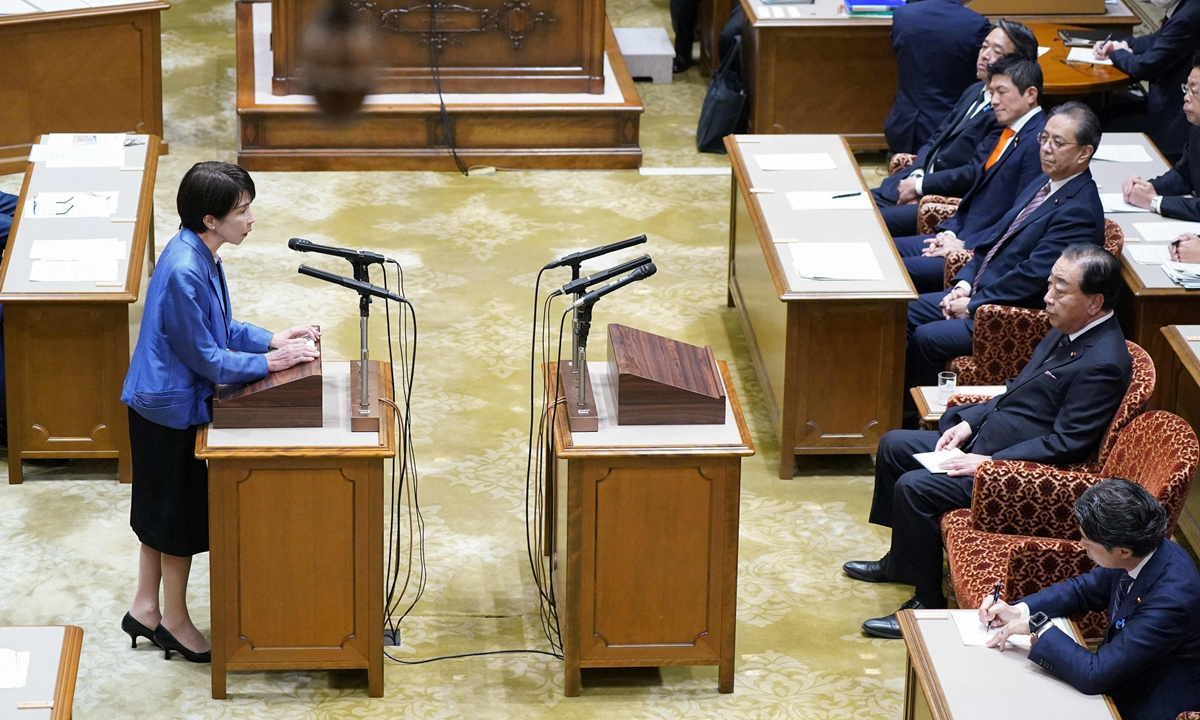
Japan's Prime Minister Sanae Takaichi (L) takes part in a debate with opposition party leaders in the National Diet in Tokyo, Japan on November 26, 2025. Photo: VCG
China on Wednesday criticized Japan for doubling down on its erroneous rhetoric concerning the Taiwan question, after Tokyo approved a government statement that Beijing says once again made "irresponsible remarks" and constituted interference in China's internal affairs.The remarks were made by spokesperson Mao Ning in response to the Japanese government on November 25 adopted a cabinet statement asserting that Prime Minister Sanae Takaichi's remarks at a parliamentary committee meeting "does not change Japan's consistent position." The statement claimed that decisions on whether a situation constitutes an existential threat would be made by considering all available information based on specific circumstances, and that Tokyo "fully maintains its position" and sees no need for a review.
"The Japanese side, instead of turning back from the wrong course, again made irresponsible remarks in the statement regarding the Taiwan question and interfered in China's internal affairs," Mao said, "Let me stress that Taiwan is China's Taiwan. How to resolve the Taiwan question and realize national reunification is purely China's own affair and not for Japan to point fingers or even meddle in it."
The rift between Beijing and Tokyo deepens after Takaichi's erroneous remarks on Taiwan question, however, the latter still lacks actual actions to improve relations.
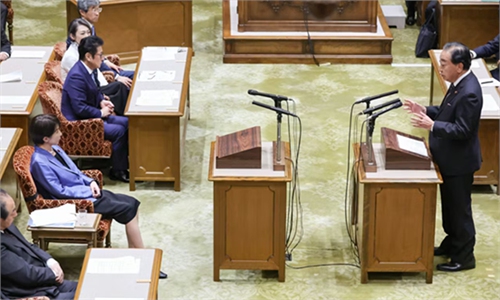
According to Nikkei, during the parliamentary debate with Takaichi on Wednesday, Yoshihiko Noda, head of the main opposition Constitutional Democratic Party of Japan, pointed out that Takaichi's November 7 remarks concerning a so-called "Taiwan contingency" had chilled China- Japan relations, asking Takaichi, "Wasn't this an act of arbitrary decision-making? Do you feel a sense of responsibility?"
Noda criticized Takaichi's November 7 claims on Taiwan, stating, "As the supreme commander of the Self-Defense Forces, there are things one must not say. Carelessly voicing personal views is reckless," Nikkei reported.
Takaichi explained that she made the comment during a parliamentary session on November 7, responding "sincerely" to a specific question about Japan's potential response to an emergency involving the Taiwan question, Nikkei reported. She claimed that it is her responsibility to maximize Japan's interests by building good relations with China through dialogue, the Kyodo News reported.
Takaichi, head of the ruling Liberal Democratic Party (LDP), also claimed that the government will make a comprehensive judgment on what constitutes a "survival-threatening situation" by taking into account all available information and reviewing the specific circumstances that arise.
Lü Chao, director of the Institute of American and East Asian Studies at Liaoning University, told the Global Times that Takaichi's latest remarks remain evasive and sidesteps the core issue.
She has neither reviewed nor retracted her previous erroneous remarks, which is completely unacceptable to China, Lü said.
As for her expressed willingness to engage in dialogue with China, the expert points out that Takaichi is deliberately turning the facts upside down. "She is attempting to create the false impression for the outside world that it is Beijing that refuses to talk, while completely omitting to mention that the current tense situation was provoked by her own challenges to China's core interests."
According to the Yomiuri Shimbun, regarding Taiwan question, Takaichi claimed that Tokyo maintains "a non-governmental, working-level relationship" with the island.
Furthermore, under the San Francisco Peace Treaty, Japan renounced all right, title, and claim to Taiwan, and Japan is not in a position to determine or recognize the legal status of Taiwan, the media quoted Takaichi as saying.
Analysts said Takaichi's remarks again showed her lack of sincerity as it is widely acknowledged that Taiwan was restored from Japanese occupation to China in 1945, and island's return to China is an integral part of the post-war international order.
Xiang Haoyu, a distinguished research fellow at the Department for Asia-Pacific Studies of the China Institute of International Studies said Japan has long pursued a strategy of "using Taiwan to contain China," but after the latest round of struggles, this approach has proven completely unworkable. "There is now no room left for ambiguity in Japan's stance and attitude on the Taiwan question. Tokyo should harbor no illusions and must face reality squarely," Xiang said.
Risky recklessness
As Takaichi marked her first full month in office, her handling of Japan-China relations has become a focal point of intense media scrutiny.
Tokyo Shimbun commented that "courage" and "recklessness" are words that appear similar but are fundamentally different. The boundary between them is not always clear. Courage can, carried by the momentum of the moment, inadvertently cross the line into recklessness, leading to regret. If this becomes a failure of national policy, it is invariably the citizens who pay the price.
Former Japanese prime minister Shigeru Ishiba on Wednesday stressed in a speech the importance of building stable relations between China and Japan when referring to the bilateral relations that have deteriorated due to current Prime Minister Sanae Takaichi's erroneous remarks on the Taiwan Straits in the Diet, the Mainichi Shimbun reported.
"Can our country exist without relations with China?" Ishiba stated in the speech in Tokyo.
Ishiba explained that, since the normalization of diplomatic relations between Japan and China in 1972, successive administrations have understood and respected the Chinese position that Taiwan is a part of China. Referring also to his own experience, he said, "It is something that must not be changed, and we have proceeded with tremendous caution," Mainichi Shimbun reported.
He also noted the current situation in which a wide range of imports from China—such as food, rare earths, and pharmaceuticals—support the Japanese economy, and once again called for paying attention to the smooth China-Japan diplomacy, said the report.
"Takaichi is a typical populist politician in Japan," Zhu said, "compared to properly handling relations with other countries, she cares more about gaining media exposure and influence in order to win greater public support."
RELATED ARTICLES