IN-DEPTH / IN-DEPTH
From past amity to today’s rift – Whose fault? Exploring how Japanese militarism erodes foundations of peace
‘No more war’ monument’s warning
By in Hangzhou, Xie Wenting, Liang Rui in Beijing Published: Nov 27, 2025 09:04 PM

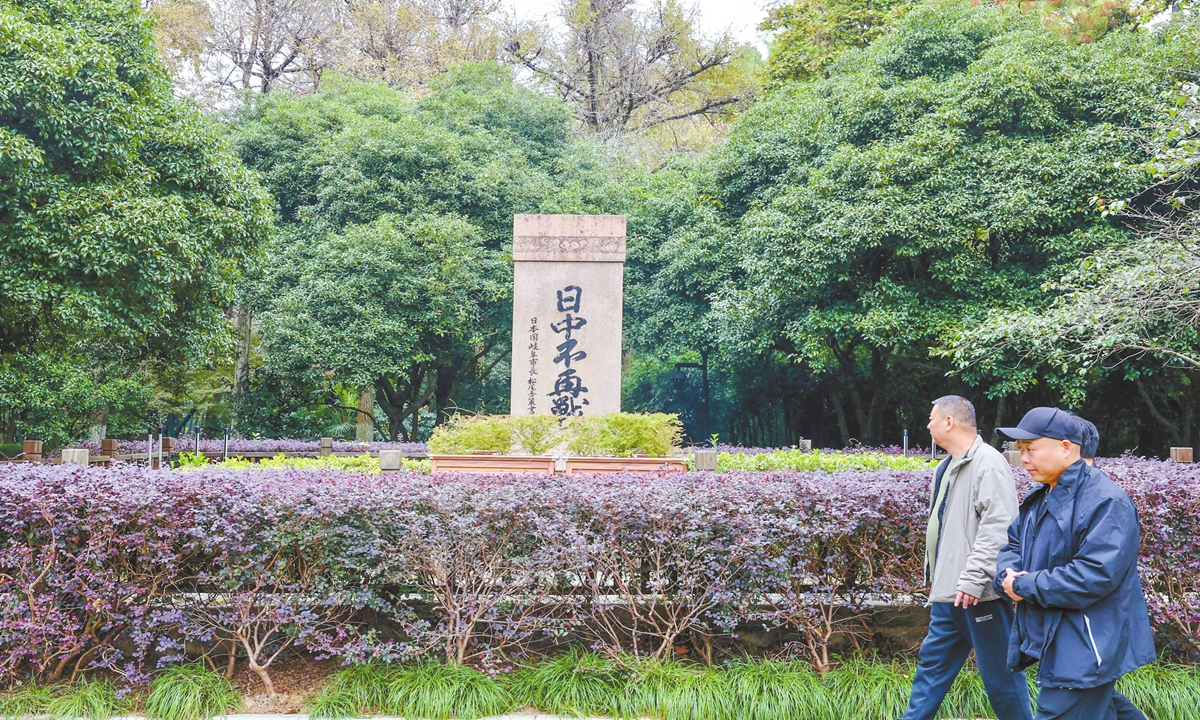
The "No More War Between Japan and China" monument in "Orioles Singing in the Willows" park by the West Lake in Hangzhou, East China's Zhejiang Province Photo: Chen Xia/GT
A cold edge rides the early-winter wind as strollers wander the rim of West Lake, one of China's most iconic and beloved scenic spots in Hangzhou, East China's Zhejiang Province. A few steps from the water, in the lakeside "Orioles Singing in the Willows" park, a stone monument nearly two meters high rises from the shrubs, bearing a line of captivating calligraphy in Chinese - "Ri Zhong Bu Zai Zhan" - which means "No More War Between Japan and China."
Nearby, some visitors pause, step closer, snap photos with their phones, and quietly read the inscriptions etched upon its surface.
Unveiled in Hangzhou in December 1962 by the then-mayor of Japan's Gifu Prefecture, the monument stands - for many - as a testament to the sincere remorse of the Japanese people, marking the dawn of Chinese-Japanese amity at that time.
"Seeing this monument, I feel the Japanese people expressed remorse for the harm they once inflicted on many countries, including China," visitor Liu Yanping told the Global Times on Monday.
An inscription on the back recounts, in Chinese, how Japan's invasion brought grievous suffering to the people of Hangzhou and other places in China. It notes that soldiers from Gifu were among the aggressors - a fact that the people of Gifu felt deep sorrow over - and expresses their wish that the peoples of the two countries might live in friendship and never again go to war.
"But now... I wonder whether their reflections on the war are truly sincere, and whether they come from the heart," Liu sighed, standing before the stone, as she mentioned the recent highly inappropriate remarks made by Japanese Prime Minister Sanae Takaichi who linked the Taiwan question to a "survival-threatening situation" of Japan, which implies the possibility of armed intervention in the Taiwan Straits.
Takaichi's irresponsible rhetoric, which has fueled recent tensions in China-Japan relations, has left many visitors like Liu deeply concerned. The aspiration for "living in friendship" and "never again going to war" inscribed on the memorial sits in sharp contrast to the current state of bilateral ties. The visitors - and more people who long for friendship between the two countries - are eager for answers to particular questions: Whose fault is this, and who should be held responsible for the deterioration of China-Japan relations today?
Da Zhigang, director of the Institute of Northeast Asian Studies at the Heilongjiang Provincial Academy of Social Sciences, told the Global Times that the current situation ultimately stems from the resurgence of right-wing militarism ideology in Japan.
"The catastrophe and scars brought by militarism are not far off. Those Japanese politicians should draw lessons from the monument, reflect, and retrospect," he said.
"China does not oppose Japan or the Japanese people, but it does oppose the revival of militarism."
'Honeymoon' forged in guilt and gratitude
When the "No More War Between Japan and China" monument was erected, although China and Japan had not established diplomatic relations at that time, there were still some trade and exchanges between the peoples of the two countries, which were continuously promoted from a grassroots level back then, according to Da.
The turning point came a decade later. On September 25, 1972, the then Japanese prime minister Kakuei Tanaka visited China. Four days later, the Chinese and Japanese governments issued the Sino-Japanese Joint Statement, normalizing diplomatic relations between the two countries and opening a new page in bilateral relations.
"The Japanese side is keenly conscious of the responsibility for the serious damage that Japan caused in the past to the Chinese people through war, and deeply reproaches itself. Further, the Japanese side reaffirms its position that it intends to realize the normalization of relations between the two countries from the stand of fully understanding 'the three principles for the restoration of relations' put forward by the Government of the People's Republic of China," read the joint communique on the website of the Ministry of Foreign Affairs of Japan.
Tanaka faced pushback from conservative factions at home at that time, but this "wise and great statesman" saw the global chessboard clearly: The rivalry between the US and Soviet Union, the fragility of the US-Japan security treaty, and the US' pivot toward China. He realized the great potential and benefits that Japan could have in cooperating with China so he "seized the moment," Da pointed out.
"Japan eyed the economic goldmine in China's vast markets and the chance to reclaim influence in Asia amid its own postwar constraints," he analyzed.
From 1975, China and Japan started negotiation for the conclusion of a treaty of peace and friendship, and in August 1978, the foreign ministers of the two countries signed the Treaty of Peace and Friendship Between the People's Republic of China and Japan.
In October 1978, Deng Xiaoping, the chief architect of China's reform and opening-up, was invited to pay an official goodwill visit to Japan. He spent a lot of time visiting Japan's modern enterprises and high-tech facilities, and met with a large number of Japanese business leaders, senior economists, technicians, and managers, according to the website of Chinese Ministry of Foreign Affairs.
"I have come to Japan to learn from the Japanese people," said Deng earnestly at a press conference. "And we believe such an attitude, together with China's policies and guidelines, will bring hope to China." Deng's frank, down-to-earth manner, his open-mindedness and confidence impressed his Japanese hosts, according to the ministry's website.
In 1978, Panasonic became the first foreign company to settle in China. In 1979, Japan began to provide China with the Official Development Assistance which was an important component in the bilateral relationship and economic cooperation between the two countries.
The 1980s unfolded as a golden interlude, a "honeymoon" period for both countries. Although there are some contradictions between the two sides, the overall atmosphere is one of amity, and many people in Japan at that time were keenly aware of the heavy burden of history and felt guilty about the crimes their country had committed. Public sentiment at the time reflected this positive momentum, according to Da.
The China-Japan Friendship Hospital was established through the cooperation of the Chinese and Japanese governments at that time.
"While the relations between the two countries now deteriorated, it is important to know how we started," he said.
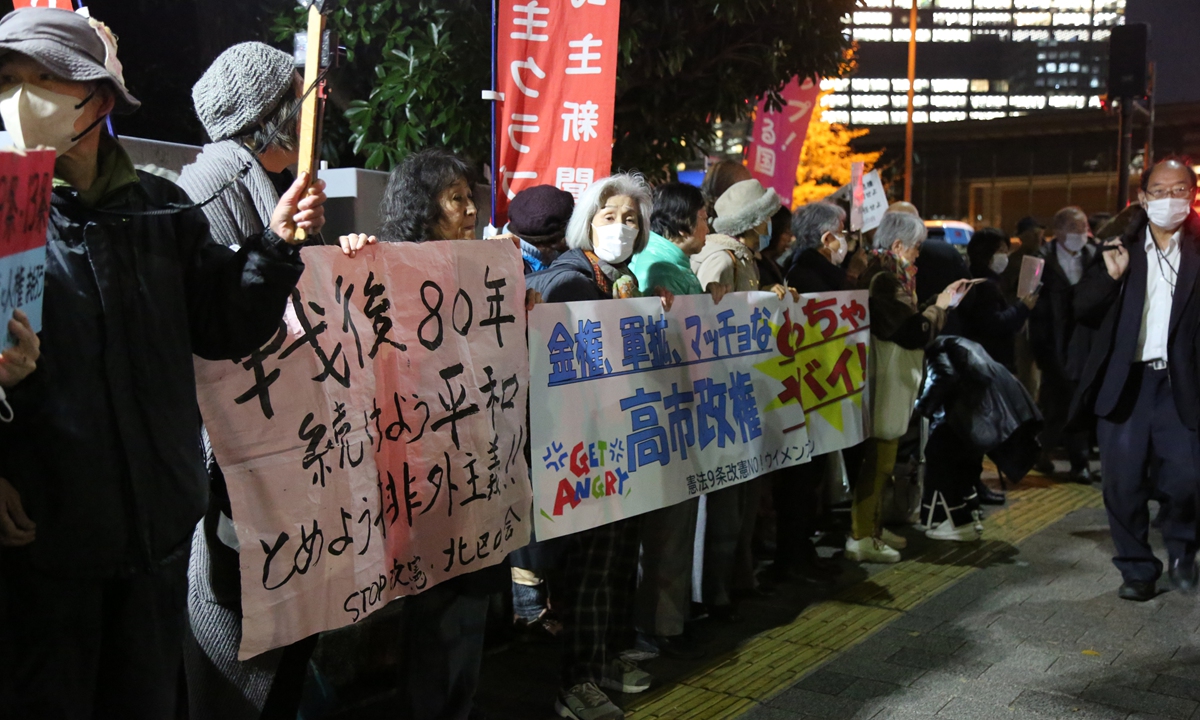
Hundreds of Japanese residents hold a protest in front of the prime minister's official residence in Tokyo, demanding that Prime Minister Sanae Takaichi retract her recent erroneous remarks on Taiwan and offer an explanation and apology, on November 25, 2025. Photo: IC
Shadows of militarism riseSince the mid-1990s, Japan's conservative and right-wing forces repeatedly stirred up controversies on historical matters, such as the visits to the notorious Yasukuni Shrine, a symbol of the country's past brutal militarism and textbook revisions, or court rulings against China in private historical disputes.
"However, in 1995 - while marking the 50th anniversary of the end of World War II - the then Japanese prime minister Murayama Tomiichi, under a coalition government, delivered the Murayama Statement. It acknowledged colonial rule, expressed remorse, and offered apologies, injecting a much-needed breath of fresh air at the time," Da said.
Yet afterward, from 2001, the then Japanese prime minister Koizumi Junichiro visited notorious Yasukuni Shrine six times, further straining bilateral ties amid Japan's own economic downturn.
In reality, China-Japan relations were also shaped by Japan's post-Plaza Accord trajectory: The bubble economy peaked around 1990 and then collapsed, ushering in a "lost decade" (or two, by some accounts) of stagnation and social malaise, according to Da.
Amid this, Japanese public opinion shifted. As one nation declined while another rose, many Japanese views of China evolved. In the 1980s, when China was still poor, Japan felt a mixture of atonement and a sense of superiority. Today, that sense of guilt has largely faded as younger generations - who have little direct knowledge of the real war-era history - have come to the forefront. At the same time, with China no longer needing Japan's Official Development Assistance, the former sense of superiority has also disappeared. This shift has given rise to anxiety, a rejection of China's rise, media-driven "China threat" narratives, and a broader rightward drift in Japanese society, where such sentiments now find wide resonance, the expert explained to the Global Times.
Ultimately, shifts in the bilateral relations stem from changing power dynamics and geopolitics, driven by China's rising comprehensive strength. Ongoing fermentation of historical issues has been compounded by new frictions. Meanwhile, Japan's governments, marked by instability, with constant changes of prime ministers like a revolving door, adopted varied China policies: Some objective and neutral, others aligning with US containment, emphasizing vigilance, or stoking public panic, he added.
Meanwhile, Japanese right-wing forces have been pushing to reinterpret the pacifist constitution, lift the ban on collective self-defense, revise the "Three Non-Nuclear Principles," and pursue the ambition of turning Japan into a "military powerhouse."
"Japan's turn is also part of a global pattern in which far-right movements regain legitimacy not by winning overwhelming majorities, but by creating enough political space that their ideas can once again be articulated without shame," Peter T C Chang, research associate at China-Malaysia Friendship Association and former deputy director at the Institute of China Studies, University Malaya, told the Global Times in a previous interview.
"In this regard, Japan's militarized turn should alarm the region. The danger is not only the possibility of future conflict, but also the deeper erosion of the normative firewall that was built out of the catastrophe of the last great war," he emphasized.
Fractured bridges
The Japanese invasion of China during WWII brought untold suffering to the Chinese people. For visitor Liu, now 55, that pain is still etched in memory.
Liu grew up in a family in Northwest China's Shaanxi Province. Her eldest uncle fought in the Battle of Taierzhuang in 1938 and was shot by Japanese soldiers before being rescued by local villagers. But the evil of the invaders continued to haunt the family long after the war ended.
Liu recalled that in the 1970s, when she was four, one day her father dug up an unidentified object while plowing a field. She and her then two-year-old sister treated it like a toy; both later fell ill with infections afterwards. Tragically, her sister succumbed to the illness.
Liu only later learned that the object was a biological weapon left behind by the Japanese during WWII. "I cannot help but hate the Japanese invaders," Liu told the Global Times, her eyes reddening with emotion.
Those who have endured the horrors of Japan's wartime aggression value peace more deeply than most, and are particularly repelled by current Japanese remarks that whitewash the past or hint at military intervention in China's internal affairs.
Standing before the monument engraved with "No More War Between Japan and China," Liu condemned the irresponsible rhetoric of Takaichi as utterly devoid of conscience. "They committed so many ugly acts; no amount of beautification can change the facts," she said.
At Monday's media briefing, Chinese Foreign Ministry spokesperson Mao Ning pointed out, "China has articulated its position multiple times on Japanese Prime Minister Sanae Takaichi's erroneous remarks on Taiwan. Those remarks seriously violate the principles laid down in the four political documents between China and Japan, and has fundamentally eroded the political foundation of China-Japan relations."
The one-China principle is an unshakable prevailing consensus in the international community. If there has truly been no change to the Japanese government's position on the Taiwan question, Japan should unequivocally uphold the one-China principle, and abide by the spirit of the four political documents between the two countries and honor the commitments Japan has made.
"China urges the Japanese side to take seriously what it has heard from China, do serious soul-searching and correct its wrongdoing, act to honor its commitment to China, and stop pursuing its misguided course, still less say one thing but do another," Mao stressed.
On Monday morning, a few visitors stood before the monument by West Lake, gazing at its inscriptions with mixed emotions. When approached by Global Times reporters for their views on current China-Japanese relations, most declined to comment.
"We also hope the two countries get along," one middle-aged visitor said with a sigh. "No one wants war, but..." He trailed off, and walked away quickly amid the cold wind.
RELATED ARTICLES