IN-DEPTH / IN-DEPTH
Wartime news restriction, postwar education causes of Japan’s historical perception gap: Vice President of Japan-China Relations Society
Peace based on truth, justice
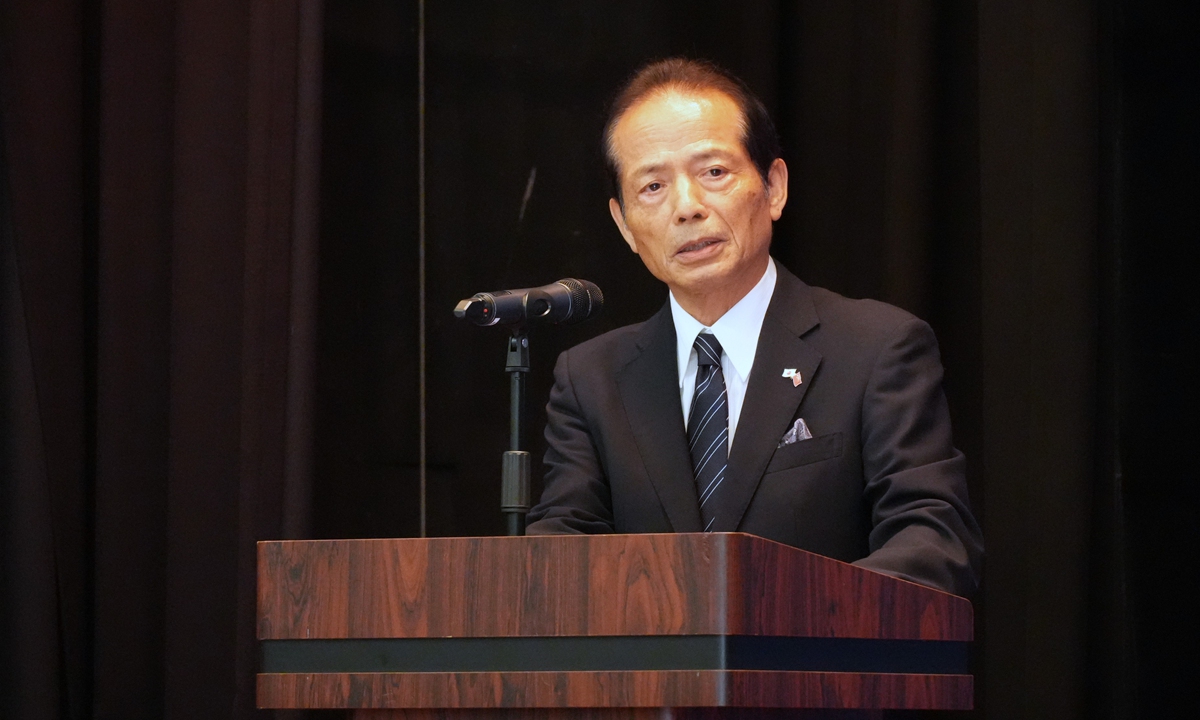
Noriyuki Kawamura, vice president of the Japan-China Relations Society Photo: Courtesy of Kawamura
Why do China and Japan hold such starkly different views on history? Noriyuki Kawamura, emeritus professor at Nagoya University of Foreign Studies and vice president of the Japan-China Relations Society, told the Global Times in a recent interview that the roots of this "perception gap" can be traced back to wartime news restriction and postwar educational orientation.
Kawamura said that since the battlefields were far overseas at the time, news reports were strictly controlled by the Japanese military. Ordinary Japanese people were almost unaware of the true situation of the war, including atrocities such as the Nanjing Massacre.
Meanwhile, postwar education in Japan mentioned the war of aggression against China, but it did not allow students to gain a deep understanding of the tragic reality. Most repatriated soldiers remained silent, and the few survivors who exposed the atrocities through memoirs or speeches were often ignored by mainstream opinion or even suppressed by conservative forces.
"This has resulted in the Japanese people's war memory focusing first on the atomic bombings of Hiroshima and Nagasaki, and then on the large-scale air raids by US forces on Tokyo and other cities."
"As a result, the vast majority of Japanese people see themselves as 'victims of war' but lack the awareness of being a 'perpetrator of war,'" Kawamura said. He also stressed that it is worrying that in recent years some Japanese politicians and intellectuals have denied the aggressive nature of the war, with such "historical revisionism" spreading in Japanese society.
As both a journalist and researcher, Kawamura has an in-depth understanding of the history of Japan's aggression against China.
In 1996, while serving as the Shanghai bureau chief of the Tokyo Shimbun, he visited the Memorial Hall of the Victims in Nanjing Massacre by Japanese Invaders with his family, and was shocked by the brutal historical facts.
In 1998, he went to Harbin in Northeast China's Heilongjiang Province and visited the former site of the Japanese Army's Unit 731, where he saw physical evidence of human experimentation with his own eyes, which left him deeply shaken.
He admitted, "Through these experiences, I directly understood the true situation of the Japanese military's aggression."
In his view, even today Japanese media coverage of the war remains unbalanced. Every year around August 15, Japanese media outlets launch special programs, but most focus on atomic bomb victims and postwar reconstruction, while rarely touching on the suffering of people in victimized countries such as China. He called on the Japanese media to objectively and fairly present the full picture of the war so that both "the experiences of victims" and "the actions of the aggressor country" can be seen.
Kawamura emphasized that the commemoration of the 80th Anniversary of the Victory of the Chinese People's War of Resistance Against Japanese Aggression and the World Anti-Fascist War not only reminds people to remember history and cherish peace, but also demonstrates China's determination to uphold historical justice and promote the building of a community with a shared future for mankind.
He believes that only when Japan truly faces history can China and Japan deepen cooperation based on mutual trust, and jointly safeguard regional stability and world peace.
He also revealed that the Tokai Japan-China Friendship Society, where he serves as president, will hold a public symposium in Nagoya on September 27. He said he will call on more Japanese people to face history and reflect on the war.
RELATED ARTICLES