IN-DEPTH / IN-DEPTH
GT investigates: Who provided shelter, excuses for Japanese fascism and its remnants after WWII?
Editor's Note:
This year marks the 80th anniversary of the victory of the Chinese People's War of Resistance against Japanese Aggression (1931-1945) and the World Anti-Fascist War. World War II (WWII) was a monumental struggle in which the anti-fascist and human just forces united to defend peace and resist aggression. However, certain countries and politicians, driven by geopolitical self-interest, have openly distorted historical facts, glorifying aggressors as heroes, downplaying the immense sacrifices and contributions of nations like China during the war, and even attempting to challenge the postwar international order. This not only desecrates the blood of millions of victims, but also poses a grave challenge to global peace and justice today.
In light of this, the Global Times presents two investigative stories aimed at exposing and analyzing how Japan and some of its allies have continued to wage a cognitive war to invert truth, promote historical revisionism, and manipulate public opinion in Japan and beyond. In the first installment, we focus on the emergence and spread of historical revisionism in Japan from the end of WWII until the early 1990s, as well as Japan's internal and external forces that sought to absolve fascism and its lingering effects.
Victory Day on September 3, which China designated to mark the signing of the Japanese Instrument of Surrender on September 2, 1945, is fast approaching. At this special commemorative moment, apart from celebrating the hard-won victory, many people are also focused on whether the previous invaders will publicly express their reflection on their aggressive history from 80 years ago.
As a primary perpetrator of the Asian theater of WWII, Japan's recent performance has been disappointing.
On August 15, the 80th anniversary of Japan's announcement of unconditional surrender, Japanese Prime Minister Shigeru Ishiba expressed "remorse" in a speech he delivered at a "national memorial service for war casualties." "We must engrave the war's remorse and lessons deeply into our hearts," Ishiba said, as reported by The Japan Times that day
Ishiba's remarks sparked widespread dissatisfaction in the international community. Some observers said that the focus of "remorse and lessons" in his speech was on Japan's own path toward the war, rather than acknowledging the suffering the country had inflicted upon various Asian countries. Moreover, prior to this, Japanese media outlets had reported Ishiba's vacillating attitudes regarding whether he would deliver a speech on the 80th anniversary of Japan's defeat, in what form, and what topics he would address.
The Japanese authorities' long-standing tendency to evade or even deny their history of aggression, stems from decades of domestic power struggles and calculations, as well as their long-term entanglement with certain US interests. The seeds of this historical revisionism can be traced back to the selective purging of Japan's militaristic forces in the aftermath of WWII, said some Chinese and Japanese scholars reached by the Global Times.
Selective reckoning of war criminals
After Japan's defeat in 1945, the Allied forces conducted a limited reckoning with Japanese militarism. However, due to the emergence of the Cold War and the strategic interests of the US, this process was fraught with compromises, oversights, and selections, which later allowed many Japanese war criminals to return to politics, and even shaped the political landscape of post-war Japan.
From 1946 to 1948, the International Military Tribunal for the Far East prosecuted 28 Class-A war criminals in what is known as the Tokyo War Crimes Trials. In this tribunal, only seven were sentenced to death, while 16 received life imprisonment, with the rest receiving lighter sentences. Compared to the severe punishments meted out during the Nuremberg Trials for Nazi war criminals, the Tokyo Trials were notably lenient.
Ryuji Ishida, a scholar of modern and contemporary history from Shanghai Jiao Tong University, believes that the earliest proponents of historical revisionism after the war in Japan were the "Class A" war criminals, who stood trial at the Tokyo Tribunal, and their defense attorneys. Among the "Class B and C" war criminals there were also those who held similar positions, Ishida added.
In the early 1950s, the US gradually lifted the ban on Japanese war criminals holding public office, which allowed many pre-war bureaucrats and right-wing politicians to return to the political arena, noted Song Libin, an intentional affairs scholar at Wuhan University, in an article published on academic journal Socialism Studies in 2023. That included "Class A" war criminal Nobusuke Kishi, according to historical materials concerning the trial of Japanese war criminals published on the China National Library website.
As shown in an English-language page introducing Kishi on the website of Japan's National Diet Library, this previous "Class A" criminal formed the Nihon Saiken Renmei (Japan Reconstruction League), after the termination of the purge of undesirables from public office in 1952, and became Japan's prime minister in 1957.
Kishi was the grandfather of former Japanese prime minister Shinzo Abe. "The political stance of the Japanese government after the war, since the 1950s, has been consistently reactionary, as exemplified by former prime minister Abe," Ishida told the Global Times. "There has been a political culture that does not attempt to conceal the fact that the [Japanese] Prime Minister himself is a historical revisionist."
Historical revisionism begins to spread
As remnants of militarism regained a foothold in Japanese politics, historical revisionism began to take root, gradually eroding the Japanese public's correct understanding of WWII over the subsequent decades.
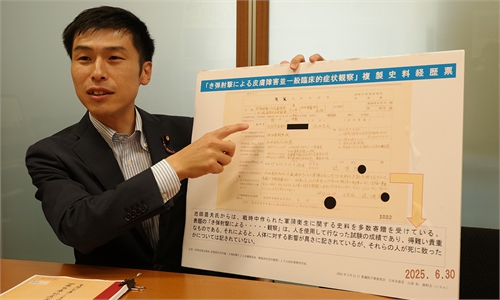
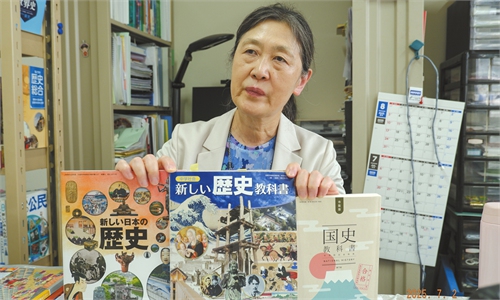
Starting in the mid-1950s, the then Japanese government intensified its scrutiny of history textbooks under pressure from right-wing factions. By the 1970s and 1980s, the tide of historical revisionism had surged further, with the denial of the Nanjing Massacre becoming a notorious hallmark of this movement. In those years, right-wing groups engaged in efforts to deny this historical atrocity through public statements, publications, and textbook alterations.
In 1973, right-wing scholar Akira Suzuki published his book The Illusion of the Nanjing Massacre, in which he questioned the authenticity of the historical event and the number of victims. The book served as a theoretical basis for Japanese right-wing historical denialism. In 1984, Masaki Tanaka published his book The Fabrication of the "Nanjing Massacre." As a former secretary to General Iwane Matsui, one of the main perpetrators of the Nanjing Massacre, Tanaka distorted historical data in his book and claimed the Nanjing Massacre was "a lie fabricated to tarnish Japan's image."
Looking back over those years, Ishida said that in the early 1970s, when diplomatic relations between Japan and China were normalized, Japanese journalist and author Katsuichi Honda's [series articles] "Journey to China," serialized in the Asahi Shimbun, garnered great attention for its extensive coverage of Japan's wartime aggression and war crimes. In response, there was immediate backlash aimed at denying wartime aggression and beautifying the narrative of imperialist wars from a revisionist standpoint.
Why did historical revisionism find such a broad market in Japan at the time? Some scholars posit that in addition to top-down incitement from the Japanese right-wing government and scholars, there was also a societal soil conducive to revisionism.
"After the consumerism of the 1970s, there was a growing alienation from politics in [Japanese] society, and young people there generally 'live in the moment,' lacking concern for the connections between history and the future," Wang Guangsheng, director of the Japanese Culture Research Center of Capital Normal University, told the Global Times. "That further exacerbated their narrow historical perceptions."
US' complicity
The resurgence of right-wing forces and the rampant spread of historical revisionism in post-war Japan have been largely enabled by the US' complicity.
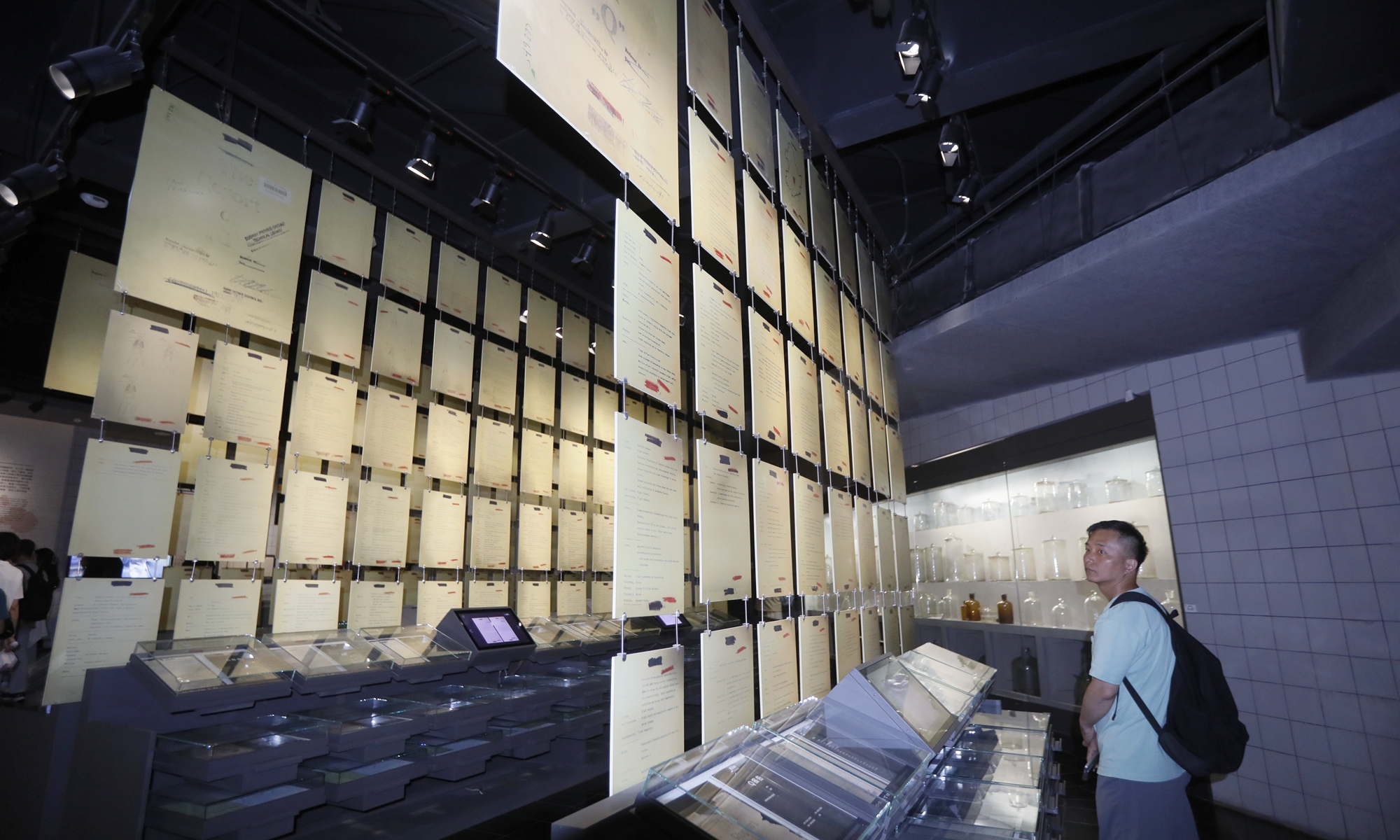
One of the most egregious examples of this complicity is the US "transactional protection" of war criminals from Unit 731. During WWII, Unit 731 conducted gruesome human experiments and biological warfare research in Northeast China. However, for the US, "The value to the US of Japanese BW (biological warfare) data is of such importance to national security as to far outweigh the value accruing from 'war crimes' prosecution." This statement appeared in the conclusion of a classified report by the State-War-Navy Coordinating Subcommittee for the Far East in August 1947.
The above-mentioned Subcommittee was an organization under the State-War-Navy Coordinating Committee, according to information on the website of Japan's National Diet Library. And a CIA document, which showed it was approved for release in May 2002, showed that the Committee was formed by the US authorities around the end of 1944 to deal with problems relating to the Far East. It was composed of representatives of the then US secretary of state, the secretary of war, and the sectary of the navy.
The US engaged in multiple negotiations with Unit 731's leader, Shiro Ishii, agreeing not to pursue war crimes charges against Unit 731 members in exchange for research data and experimental reports. These materials were allegedly sent to US Army Medical Research Institute of Infectious Diseases (USAMRIID) at Fort Detrick, forming a crucial foundation for the latter's biological warfare research.
After the end of WWII, the US sent germ warfare experts at Fort Detrick to Japan over several years to learn about Japan's bacterial warfare, including from Ishii, head of Unit 731, as well as other key members, former Chinese foreign ministry spokesperson Wang Wenbin said at a press conference in June 2021. "What's worse, the US concealed the atrocities of Ishii and Unit 731 from the world and even made Ishii Shiro a bio-weapon consultant at Fort Detrick," Wang Wenbin added.
Following the outbreak of the Cold War in 1947, US policy toward Japan largely shifted, viewing it as a "bulwark against communism" in East Asia, noted scholars in Japanese history reached by the Global Times.
What's more, Japan's economy rapidly rose after WWII with the support of the US, led to a gradual inflation of nationalist sentiments within the country, where the sense of oppression felt by the defeated nation was somewhat replaced by a sense of superiority, the scholars said.
Germany's earnest postwar reflection was, in essence, "born of necessity," as it was compelled to improve relations with neighboring nations to secure space for development,Wang told the Global Times in a previous interview. In contrast, under the US-Japan alliance framework, Japan's geopolitical reality has led it to think that it no longer needs to seek forgiveness from victimized nations like China and South Korea, objectively diminishing incentives for profound remorse, Wang added.
Today, amid the rampant historical revisionism in Japan, its right-wing forces continue to regress on historical issues. On Japan's defeat day on August 15 this year, several senior Japanese officials visited the Yasukuni Shrine, provoking international outrage.
"China strongly deplores Japan's actions that grossly challenge historical justice and human conscience. We have lodged serious protests with the Japanese side," stated a Chinese Foreign Ministry spokesperson in response to media inquiries the following day.
"We urge Japan to face squarely and reflect on its history of aggression, be prudent on historical issues such as the Yasukuni Shrine, make a clean break with militarism, stick to the path of peaceful development, and earn the trust of its Asian neighbors and the international community through real actions," the spokesperson stressed.
The absurd act of Japanese officials' visit to Yasukuni Shrine on its defeat day was akin to rubbing salt into the wounds of the Asian countries it once invaded, rightly provoking widespread outrage from the involved nations. South Korea's Foreign Ministry strongly condemned the Japanese Defense Minister's tribute at the shrine, which Seoul views as glorifying Japan's militaristic past, calling it an "anachronistic act" and unfathomable behavior, The Korea Herald reported on August 15.
Unfortunately, the current Japanese government seems not only unable to reflect on its history of aggression, but is also increasingly straying further down the wrong path. Japan's Kyodo News cited "diplomatic sources" who claimed that the Japanese government had recently, through its "embassies abroad" and other diplomatic channels, "asked" other countries to refrain from attending a military parade and other events that China will hold to mark the 80th anniversary of the victory in the Chinese People's War of Resistance Against Japanese Aggression and the World Anti-Fascist War.
If this reported move is true, it a blatant provocation against historical justice and the post-war international order, a deliberate sabotage of the foundation of peace in Asia and the world, and an affront to all nations that once suffered from Japanese militarist aggression, commented a Global Times editorial on August 26. It warned relevant reporting by Japanese media was a reminder that historical nihilism and revisionism have not disappeared.
"The deeper issue is that Japan lacks profound reflection on its wartime history and crimes of aggression, and has become a serious obstacle to East Asian unity and cooperation, as well as a serious threat to regional peace and stability," it noted.
This year marks the 80th anniversary of the victory of the Chinese People's War of Resistance against Japanese Aggression (1931-1945) and the World Anti-Fascist War. World War II (WWII) was a monumental struggle in which the anti-fascist and human just forces united to defend peace and resist aggression. However, certain countries and politicians, driven by geopolitical self-interest, have openly distorted historical facts, glorifying aggressors as heroes, downplaying the immense sacrifices and contributions of nations like China during the war, and even attempting to challenge the postwar international order. This not only desecrates the blood of millions of victims, but also poses a grave challenge to global peace and justice today.
In light of this, the Global Times presents two investigative stories aimed at exposing and analyzing how Japan and some of its allies have continued to wage a cognitive war to invert truth, promote historical revisionism, and manipulate public opinion in Japan and beyond. In the first installment, we focus on the emergence and spread of historical revisionism in Japan from the end of WWII until the early 1990s, as well as Japan's internal and external forces that sought to absolve fascism and its lingering effects.
A visitor reads documents at the Exhibition Hall of Evidences of Crime Committed by Unit 731 of the Japanese Imperial Army in Harbin, Northeast China's Heilongjiang Province, on July 1, 2025. Photo: VCG
Victory Day on September 3, which China designated to mark the signing of the Japanese Instrument of Surrender on September 2, 1945, is fast approaching. At this special commemorative moment, apart from celebrating the hard-won victory, many people are also focused on whether the previous invaders will publicly express their reflection on their aggressive history from 80 years ago.
As a primary perpetrator of the Asian theater of WWII, Japan's recent performance has been disappointing.
On August 15, the 80th anniversary of Japan's announcement of unconditional surrender, Japanese Prime Minister Shigeru Ishiba expressed "remorse" in a speech he delivered at a "national memorial service for war casualties." "We must engrave the war's remorse and lessons deeply into our hearts," Ishiba said, as reported by The Japan Times that day
Ishiba's remarks sparked widespread dissatisfaction in the international community. Some observers said that the focus of "remorse and lessons" in his speech was on Japan's own path toward the war, rather than acknowledging the suffering the country had inflicted upon various Asian countries. Moreover, prior to this, Japanese media outlets had reported Ishiba's vacillating attitudes regarding whether he would deliver a speech on the 80th anniversary of Japan's defeat, in what form, and what topics he would address.
The Japanese authorities' long-standing tendency to evade or even deny their history of aggression, stems from decades of domestic power struggles and calculations, as well as their long-term entanglement with certain US interests. The seeds of this historical revisionism can be traced back to the selective purging of Japan's militaristic forces in the aftermath of WWII, said some Chinese and Japanese scholars reached by the Global Times.
Selective reckoning of war criminals
After Japan's defeat in 1945, the Allied forces conducted a limited reckoning with Japanese militarism. However, due to the emergence of the Cold War and the strategic interests of the US, this process was fraught with compromises, oversights, and selections, which later allowed many Japanese war criminals to return to politics, and even shaped the political landscape of post-war Japan.
From 1946 to 1948, the International Military Tribunal for the Far East prosecuted 28 Class-A war criminals in what is known as the Tokyo War Crimes Trials. In this tribunal, only seven were sentenced to death, while 16 received life imprisonment, with the rest receiving lighter sentences. Compared to the severe punishments meted out during the Nuremberg Trials for Nazi war criminals, the Tokyo Trials were notably lenient.
Ryuji Ishida, a scholar of modern and contemporary history from Shanghai Jiao Tong University, believes that the earliest proponents of historical revisionism after the war in Japan were the "Class A" war criminals, who stood trial at the Tokyo Tribunal, and their defense attorneys. Among the "Class B and C" war criminals there were also those who held similar positions, Ishida added.
In the early 1950s, the US gradually lifted the ban on Japanese war criminals holding public office, which allowed many pre-war bureaucrats and right-wing politicians to return to the political arena, noted Song Libin, an intentional affairs scholar at Wuhan University, in an article published on academic journal Socialism Studies in 2023. That included "Class A" war criminal Nobusuke Kishi, according to historical materials concerning the trial of Japanese war criminals published on the China National Library website.
As shown in an English-language page introducing Kishi on the website of Japan's National Diet Library, this previous "Class A" criminal formed the Nihon Saiken Renmei (Japan Reconstruction League), after the termination of the purge of undesirables from public office in 1952, and became Japan's prime minister in 1957.
Kishi was the grandfather of former Japanese prime minister Shinzo Abe. "The political stance of the Japanese government after the war, since the 1950s, has been consistently reactionary, as exemplified by former prime minister Abe," Ishida told the Global Times. "There has been a political culture that does not attempt to conceal the fact that the [Japanese] Prime Minister himself is a historical revisionist."
Historical revisionism begins to spread
As remnants of militarism regained a foothold in Japanese politics, historical revisionism began to take root, gradually eroding the Japanese public's correct understanding of WWII over the subsequent decades.
Starting in the mid-1950s, the then Japanese government intensified its scrutiny of history textbooks under pressure from right-wing factions. By the 1970s and 1980s, the tide of historical revisionism had surged further, with the denial of the Nanjing Massacre becoming a notorious hallmark of this movement. In those years, right-wing groups engaged in efforts to deny this historical atrocity through public statements, publications, and textbook alterations.
In 1973, right-wing scholar Akira Suzuki published his book The Illusion of the Nanjing Massacre, in which he questioned the authenticity of the historical event and the number of victims. The book served as a theoretical basis for Japanese right-wing historical denialism. In 1984, Masaki Tanaka published his book The Fabrication of the "Nanjing Massacre." As a former secretary to General Iwane Matsui, one of the main perpetrators of the Nanjing Massacre, Tanaka distorted historical data in his book and claimed the Nanjing Massacre was "a lie fabricated to tarnish Japan's image."
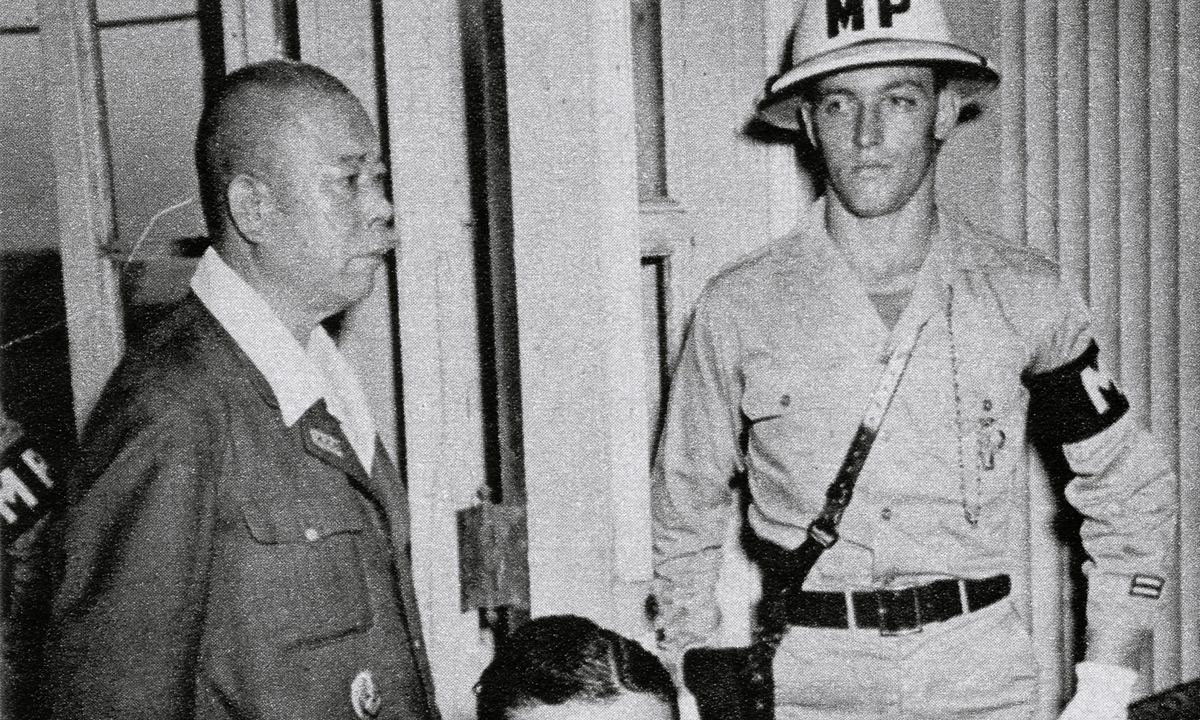
Japanese General Tomoyuki Yamashita (left) is on trial in Manila, the Philippines for war crimes committed by the Japanese during World War II on October 29, 1945. Photo: VCG
Looking back over those years, Ishida said that in the early 1970s, when diplomatic relations between Japan and China were normalized, Japanese journalist and author Katsuichi Honda's [series articles] "Journey to China," serialized in the Asahi Shimbun, garnered great attention for its extensive coverage of Japan's wartime aggression and war crimes. In response, there was immediate backlash aimed at denying wartime aggression and beautifying the narrative of imperialist wars from a revisionist standpoint.
Why did historical revisionism find such a broad market in Japan at the time? Some scholars posit that in addition to top-down incitement from the Japanese right-wing government and scholars, there was also a societal soil conducive to revisionism.
"After the consumerism of the 1970s, there was a growing alienation from politics in [Japanese] society, and young people there generally 'live in the moment,' lacking concern for the connections between history and the future," Wang Guangsheng, director of the Japanese Culture Research Center of Capital Normal University, told the Global Times. "That further exacerbated their narrow historical perceptions."
US' complicity
The resurgence of right-wing forces and the rampant spread of historical revisionism in post-war Japan have been largely enabled by the US' complicity.
One of the most egregious examples of this complicity is the US "transactional protection" of war criminals from Unit 731. During WWII, Unit 731 conducted gruesome human experiments and biological warfare research in Northeast China. However, for the US, "The value to the US of Japanese BW (biological warfare) data is of such importance to national security as to far outweigh the value accruing from 'war crimes' prosecution." This statement appeared in the conclusion of a classified report by the State-War-Navy Coordinating Subcommittee for the Far East in August 1947.
The above-mentioned Subcommittee was an organization under the State-War-Navy Coordinating Committee, according to information on the website of Japan's National Diet Library. And a CIA document, which showed it was approved for release in May 2002, showed that the Committee was formed by the US authorities around the end of 1944 to deal with problems relating to the Far East. It was composed of representatives of the then US secretary of state, the secretary of war, and the sectary of the navy.
The US engaged in multiple negotiations with Unit 731's leader, Shiro Ishii, agreeing not to pursue war crimes charges against Unit 731 members in exchange for research data and experimental reports. These materials were allegedly sent to US Army Medical Research Institute of Infectious Diseases (USAMRIID) at Fort Detrick, forming a crucial foundation for the latter's biological warfare research.
After the end of WWII, the US sent germ warfare experts at Fort Detrick to Japan over several years to learn about Japan's bacterial warfare, including from Ishii, head of Unit 731, as well as other key members, former Chinese foreign ministry spokesperson Wang Wenbin said at a press conference in June 2021. "What's worse, the US concealed the atrocities of Ishii and Unit 731 from the world and even made Ishii Shiro a bio-weapon consultant at Fort Detrick," Wang Wenbin added.
Following the outbreak of the Cold War in 1947, US policy toward Japan largely shifted, viewing it as a "bulwark against communism" in East Asia, noted scholars in Japanese history reached by the Global Times.
What's more, Japan's economy rapidly rose after WWII with the support of the US, led to a gradual inflation of nationalist sentiments within the country, where the sense of oppression felt by the defeated nation was somewhat replaced by a sense of superiority, the scholars said.
Germany's earnest postwar reflection was, in essence, "born of necessity," as it was compelled to improve relations with neighboring nations to secure space for development,Wang told the Global Times in a previous interview. In contrast, under the US-Japan alliance framework, Japan's geopolitical reality has led it to think that it no longer needs to seek forgiveness from victimized nations like China and South Korea, objectively diminishing incentives for profound remorse, Wang added.
Today, amid the rampant historical revisionism in Japan, its right-wing forces continue to regress on historical issues. On Japan's defeat day on August 15 this year, several senior Japanese officials visited the Yasukuni Shrine, provoking international outrage.
"China strongly deplores Japan's actions that grossly challenge historical justice and human conscience. We have lodged serious protests with the Japanese side," stated a Chinese Foreign Ministry spokesperson in response to media inquiries the following day.
"We urge Japan to face squarely and reflect on its history of aggression, be prudent on historical issues such as the Yasukuni Shrine, make a clean break with militarism, stick to the path of peaceful development, and earn the trust of its Asian neighbors and the international community through real actions," the spokesperson stressed.
The absurd act of Japanese officials' visit to Yasukuni Shrine on its defeat day was akin to rubbing salt into the wounds of the Asian countries it once invaded, rightly provoking widespread outrage from the involved nations. South Korea's Foreign Ministry strongly condemned the Japanese Defense Minister's tribute at the shrine, which Seoul views as glorifying Japan's militaristic past, calling it an "anachronistic act" and unfathomable behavior, The Korea Herald reported on August 15.
Unfortunately, the current Japanese government seems not only unable to reflect on its history of aggression, but is also increasingly straying further down the wrong path. Japan's Kyodo News cited "diplomatic sources" who claimed that the Japanese government had recently, through its "embassies abroad" and other diplomatic channels, "asked" other countries to refrain from attending a military parade and other events that China will hold to mark the 80th anniversary of the victory in the Chinese People's War of Resistance Against Japanese Aggression and the World Anti-Fascist War.
If this reported move is true, it a blatant provocation against historical justice and the post-war international order, a deliberate sabotage of the foundation of peace in Asia and the world, and an affront to all nations that once suffered from Japanese militarist aggression, commented a Global Times editorial on August 26. It warned relevant reporting by Japanese media was a reminder that historical nihilism and revisionism have not disappeared.
"The deeper issue is that Japan lacks profound reflection on its wartime history and crimes of aggression, and has become a serious obstacle to East Asian unity and cooperation, as well as a serious threat to regional peace and stability," it noted.
RELATED ARTICLES