IN-DEPTH / IN-DEPTH
Testimony of history: ‘Hope to promote Japan's reflection by revealing the truth’: Japanese history researcher Seiya Matsuno
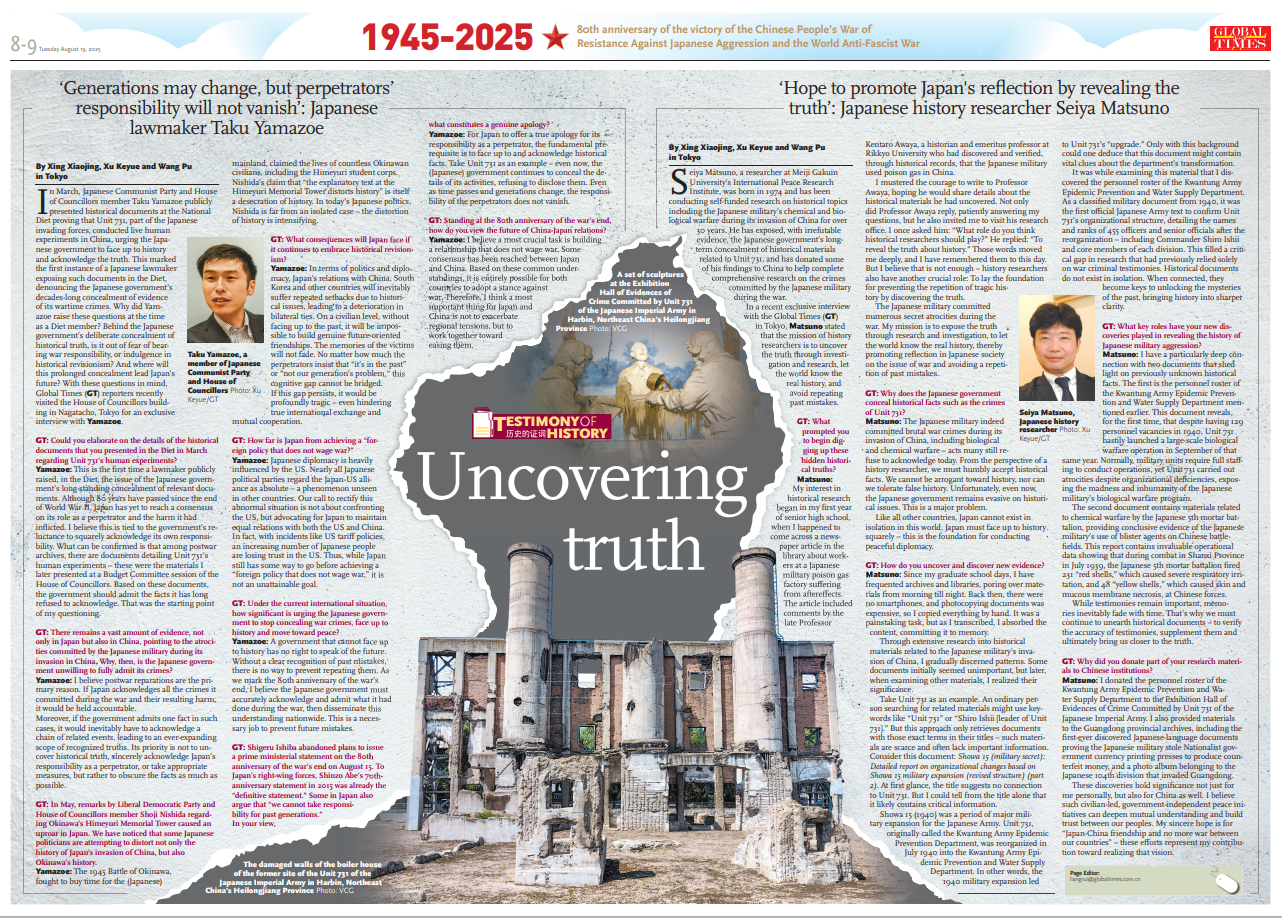
Uncovering truth
By Xing Xiaojing, and Wang Pu in Tokyo Published: Aug 18, 2025 10:59 PM

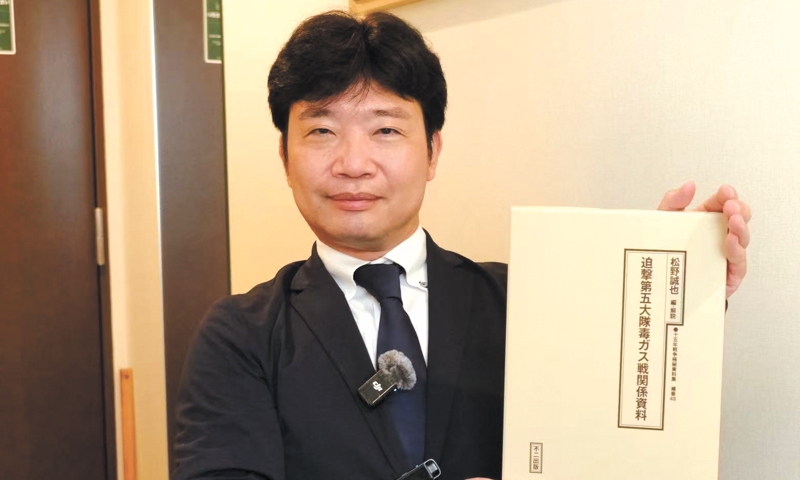
Japanese history researcher Seiya Matsuno shows Global Times reporters his compiled work The fif-teen-year war: Top secret documents collection, supplementary volume 49 - Materials related to chemical warfare by the 5th mortar battalion. Photo: Xu Keyue/GT
Seiya Matsuno, a researcher at Meiji Gakuin University's International Peace Research Institute, was born in 1974 and has been conducting self-funded research on historical topics including the Japanese military's chemical and biological warfare during its invasion of China for over 30 years. He has exposed, with irrefutable evidence, the Japanese government's long-term concealment of historical materials related to Unit 731, and has donated some of his findings to China to help complete comprehensive research on the crimes committed by the Japanese military during the war. In a recent exclusive interview with the Global Times (GT) in Tokyo, Matsuno stated that the mission of history researchers is to uncover the truth through investigation and research, let the world know the real history, and avoid repeating past mistakes.
GT: What prompted you to begin digging up these hidden historical truths?
Matsuno: My interest in historical research began in my first year of senior high school, when I happened to come across a newspaper article in the library about workers at a Japanese military poison gas factory suffering from aftereffects. The article included comments by the late Professor Kentaro Awaya, a historian and emeritus professor at Rikkyo University who had discovered and verified, through historical records, that the Japanese military used poison gas in China.
I mustered the courage to write to Professor Awaya, hoping he would share details about the historical materials he had uncovered. Not only did Professor Awaya reply, patiently answering my questions, but he also invited me to visit his research office. I once asked him: "What role do you think historical researchers should play?" He replied: "To reveal the truth about history." Those words moved me deeply, and I have remembered them to this day. But I believe that is not enough - history researchers also have another crucial role: To lay the foundation for preventing the repetition of tragic history by discovering the truth.
The Japanese military committed numerous secret atrocities during the war. My mission is to expose the truth through research and investigation, to let the world know the real history, thereby promoting reflection in Japanese society on the issue of war and avoiding a repetition of past mistakes.
GT: Why does the Japanese government conceal historical facts such as the crimes of Unit 731?
Matsuno: This is an extremely important question. The Japanese military indeed committed brutal war crimes during its invasion of China, including biological and chemical warfare - acts many still refuse to acknowledge today. From the perspective of a history researcher, we must humbly accept historical facts. We cannot be arrogant toward history, nor can we tolerate false history. Unfortunately, even now, the Japanese government remains evasive on historical issues. This is a major problem.
Like all other countries, Japan cannot exist in isolation in this world. Japan must face up to history squarely - this is the foundation for conducting peaceful diplomacy.
GT: How do you uncover and discover new evidence?
Matsuno: Since my graduate school days, I have frequented archives and libraries, poring over materials from morning till night. Back then, there were no smartphones, and photocopying documents was expensive, so I copied everything by hand. It was a painstaking task, but as I transcribed, I absorbed the content, committing it to memory.
Through extensive research into historical materials related to the Japanese military's invasion of China, I gradually discerned patterns: What kinds of titles generally corresponded to what content, and how significant that content might be. Some documents initially seemed unimportant, but later, when examining other materials, I realized their significance. Now, I can usually gauge a document's value just from its title.
Take Unit 731 as an example. An ordinary person searching for related materials might use keywords like "Unit 731" or "Shiro Ishii [leader of Unit 731]." But this approach only retrieves documents with those exact terms in their titles - such materials are scarce and often lack important information. Consider this document: Showa 15 (military secret): Detailed report on organizational changes based on Showa 15 military expansion (revised structure) (part 2). At first glance, the title suggests no connection to Unit 731. But I could tell from the title alone that it likely contains critical information.
Showa 15 (1940) was a period of major military expansion for the Japanese Army. Unit 731, originally called the Kwantung Army Epidemic Prevention Department, was reorganized in July 1940 into the Kwantung Army Epidemic Prevention and Water Supply Department. In other words, the 1940 military expansion led to Unit 731's "upgrade." Only with this background could one deduce that this document might contain vital clues about the department's transformation.
It was while examining this material that I discovered the personnel roster of the Kwantung Army Epidemic Prevention and Water Supply Department. As a classified military document from 1940, it was the first official Japanese Army text to confirm Unit 731's organizational structure, detailing the names and ranks of 455 officers and senior officials after the reorganization - including Commander Shiro Ishii and core members of each division. This filled a critical gap in research that had previously relied solely on war criminal testimonies.
Historical documents do not exist in isolation. When connected, they become keys to unlocking the mysteries of the past, bringing history into sharper clarity.
GT: What key roles have your new discoveries played in revealing the history of Japanese military aggression?
Matsuno: Among the materials I've uncovered, I have a particularly deep connection with two documents that shed light on previously unknown historical facts.
The first is the personnel roster of the Kwantung Army Epidemic Prevention and Water Supply Department mentioned earlier. This document reveals, for the first time, that despite having 129 personnel vacancies in 1940, Unit 731 hastily launched a large-scale biological warfare operation in September of that same year. Normally, military units require full staffing to conduct operations, yet Unit 731 carried out atrocities despite organizational deficiencies, exposing the madness and inhumanity of the Japanese military's biological warfare program.
The second document contains materials related to chemical warfare by the Japanese 5th mortar battalion, providing conclusive evidence of the Japanese military's use of blister agents on Chinese battlefields. This report contains invaluable operational data showing that during combat in Shanxi Province in July 1939, the Japanese 5th mortar battalion fired 231 "red shells," which caused severe respiratory irritation, and 48 "yellow shells," which caused skin and mucous membrane necrosis, at Chinese forces.
While testimonies remain important, memories inevitably fade with time. That's why we must continue to unearth historical documents - to verify the accuracy of testimonies, supplement them and ultimately bring us closer to the truth.
GT: Why did you donate part of your research materials to Chinese institutions?
Matsuno: I donated the personnel roster of the Kwantung Army Epidemic Prevention and Water Supply Department to the Exhibition Hall of Evidences of Crime Committed by Unit 731 of the Japanese Imperial Army. I also provided materials to the Guangdong provincial archives, including the first-ever discovered Japanese-language documents proving the Japanese military stole Nationalist government currency printing presses to produce counterfeit money, and a photo album belonging to the Japanese 104th division that invaded Guangdong.
These discoveries hold significance not just for me personally, but also for China as well. I believe such civilian-led, government-independent peace initiatives can deepen mutual understanding and build trust between our peoples. My sincere hope is for "Japan-China friendship and no more war between our countries" - these efforts represent my contribution toward realizing that vision.
Uncovering truth
RELATED ARTICLES