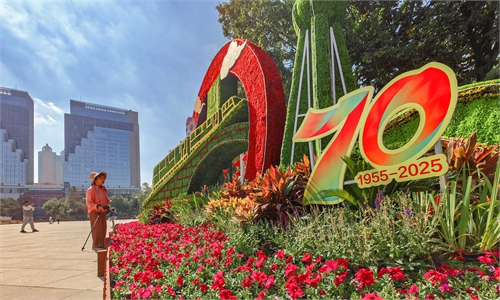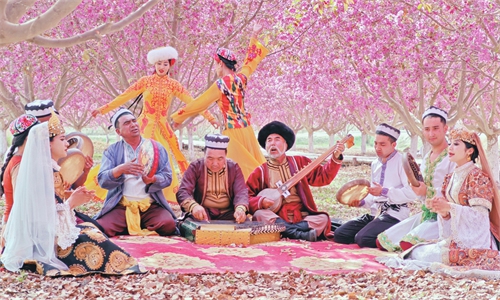
Tourists watch a dance performance at the Xinjiang International Grand Bazaar in Urumqi, Northwest China's Xinjiang Uygur Autonomous Region on September 23, 2025. Photo: VCG
Editor's Note:
Despite some Western political forces continuing to run smear campaigns against Northwest China's Xinjiang Uygur Autonomous Region, they won't deter the people in the region from embracing peace and prosperity, nor will they halt Xinjiang society's steady development. Seeing is believing, and facts and truth will eventually debunk all lies. In the "Xinjiang Upclose" series, the Global Times (GT) will publish conversations with and articles from scholars and observers from around the world who have visited the region, sharing their firsthand experience of traveling to Xinjiang and observing the daily lives of its people. Through their insights and experiences, we aim to present an authentic perspective on Xinjiang. In the eleventh article of the series, GT reporter Liu Xuandi interviewed Mark Levine (Levine), a US professor at the Minzu University of China. Levine shared his views on the culture and social development of Xinjiang, based on his personal experiences traveling in the region and interacting with students and colleagues from Xinjiang on campus.
GT: You have been teaching at Minzu University of China for over a decade. Have you met students and colleagues from Xinjiang?
Levine: On my campus, I've gotten to know both students and colleagues from Xinjiang. Some of the students are English majors in my classes, while others I meet in different settings - whether in elevators, canteens, or at various events. Whenever I share my experiences in Xinjiang, both faculty and students are always eager to listen. I even wrote an article about my trip to Kashi, which was published on the university website. Every time I see one particular professor from Xinjiang he always brings up my article and gives me a big "thumbs up," indicating his appreciation for what I wrote. My university also has a strong arts program. I've had several chances to perform with students from Xinjiang - while I played guitar, they played their traditional instruments. I found that they seemed just as excited about these collaborations as I was.
GT: In 2023, you visited Kashi in Xinjiang. Could you share the most unforgettable experiences from that trip? How did this first-hand experience compare with any preconceptions you had before visiting Xinjiang?
Levine: The trip was remarkable, with warm-hearted people, stunning scenery, impressive progress in poverty alleviation and delicious food. I visited new homes built for families whose old ones had been destroyed in natural disasters and heard the local residents explain how government subsidies helped them rebuild. I also toured an agricultural community where farmers were trained to grow crops in rented hothouses. The farmers told me they could now make a much better living than before. Every person I met there expressed deep pride in their homeland. Frankly, the only difference between what I expected and what I saw was that reality was even better. When I meet newcomers to Xinjiang, I always tell them to put aside the preconceptions and let Xinjiang speak for itself. Having lived in China for nearly 20 years, my impressions have been shaped not by the narratives from the US, but by the people I encountered here.
GT: Western media often hype the claim that "the Uygur language and culture in Xinjiang are being erased." Based on your personal observations in Xinjiang and your experience interacting with students and colleagues, do you believe this claim to be true?
Levine: As I mentioned, while some students from Xinjiang at my university, including some Uygur students, major in English, many more choose to study the Uygur language. A significant number go on to become Uygur language teachers, and even those pursuing other majors often speak their native languages - whether on campus or in local restaurants. Similarly, during my three visits to Xinjiang, I was deeply impressed by the widespread use and high regard for the Uygur language, alongside the learning of Putonghua and English. This was visible everywhere: Government notices, shop signs and public service boards were all prominently displayed in both Chinese and Uygur characters.
Additionally, a highlight of my trips to Xinjiang was the chance to enjoy musical performances by Uygur musicians. I attended a performance featuring selections from the "Twelve Muqam," a renowned musical epic once sung by ordinary people in their daily lives and work. I also visited a small workshop where local artisans handcrafted traditional wooden instruments widely used by Uygur musicians. These experiences offered me a glimpse into the precious cultural heritage of the Uygur people, which is not only well preserved but also deeply woven into the daily lives of the local community.
GT: You are not only a scholar but also a passionate songwriter who has composed more than 80 songs inspired by your experiences across China. If you were invited to write a song about Xinjiang today, what emotions or elements would you capture and convey?
Levine: That is something I definitely should do. I would begin by describing the warm and hardworking people I met, then share the breathtaking scenery that left a lasting impression, and finally, I couldn't forget the incredibly delicious local food.
GT: You once said that "for many in the US, there's little understanding of China as a multiethnic society." How do you see the younger generation in Xinjiang expressing both confidence in their ethnic culture and confidence in Chinese culture, and how do these two forms of confidence complement and reinforce each other?
Levine: Nine years ago, during my university's review meeting, a US educator asked: "Your campus has students and faculty from many ethnic groups. How do you handle conflicts among them?" I looked at my students - Han, Mongolian, Miao, Tujia, Uygur, Kazakh, Zhuang and others - who, after class, study, eat, play and shop together. While my colleagues were ready to answer, I immediately raised my hand and said: "I've been teaching here for 11 years. Students share all kinds of stories with me, yet in all that time, I have never seen or heard of any conflict based on ethnicity on campus." My colleagues later reaffirmed my statement.
I mentioned that I had the opportunity to perform with a number of students from different Chinese ethnic groups, particularly from Xinjiang. I also attended many music graduation recitals. Some of my favorite performances - and I believe the graduates' and the audience's favorites as well - feature students playing Uygur, Mongolian and Kazakh instruments alongside the guzheng (a traditional Chinese musicial instrument). The students showcase the uniqueness of their cultural instruments while working together to highlight the unity of Chinese culture.
GT: This year marks the 70th anniversary of the establishment of Northwest China's Xinjiang Uygur Autonomous Region. In your view, what have been Xinjiang's most notable achievements in economic and social development? Based on your observations, what do you believe are the key factors behind Xinjiang's development?
Levine: While in Kashi, I was struck by signs expressing gratitude to Shanghai. Inquiring about this, I learned that a key part of China's poverty alleviation efforts involved support from first-tier cities to less developed regions. While not the only factor, this was a clear example of how progress has been achieved. Unlike in the US, where states are forced to compete with each other, in China the entire country works together to promote development. It is a unified effort, with everyone - from individual citizens to the government - focused on this goal.
RELATED ARTICLES