US media unveils composition of US military task force in Philippines; Chinese experts say it merely ‘placates’ Manila
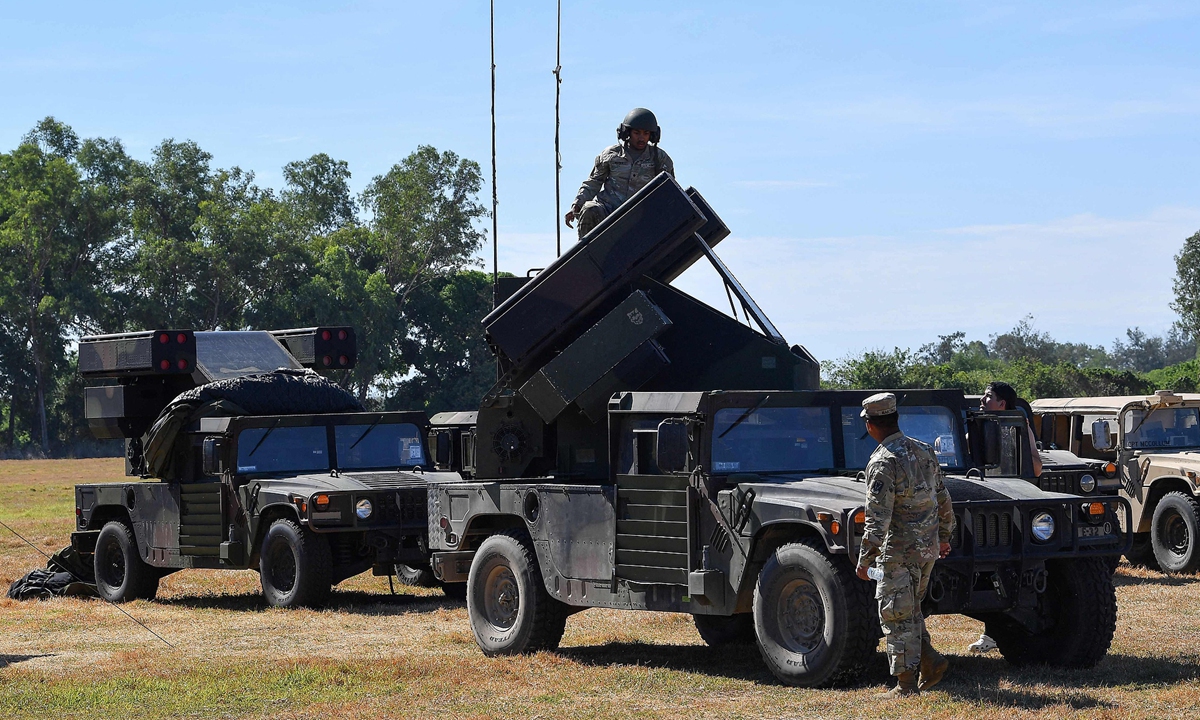
US soldiers stand beside an Avenger air defence system during the Balikatan annual US-Philippine joint military exercise at a naval training base in San Antonio town, Zambales province on April 27, 2025. Photo: VCG
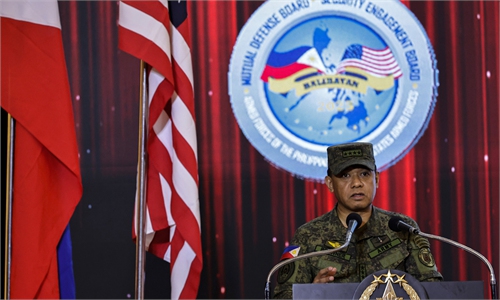
US media Stars and Stripes recently revealed the composition of a US military task force in the Philippines, with a core element of approximately 60 personnel serving as primary staff. Experts told the Global Times that the US task force stationed in the Philippines may appear to give the Philippine military reassurance and play a placating role, but Manila's attempt to rely on external powers to provoke China's sovereignty is doomed to fail.Citing the US Pacific Fleet, Stars and Stripes on Friday reported that 60 personnel from the US Army, Navy, Air Force and Marine Corps led by a Marine major general are working for a new US military task force in the Philippines.
Reuters reported on October 31 that the US and the Philippines have formed a new joint task force to strengthen cooperation and increase military readiness in areas including the South China Sea, citing Pentagon.
The announcement followed a meeting between US Defense Secretary Pete Hegseth and Philippine Secretary of National Defense Gilberto Teodoro at a gathering of ASEAN defense ministers in the Malaysian capital of Kuala Lumpur.
"The presence of Task Force-Philippines reinforces our dedication to supporting the Philippine government's efforts to maintain stability and security in the country," Stars and Stripes reported, citing an email exchange with Pacific Fleet spokesperson Christina Hough.
Task Force-Philippines has no equipment, warships, aircraft or vehicles assigned to it and officials declined to disclose its headquarters location, citing operational security, according to Hough's email.
"The number of US personnel will fluctuate on a rotational basis, as need and requested by the host nation, but a core element of approximately 60 personnel serve as the primary staff," she said. "Task Force-Philippines helps maintain the high-level of combined military readiness required to respond jointly to future crises, contingencies, or natural disasters."
Judging from the reports, the US task force is not large and remains a small unit at the tactical level, therefore its symbolic significance outweighs its practical value, Song Zhongping, a military affairs expert, told the Global Times on Sunday.
Given how low-key the US has been this time in not disclosing the location, this new task force is likely a rebranded version of the previously touted task force named after Philippine name of China's Ren'ai Jiao (also known as Ren'ai Reef), Ding Duo, director of the Research Center for International and Regional Studies at the National Institute for South China Sea Studies, told the Global Times.
The most important message the US task force in the Philippines tries to convey to the outside world is Washington's support for its ally and its security cooperation with Manila, essentially providing reassurance to the Philippine military and playing a placating, confidence-boosting role, Ding noted.
The primary functions of the US task force in the Philippines are likely to provide tactical training for Philippine personnel and to coordinate US-Philippine joint exercise plans. It is essentially a posture-setting move, Ding said.
He noted that at the same time, the US will not likely provide large amounts of military equipment to the Philippines to increase its own burden, it will likely mainly focus on intelligence sharing and information-system interoperability.
The US also has its own calculations behind the move, Ding said, noting that by leveraging the Philippines' strategic location, it can enhance intelligence collection on China, particularly tracking Chinese vessels operating in the South China Sea and the Bashi Channel.
Ultimately, the Philippines is little more than a "pawn" in Washington's "Indo-Pacific" strategy. Manila's attempt to rely on external forces to provoke China's sovereignty is doomed to fail, Ding said.
Song noted that this task force is headed by a US Marine Corps general. The Marine Corps' core strength lies in island seizure and defense operations, so having a Marine lead the task force is fitting.
The Marine Corps has three divisions, and a task force operating in the Philippines should logically be led by the 3rd Marine Division, which is stationed in the Ryukyu Islands and responsible for South China Sea-related missions. But this time, the commander comes from the 1st Marine Division based at Camp Pendleton, Song said.
Song noted that from this detail we can infer two possibilities: First, it may suggest that the 3rd Marine Division currently faces a heavy operational workload and cannot spare personnel. Second, the US may be planning to incorporate the 1st Marine Division's combat capabilities into the Indo-Pacific theater, especially in the Western Pacific. Strengthening coordination between the 1st and 3rd Divisions aligns with US military interests, and this development warrants further observation, he said.
Given the Marine Corps' increasingly prominent role, he noted, this has stirred controversy within the US military, particularly dissatisfaction from the Army. The Army is even seeking to transform itself into an "Army Marine Corps," Song said.
Song noted that as a result, both services are vying for more resources and larger budgets to expand their influence. Confronted with such challenges, the Marine Corps must demonstrate its unique value in order to gain the upper hand in its rivalry with the Army.
The PLA Southern Theater Command deployed naval and air forces to conduct combat-readiness patrols in the territorial waters, airspace and surrounding areas of China's Huangyan Dao on Saturday. Since the beginning of November, the theater's forces have continuously reinforced patrols and vigilance in the maritime and airspace areas around China's territorial waters of Huangyan Dao, further strengthening control over the relevant sea and air zones, the PLA's Southern Theater Command said in an announcement. These actions are aimed at resolutely safeguarding national sovereignty and security and firmly maintaining peace and stability in the region.
The CCG carried out law-enforcement patrols in the territorial waters of China's Huangyan Dao and surrounding areas on Saturday. Since November, the CCG has continued to step up law-enforcement patrols in these waters, lawfully tracking and monitoring, issuing warnings and blocking or expelling vessels and aircraft engaged in illegal intrusion or disruptive activities, according to the CCG. These efforts have further strengthened the management and control of the relevant maritime areas and will firmly safeguard China's territorial sovereignty and maritime rights and interests.
Ding noted that in safeguarding China's rights in the South China Sea, coordination between the CCG and the military forms a comprehensive system in which the Coast Guard carries out frontline law-enforcement operations while the military provides strategic support.
This division of roles demonstrates China's strategic planning and flexibility in rights-protection operations, enabling routine management through law-enforcement forces while simultaneously showcasing the nation's strong resolve and capability to defend its maritime rights, Ding said.
RELATED ARTICLES