ARTS / CULTURE & LEISURE
Co-op agreements signed during ‘Week of Chinese and Russian Literature 2025’
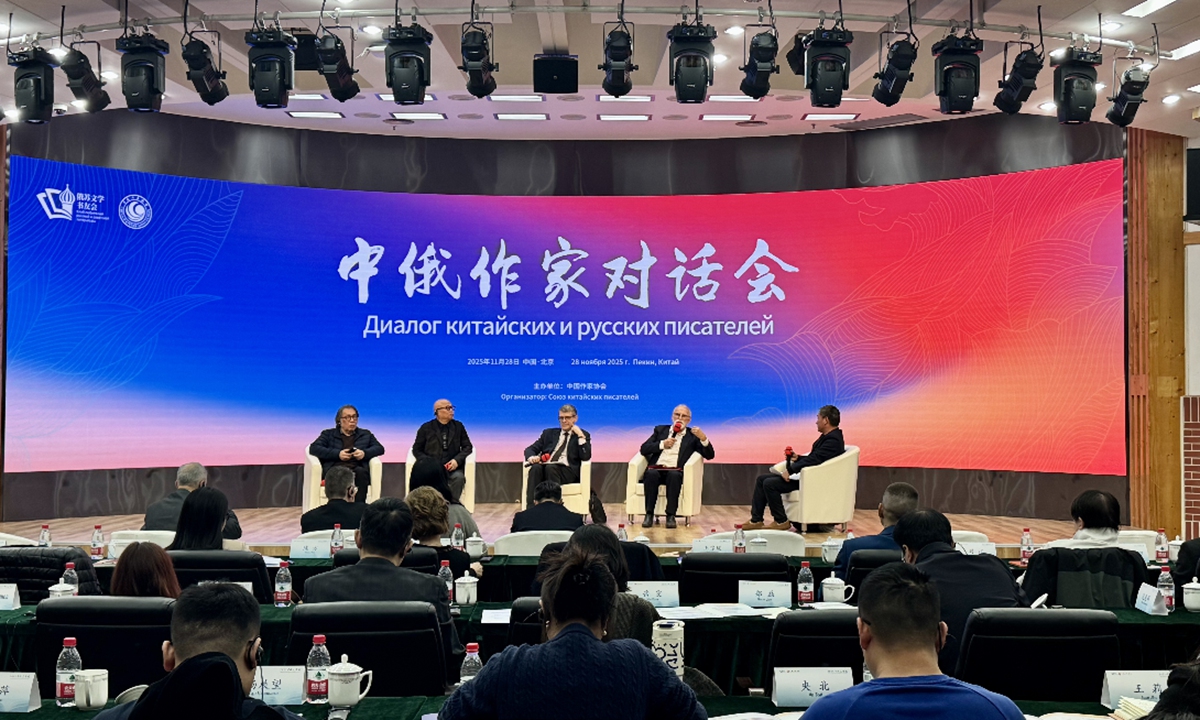
Writers attend a panel session of the China-Russia Writers Dialogue Conference in Beijing on November 28, 2025. Photo: Dong Feng/GT
At the recent launch ceremony for the Week of Chinese and Russian Literature 2025 and China-Russia Writers Dialogue Conference in Beijing, Dmitry Bak, director of the V.I. Dahl State Museum of Russian Literary History (State Literary Museum) told the Global Times that he appreciated his Chinese library colleagues' professionalism, responsibility, and deep appreciation for Leo Tolstoy's heritage, saying the collaboration was "truly creative."Zhang Hongsen, chairman and Party secretary of the China Writers Association (CWA), said in his keynote speech that through a series of activities such as the Week of Chinese and Russian Literature 2025, CWA aims to create a regular, professional, and public platform for cultural exchange, contributing unique literary strength to the overall diplomatic landscape between China and Russia.
"It is expected that writers, scholars, and translators will actively participate, leveraging literature as a medium to enhance mutual understanding, using writing as a bridge to promote people-to-people connectivity, and advancing cultural exchange and mutual learning," said Zhang.
The literature of China and Russia, with their grand and profound spirit, depicts the times and, with a deep and delicate touch, observes human nature, powerfully promoting the development of world literature. The two countries' literature has become a spiritual bond connecting the people of both countries and a precious treasure that nourishes the human soul, he stated.
During the event, important literary and cultural institutions from both countries signed three significant cooperation agreements, marking a new stage in bilateral cooperation.
Bak, who is also a professor at the Russian State University for the Humanities, told the Global Times that he has facilitated several collaborations between the Russian State Museum of Literature and History and China. At the end of October, the exhibition project Leo Tolstoy and His World was held in the libraries of three cities in South China's Guangdong Province: Guangzhou, Shenzhen and Foshan.
"In addition, each library supplemented the exhibitions with material dedicated to the perception of Leo Tolstoy's works in China. It was a truly creative collaboration," said Bak.
"During these meetings, creative relationships between Russian and Chinese translators emerged. Thanks to them, modern Chinese literature has became more accessible to Russians, while in China, people have learned about new literary figures in Russia," Bak added.
"We hope that exhibitions presenting Chinese literature will also take place in Moscow. There is currently great interest in China, Chinese culture, language, and literature in Russia. I am confident that this will produce new formats of intercultural interaction, facilitating the rapprochement and mutual enrichment of our cultures," said Bak.
Anna Timokova, head of the Department of Literature and Literary Pedagogy, Penza State University in Penza, Russia, told the Global Times that from her point of view the goal of participants in this and similar cultural events is to demonstrate openness to dialogue, a focus on embodying shared spiritual and moral values in artistic creativity, and a desire to expand cultural boundaries.
"Our interaction significantly contributes to the understanding of contemporary literary processes taking place in our countries by readers in China and Russia. Each side of this cultural dialogue shares its own experiences of understanding the world and expressing them in artistic expression. This also provides material for scholarly work - identifying common vectors of literary development, common themes, and motifs," said Timokova.
It is important for every writer to understand that their work is a contribution to the overall process of shaping the cultural agenda of their time, she added.
RELATED ARTICLES