Expanding eVTOLs fire up China’s low-altitude economy, as more people embrace airborne mobility
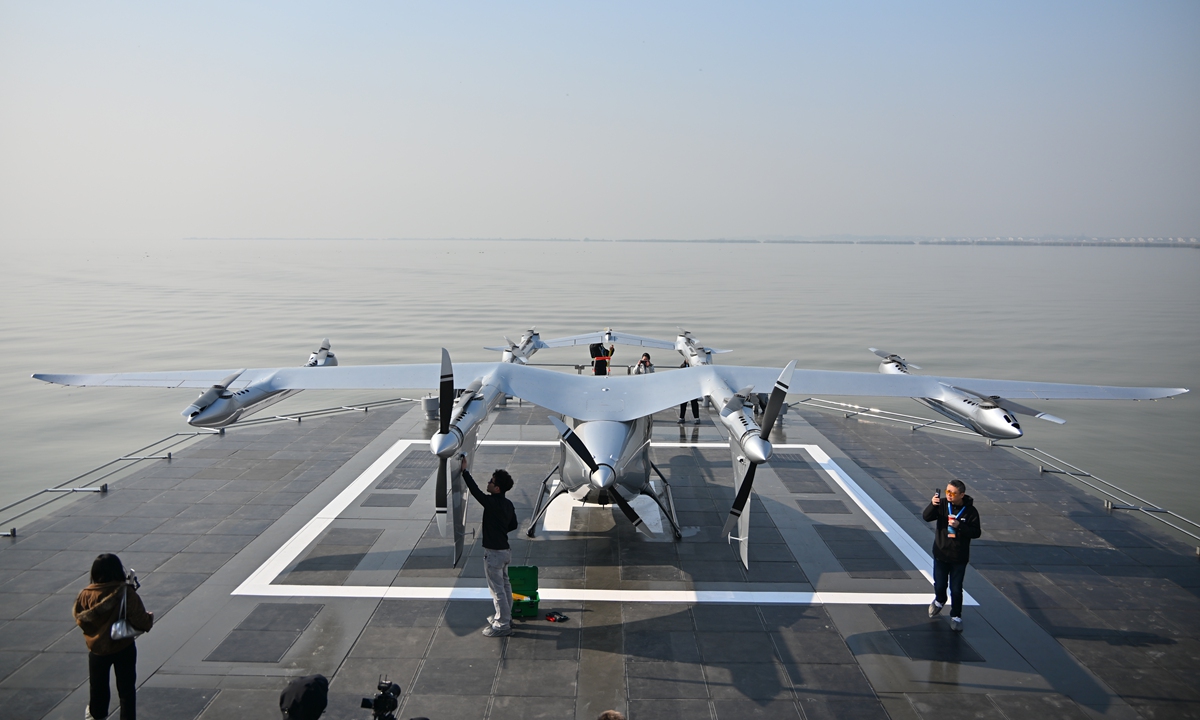
AutoFlight's eVTOL aircraft "CarryAll" parks at a water-based vertiport at the Dianshan Lake in Kunshan, East China's Jiangsu Province, on November 22, 2025. Photo: Tao Mingyang/GT
At the shore of Dianshan Lake in Kunshan, East China's Jiangsu Province, an electric vertical take-off and landing (eVTOL) aircraft took off from a floating mobile platform and ascended to about 100 meters in air within seconds of the commander's order.
Moments later, a trio of eVTOLs swept over the lake in a formation, performing a synchronized aerial display. The demonstration then shifted to emergency response, as two rescue-configured eVTOLs executed low-altitude drops of emergency supplies onto the water, drawing applause and cheers from the enthusiastic audience.
This marked a show of the latest achievement in China's low-altitude economy — a zero-carbon water-based vertiport system developed by AutoFlight.
The system integrates mobile water platforms with eVTOL aircraft, enabling rapid deployment across rivers, lakes, coastal waters, and offshore areas, significantly expanding "point-to-point" low-altitude mobility scenarios.
The demonstration offered a snapshot of China's rapidly advancing low-altitude economy industry. From November 22 to 24, the 2025 China (Jiangxi) Aviation Industry Conference was held in Jingdezhen, East China's Jiangxi Province.
Data released at the event shows that the size of China's low-altitude economy is expected to reach 1.5 trillion yuan in 2025 and exceed 2 trillion yuan by 2030, CCTV News reported, underscoring strong growth momentum.
"Low altitude" refers to airspace below 1,000 meters above surface, extendable to 4,000 meters depending on local conditions. The low-altitude economy is a comprehensive economic system centered on general aviation, covering sectors such as low-altitude flight, aerial tourism, regional air mobility, general aviation services, scientific research and education — all featuring long industrial chains and strong spillover effects, according to the Economic Daily.
New aircraft, new business
Behind the sector's rapid expansion is a wave of breakthroughs in low-altitude equipment. According to official data, 969 companies in China have registered civilian unmanned aerial products, with 3,191 models filed and more than 4.78 million units registered, CCTV News reported.
AutoFlight's water-based vertiport system exemplifies the trend. It can be rapidly deployed dozens or even hundreds of kilometers offshore — including near-sea oilfields, remote wind farms, and inland waterways — Xie Jia, senior vice-president of AutoFlight, told the Global Times.
The vertiport supports 2-ton-class cargo and passenger eVTOL models, as well as industrial-grade aircraft with a 500-kilometer range for offshore energy operations and maritime rescue. The first batch has been delivered to "early clients," Xie noted.
Tests show that the system enables eVTOLs to reach offshore platforms up to 150 kilometers away in less than an hour — more than 10 times faster than conventional transportation means — and, when combined with drones for initial searches, can cut rescue response time by over 50 percent. In coastal bays and island regions, a 50-kilometer cross-sea trip can be completed in about 20 minutes, with future fares projected at around 300 yuan ($42), significantly boosting commuting efficiency and unlocking new low-altitude tourism scenarios.
Xie said the integrated sea-air solution is expected to enter a rapid growth phase during the next three to five years. "By 2030, we expect it to cover China's major offshore wind farms, more than 50 percent of key ports, and numerous coastal and river-front city clusters."
Other industry players are also advancing. Chinese low-altitude aircraft maker XPENG Aridge began trial production at its Guangzhou Huangpu plant on November 3, rolling out its first "Land Aircraft Carrier" — the world's first mass-production flying-car vehicle, using an automotive-style assembly system, the company told the Global Times.
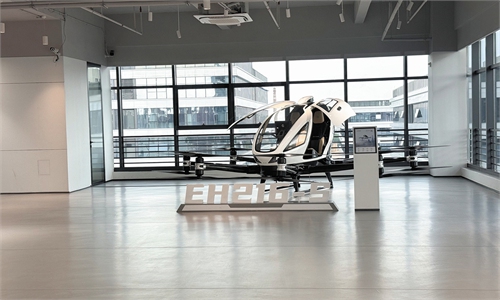
In overseas markets, Guangzhou-based EHang announced on November 18 that its flagship EH216-S completed a manned demo flight in Doha, Qatar, reducing a 30-minute car trip to an eight-minute zero-emission flight — further advancing cooperation with the local transport authority on next-generation air mobility.
Entering the final stage of the 14th Five-Year Plan period 2021-25, the low-altitude economy has been listed as a strategic emerging industry in the Government Work Report for two consecutive years -- 2024 and 2025.
Wang Yanan, chief editor of Aerospace Knowledge magazine, said that China's domestic efforts have focused largely on technology and equipment development, with several eVTOL aircraft models obtaining airworthiness certification from the Civil Aviation Administration of China, noting that the sector has made significant tech strides now.
Toward real deployment
The Recommendations of the CPC Central Committee for Formulating the 15th Five-Year Plan call for accelerating the development of industrial clusters in strategic emerging fields including new energy, new materials, aviation and aerospace, and the low-altitude economy.
The low-altitude economy covers far more than aircraft R&D and manufacturing. Its application scenarios span a multiple industries. Experts note that despite its rapid expansion, the sector still faces challenges, including infrastructure deployment, airspace resource allocation, business-model innovation, and talent training. Enabling real-world application scenarios remains the key to high-quality development, according to CCTV News.
Looking toward the 15th Five-Year Plan period 2026-30, Wang said that beyond overcoming limitations related to complex weather and nighttime flight, China's low-altitude economy industry needs to accelerate the construction of scenario-adapted environment, including scientific research, testing bases, and pilot zones to improve technologies, management systems, regulatory standards, and commercial logic.
To that end, multiple Chinese cities began deploying low-altitude infrastructure and supportive policies as early as 2024. On October 17, 2025, Yuzhong district in Southwest China's Chongqing Municipality released a three-year action plan (2025-2027) to build a safe, efficient, and interconnected low-altitude network by 2027, with the local industry expected to exceed 1 billion yuan.
Shenzhen's plan, released in November 2024, targets the construction of more than 1,200 takeoff-and-landing points by 2026, covering passenger flights, cargo logistics, community deliveries and urban-governance services. Industry financing in the sector has also continued to go up.
Wang noted that China is not the only country accelerating development of the low-altitude economy — the US and Europe are also laying out their plans. "Future global competition will not only center on technology, but also on who can build mature, integrated and scenario-based systems more quickly. If China achieves breakthroughs in application-scenario systems and the supportive regulatory framework, it will be well-positioned to gain an edge in global competition," he said.
RELATED ARTICLES