SK President Lee Jae-myung expresses expectation of China visit at an early date: local media
Maintaining positive momentum a rational choice made by both countries: experts
By and Jiang Ailing Published: Nov 25, 2025 12:27 AM

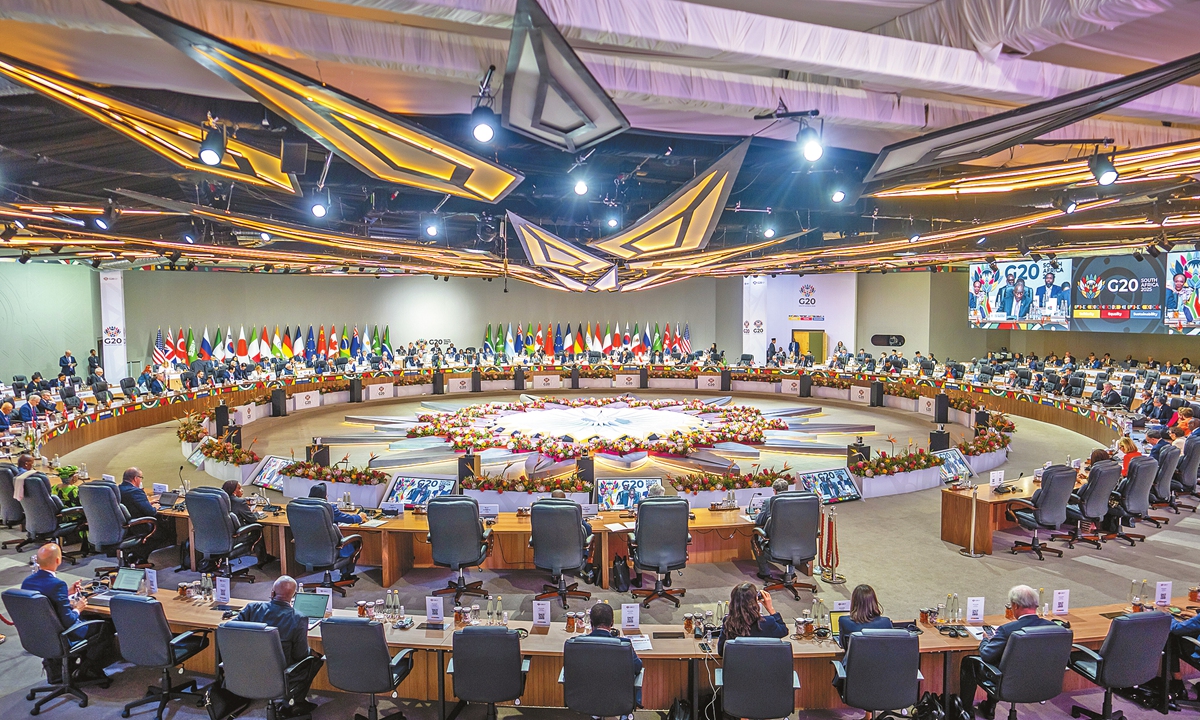
The G20 Leaders' Summit in Johannesburg, South Africa enters its second and final day on November 23, 2025. Photo: VCG
Chinese Premier Li Qiang appealed for efforts of the Group of 20 (G20) to strive for broader global cooperation to jointly cope with challenges and promote development. Li made the remarks when attending the second and third sessions of the 20th G20 Summit scheduled here for Saturday and Sunday, according to the Xinhua News Agency.Li also held friendly exchanges with French President Emmanuel Macron, South Korean President Lee Jae-myung, Angolan President Joao Lourenco, Spanish Prime Minister Pedro Sanchez, WTO Director-General Ngozi Okonjo-Iweala, and others, during the 20th G20 Summit in Johannesburg which concluded on Sunday local time, Xinhua reported.
The meeting between the Chinese premier and President Lee was widely covered by South Korean media. Citing the South Korean Presidential Office, Yonhap News Agency on Monday morning reported that Lee expressed his expectations of visiting Beijing at an early date.
JoongAng reported that in talks with the Chinese Premier, President Lee proposed that the two countries actively pursue cooperation that can make a real, tangible contribution to the livelihoods of their citizens.
In other related coverage, Korean-language newspaper Segye Ilbo also wrote that President Lee positively assessed the full restoration of bilateral ties achieved through the Korea-China summit on the sidelines of the APEC meeting in Gyeongju and emphasized the importance of communication to enhance political trust between South Korea and China.
Positive momentum
Zhan Debin, director and professor of the Center for Korean Peninsula Studies at the Shanghai University of International Business and Economics, told the Global Times that President Lee's expectation of a potential China visit reflects his willingness to take the positive momentum to work together with China to elevate China-South Korea relations to a new level.
The restoration of China-South Korea relations is a rational choice made by both countries, in line with both practical needs of economic and trade cooperation and based on the common concern for regional security, Zhan said.
Since the establishment of diplomatic ties 33 years ago, China and South Korea have made remarkable accomplishments in economic and trade cooperation. In 2024, the bilateral trade volume reached $328.08 billion, marking a 5.6-percent increase, according to Xinhua.
With their production and supply chains deeply intertwined, China has been South Korea's largest trading partner for 21 consecutive years, and South Korea is China's second-largest trading partner, per Xinhua.
In October, South Korea appointed Roh Jaeheon, the son of former president Roh Tae-woo, as its ambassador to China. The Lee administration's selection of Roh drew attention for its historical symbolism and Seoul's intent to further develop ties with China, given the "Northern Diplomacy" initiative pursued under his father, the Korea Herald said.
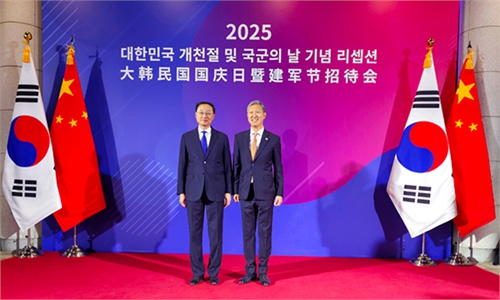
On November 7, China's Vice Foreign Minister Sun Weidong attended a reception hosted by the South Korean Embassy in Beijing to mark South Korea's National Foundation Day and Armed Forces Day, and exchanged views on China-South Korea relations with South Korean Ambassador to China Noh Jaeheon, according to the Chinese Foreign Ministry.
Positive results from recent frequent exchanges between the two peoples are also evident.
The Chosun Daily said on October 29 that foreign visitors to domestic duty-free shops in September exceeded 1 million for the first time in five years and eight months. Analysts attribute this recovery in the duty-free industry to the implementation of a visa-free policy for Chinese group tourists and growing expectations of improved South Korea-China relations ahead of the Asia-Pacific Economic Cooperation (APEC) summit, according to the report.
The Chosun Daily quoted Korea Tourism Organization data as showing that Chinese visitor numbers grew from 364,000 in January to 605,000 in August—surpassing the 578,000 recorded in August 2019, pre-pandemic.
Similarly, independent travel to China has also grown strongly after China implemented a trial visa-free policy for South Korean citizens last November, Xinhua report said.
Dong Xiangrong, a senior research fellow at the National Institute of International Strategy, Chinese Academy of Social Sciences, told the Global Times that South Korean domestic public opinion on China is also showing positive signs.
A survey conducted in September 2025 by Dong's team showed that among 1,322 South Korean respondents, 65 percent agreed or strongly agreed that "China-South Korea relations are very important to South Korea."
Stark contrast
The positive momentum in relations between China and South Korea stands in stark contrast to the increasingly frosty ties between China and its another neighbor, Japan. Relations have chilled significantly recently following erroneous remarks on Taiwan by Japanese Prime Minister Sanae Takaichi.
At the G20 Summit, "China-Japan relations rarely found a breakthrough, as the leaders of Japan and China did not even share light greetings, let alone talks," South Korean media outlet Maeil Business Newspaper wrote in a report on Monday.
During a press conference aboard Air Force One en route to Turkey after the G20 summit, the South Korean president stated the foundation is pragmatic diplomacy centered on national interest, adding the core is expanding autonomy in every area of the country's military and security, South Korean Dong-A Ilbo reported on Monday
The fundamental principle of the South Korea's diplomacy is to maintain the South Korea-US alliance as its foundation while stably and effectively managing relations with China, Lee remarked, per the report. Promoting economic cooperation with China and enhance people-to-people exchange serve our national interests, Lee added.
Zhan pointed out that despite both being new leaders, President Lee and Prime Minister Takaichi's approaches to handling relations with China have been markedly different.
Lee has actively worked to restore South Korea's relations with China, seeking to overcome the chilling effect that characterized the Yoon Suk-yeol administration while pursuing strategic autonomy and a "pragmatic diplomacy" policy. In contrast, Takaichi has made erroneous remarks on Taiwan, dragging Japan-China relations to a low point since the normalization of diplomatic ties, the expert added.
While elaborating on his pragmatic diplomacy, Lee also listed that recovering wartime operational control and building nuclear-powered submarines are also among things that Seoul must naturally do for the sake of national interests, according to the same Dong-A Ilbo report.
China made clear its position on the relevant issue more than once. We hope the South Korea and the US will prudently handle the matter, Chinese Foreign Ministry spokesperson Mao Ning commented on November 17.
And previous to that another spokesperson Guo Jiakun urged that South Korea and the US will earnestly fulfill their nuclear non-proliferation obligations, and do what is conducive to regional peace and stability, not otherwise.
Such development will not only undermine the international nuclear non-proliferation system but also increase the difficulty of denuclearizing the Korean Peninsula, triggering a chain reaction of military competition and strategic instability in the region, warned some Chinese observers reached by the Global Times.
RELATED ARTICLES