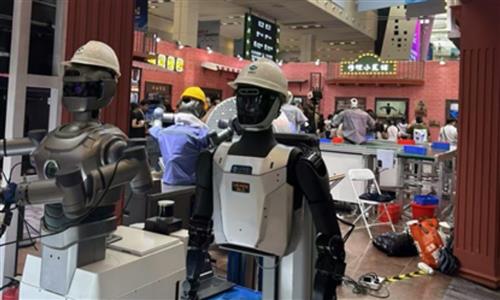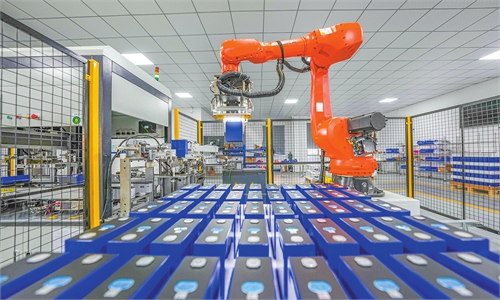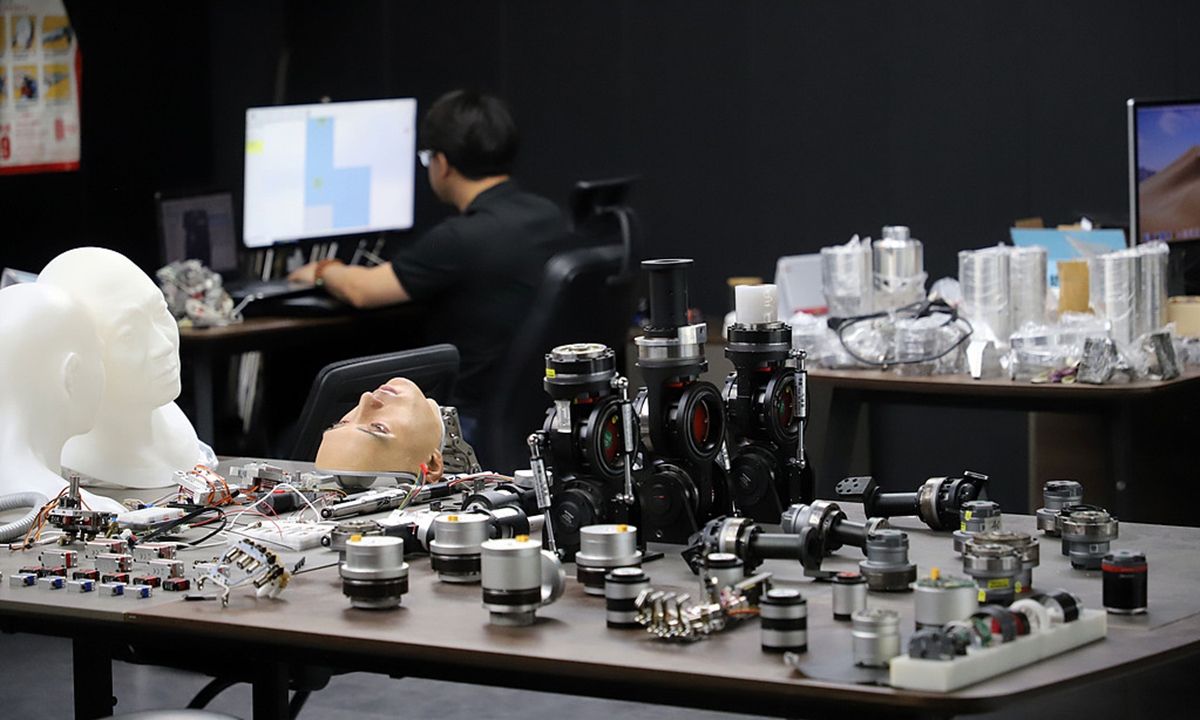
Robots are developed and assembled at an EX Robots research and production workshop in Dalian, Northeast China's Liaoning Province, on June 23, 2025.
China's local governments are reinforcing forward-looking strategies and accelerating the development of future industries in their newly released recommendations for the 15th Five-Year Plan (2026-30) period. Future industries are vital for China to boost its competitiveness, secure core technology and shift from follower to leader as global supply chains are reshaped, said an expert.
Northeast China's Liaoning Province has published the recommendation of the Liaoning Provincial Committee of the Communist Party of China (CPC) for Formulating the 15th Five-Year Plan for Economic and Social Development, calling for the expansion of emerging and future industries, Liaoning Daily reported.
The document emphasizes strengthening strategic foresight, building new pillar industries, and cultivating fresh growth engines. Liaoning will prioritize sectors including new energy, new materials, aerospace, biomedicine and medical equipment, software and information technology services, integrated-circuit equipment and robotics, along with the coordinated development of innovation infrastructure, research and development and product upgrading, according to the report.
Also on Monday, Southwest China's Guizhou Province further highlighted the province's role as a major computing-power hub, according to Guizhou Daily. The province boasts 85 exaflops of computing power, 48 key data centers, and the world's first 400-gigabit computing-power channel linking 42 major Chinese cities. Its cloud-rendering services now reach 200,000 users in more than 50 countries and regions, the Guizhou Daily reported on August 19, 2025.
The province's recommendations for the 15th Five-Year Plan (2026-30) period call for the integrated development of computing power, data, applications and industry, focusing on intelligent computing to strengthen its computing-power industry, push forward the "East Data, West Computing" initiative, and enhance computing, storage and network capacity, including stronger coordination between power supply and computing-power infrastructure.
The 15th Five-Year Plan recommendations of North China's Tianjin Municipality include deepening data-resource sharing and utilization, and advancing the construction of a next-generation artificial intelligence innovation pilot zone, according to Tianjin Daily on Friday.
Chen Jing, vice-president of the Technology and Strategy Research Institute, told the Global Times that local governments' focus on emerging and future industries is fully aligned with the central government's roadmap for the national 15th Five-Year Plan recommendations, while also allowing regions to leverage their comparative advantages and avoid repetitive investment.
"Future industries represent forward-looking planning for a modern industrial system," said Wang Peng, an associate researcher at the Beijing Academy of Social Sciences. "By developing these sectors, China can better integrate traditional, emerging and future industries, forming a multi-level, resilient industrial landscape that underpins high-quality development."
Chen noted that the development of future industries will accelerate the shift from old to new growth drivers and elevate traditional sectors. "Intelligent manufacturing, green manufacturing and service-oriented manufacturing can promote the upgrading of petrochemicals, steel, non-ferrous metals and building materials," he said.
The 15th Five-Year Plan has given top priority to building a modernized industrial system and reinforcing the foundations of the real economy, Zheng Shanjie, head of the National Development and Reform Commission, said at a press conference on October 24 on the guiding principles from the fourth plenary session of the 20th CPC Central Committee.
China's innovation momentum has attracted global attention throughout 2025, from the rapid rise of the low-altitude economy, to advances in commercial spaceflight, to breakthroughs by companies such as DeepSeek and Unitree Robotics.
The low-altitude economy, designated as a strategic emerging industry, has entered a phase of leapfrog development, transitioning from a technology-catching-up stage to leading in key areas. Data released at the 2025 China (Jiangxi) Aviation Industry Conference showed that the scale of China's low-altitude economy is expected to reach 1.5 trillion yuan ($211.99 billion) in 2025 and exceed 2 trillion yuan by 2030, CCTV News reported on November 23.
China's National Space Administration has set up a commercial space development department to oversee the nation's rapidly growing commercial space industry. The new department is gradually carrying out its work, marking the arrival of a dedicated regulatory body for China's commercial space industry, the Xinhua News Agency reported on November 29.
"Future industries demonstrate high growth potential and sustainability. They are the new engines of long-term stable economic expansion," Wang said. "By developing these sectors, China can optimize its economic structure, reduce reliance on traditional industries, and enhance the economy's intrinsic growth momentum and resilience."
RELATED ARTICLES